
Ritual Sacrifice on Eid al-Adha turning Into a Social Event

By S.
Arshad, New Age Islam
10 July
2021
Qurbani in
Pakistan and Bangladesh Has Grown Into A Billion Dollar Industry
Main
Points:
1. Bablu, a giant bull in Pakistan is priced at
10 million rupees.
2. Gullu, the giant bull is priced at 9 million
rupees.
3. Bahadur of Bangladesh was sold at 28 lakh
Taka.
4. Elite class of Bangladesh prefer cows from
the US.
5. Qurbani is a boon for poor farmers and
cattle owners.
-----
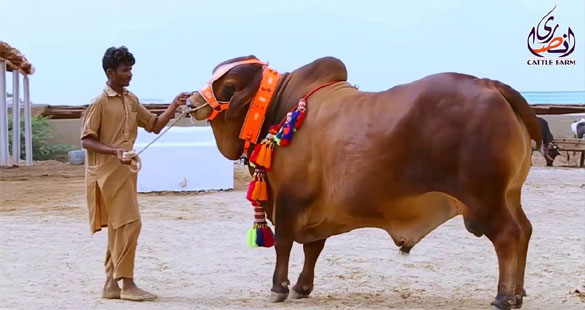
(Photo courtesy: YouTube: Bablu, the giant bull)
-----
Bablu, the
giant bull has arrived at Karachi's expansive 900 acre cattle market called
Maveshi Mandi on the eve of the festival of Eid-al-Adha. It is awaiting buyers. Its price
will overwhelm you -- a cool 10 million Pakistani rupees which is more than one
crore rupees. The owner says he feeds Bablu wheat, butter, Desi ghee and nuts.
Ballu's
friend Gullu, another giant bull up for sale for Qurbani is priced at 9 million
or 90 lakh Pakistani rupees.
In 2019, a
similar giant bull called Surmawala King was up for sale for one crore rupees
in the same market. Though this may be an indicator of the purchasing power of
a well to do Pakistani, the trend shows how excited Pakistanis are about Qurbani.
Whether
Bablu and Gullu will be bought or not will be learnt after Eid-al-Adha but this
is certainly an indicator that Eid-al-Adha is fast turning into a social event
where ritual sacrifice has become an occasion for show of
pomp more than of piety.
Though not
all sacrificial animals are so costly, but the price falls in lakhs. For
example, goats are sold at as high a price as 3.5 lakh and cows and buffaloes
and bulls are sold at around 50 lakh rupees.
Though
Islam has made Qurbani Wajib (obligatory) for the well-to-do of the society, it
does not say that the sacrificial animals should be costly. God says:
"It is neither their flesh nor their blood
that reaches Allah, but what does reach Him is taqwa (piety) on your
part."(Al Hajj:
37))
During the
life of the prophet of Islam pbuh, goats, sheep and camel that were available
to the Muslims, were sacrificed.
In
Bangladesh, another Muslim majority country, the situation is almost the same.
Here too the price of animals meant for Qurbani is higher than in normal days.
In 2021 as was in 2020, the prices are comparatively higher because of
restrictions due to Covid-19.
In Pakistan and Bangladesh, business of sacrificial animals
has become a lucrative one because of this new trend among Muslims. Many rich
people invest in sacrificial animals on Eid eve for making fast money. It has
turned into a big industry. According to the Pakistan Tanneries Association, a business
of PKR 150 billion is done in Eid-al-Adha. Around 7 million animals were bought
and sold last year. Animals are especially groomed and lavishly fed so that
they can be sold at higher prices.
In
Bangladesh also, Qurbani cattle business is a $ 1 billion business with about
ten lakh animals being sacrificed. The market is increasing both in size and
standard. The demand for costlier animals, particularly cows is increasing by
the year thanks to the economic growth of the country.
In
Bangladesh, the sacrificial cows are categorised under four grades according to
their physique, look and weight: Grade A, Grade B, Grade C and Grade B. Their
price depends on their grade. For example, a Grade A cow sells at 1.5 lakh BDT
(Bangladeshi Taka) to 9 lakh BDT; Grade B cow sells at 1 lakh to 1.5 BDT; Grade
C cow sells at 70, 000 to 90,000 BDT and Grade C cow sells at 60, 000. Grade C
and D cows are the local breed sold by poor farmers to earn money in the
festival season.
Above them
are the elite class of imported cows that are tall, huge and beautiful and are
bought by the upper class of the society at high prices. These are imported
from the US through cargo planes every year. These cows cost between 10 lakh
BDT to 30 lakh BDT. For example, in 2018, seven cows had been imported from
Texas ( US) and were sold for more than one crore Taka. Bahadur, the cow
weighing 1500 kg was sold at 28 lakh BDT. Another Texan cow was also sold for
24 lakh BDT.
This
ever-growing business of sacrificial cattle has not only benefitted the big
cattle traders but also poor farmers who make fast money by selling their
cattle in the market at higher prices. Thousands of village folk wait for Qurbani
season to sell their cows and goats on Eid-al-Adha to earn money which removes
their financial woes.
However,
the lockdown this year is going to pose small cattle traders big problem. The
Bangladesh government has set up online cattle markets called Digital Haat for
sale and purchase of cattle for Qurbani. Apart from the Digital Haat, many designated
cattle markets have been set up with Covid-19 SOP. Therefore, cattle traders
fear a low business this year.
In India,
the prospects of cattle business are bleak for cattle traders because of strict
lockdown imposed by many states. Buyers and sellers will have to make
transactions online and the sacrifices will be symbolic.
In short,
the festival of sacrifice in Muslim majority countries is increasingly becoming
a big social event during which a religious ritual turns into a big economic
activity and animals take centre stage.
However, it
would have been better in the interests of the community if the crores of
rupees spent on sacrificial animals could be spent on developmental projects
for the educational and economic upliftment of the community.
------
Sohail
Arshad is a columnist with NewAgeIslam.com.
URL: https://www.newageislam.com/islamic-society/sacrifice-eid-al-adha-ritual/d/125074
New
Age Islam, Islam Online, Islamic
Website, African
Muslim News, Arab
World News, South
Asia News, Indian
Muslim News, World
Muslim News, Women
in Islam, Islamic
Feminism, Arab
Women, Women
In Arab, Islamophobia
in America, Muslim
Women in West, Islam
Women and Feminism