
Revisiting Surah An-Nur 24:31 In Today's World
By New Age Islam Special Correspondent
30 April 2026
Surah An-Nur 24:31 holds enduring significance as it delves into identity, morality, and the dynamics between genders. However, contemporary interpretations reveal that it's far from a simple, one-dimensional statement. Instead, it's a verse rich in layers, moulded by language, history, legal frameworks, cultural norms, and personal conscience.
Major points:
· Moderate scholars emphasise to Muslims that modesty is fundamentally an ethical principle, preceding its visual manifestation. Women scholars worldwide assert the importance of women having their own voices. Reform-minded thinkers remind communities to consider the verse's context. Traditional believers urge modern society to acknowledge the respect that faith practices deserve.
· Perhaps the most insightful approach lies neither in obsession nor dismissal but in recognising the verse as a call to humanity, urging us toward dignity, mutual respect, and moral self-discipline.
· When interpreted in this light, Surah An-Nur 24:31 transcends a mere discussion about fabric. It evolves into a profound dialogue about freedom balanced with responsibility, faith tempered with humility, and identity interwoven with justice.
…
Surah An-Nur (24:31) stands out as one of the most frequently discussed verses in the Qur'an, touching on modesty, gender dynamics, and how we interact in public. It speaks directly to believing women, advising them to lower their gaze, protect their modesty, only reveal their adornments within appropriate boundaries, cover their chests, and uphold moral standards in society. Over the centuries, this verse has been understood and debated through legal, cultural, linguistic, and political perspectives. In our modern era, it's become a focal point in discussions about the hijab, women's freedom, identity, patriarchy, secularism, and matters of faith.
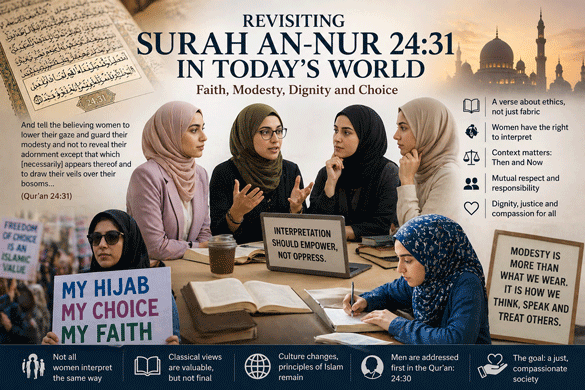
It's worth noting that contemporary Muslim scholars, female intellectuals, reformist thinkers, and traditional jurists don't all interpret this verse in the same way. Some view it as a timeless instruction to cover the head. Others contend that its primary message revolves around modesty, dignity, and ethical social conduct, rather than a specific dress code. Certain female scholars question why this single verse has become the defining symbol of Muslim womanhood, while broader Qur'anic teachings on justice, education, spirituality, and economic rights often receive less attention.
This article aims to explore Surah An-Nur 24:31 through modern interpretations, particularly those offered by moderate scholars and female thinkers.
Deciphering the Verse and Its Essence
The verse is often summarised as a directive for believing women to lower their gaze, safeguard their chastity, only display necessary adornments, and drape their coverings over their chests.
The Arabic phrase "wal-yadribna bi-khumurihinna 'ala juyubihinna" is a key point of discussion. The terms khumur (plural of khimar) and juyub (plural of jayb) are especially significant. Traditionally, khimar refers to a cloth or covering worn on the head, while jayb denotes the opening of a garment around the chest or neckline.
Many classical commentators have pointed out that women in Arabia were already wearing head coverings, but often left the chest area uncovered. According to this interpretation, the verse was meant to refine this practice, instructing women to draw the cloth over their chest for increased modesty.
This historical context greatly influences modern debates. If women were already covering their heads, was the verse affirming this practice or simply adjusting it to ensure the chest was also covered? This question remains central to the discussion.
The Enduring Relevance of Classical Interpretations
Most classical jurists concluded that the verse advocates covering the hair and body, except for the face and hands, though specific interpretations varied among different schools of thought. This legacy continues to hold sway in numerous Muslim communities.
However, contemporary scholars emphasise that classical jurists lived in societies with firmly established customs regarding gender segregation, slavery, class distinctions, and limited participation of women in public life. Consequently, modern readers question whether legal rulings reflected timeless principles or were shaped by historical circumstances.
The distinction between fundamental principles and contextual factors is a recurring theme in modern Islamic thought.
Moderate Scholars and an Ethics-Focused Interpretation
Many present-day moderate scholars argue that Surah An-Nur 24:31 should be understood within the broader framework of the Qur'anic moral vision, rather than in isolation.
Yusuf al-Qaradawi, while often conservative on matters of dress, consistently maintained that modest attire should not hinder women from pursuing education, employment, or civic involvement. He emphasised that Islam seeks to integrate women into society while promoting morality for both genders.
Tariq Ramadan has written that modesty in Islam originates with character, not clothing. He asserts that "the veil is not the whole of Islam," stressing that justice, honesty, and spiritual discipline are equally vital.
Abdullah bin Bayyah frequently underscores the importance of wisdom, public welfare, and avoiding severity when applying religious rules. According to this perspective, enforcing dress codes contradicts the essence of religion.
Hamza Yusuf has observed that modern Muslims often overemphasise symbols while neglecting core ethics. His broader message is that modesty encompasses humility, speech, conduct, and inner dignity.
While these scholars may hold differing views on the obligatory nature of the hijab, many concur that faith should not be reduced to mere articles of clothing.
Women Scholars Redefining Interpretation
One of the most significant developments in recent times is the growing number of Muslim women who are independently interpreting scripture.
Amina Wadud argues that the Qur'an addresses women as moral actors, not passive recipients. She believes that verses concerning dress must be interpreted in light of the Qur'an's broader themes of justice, dignity, and God-consciousness. In her understanding, patriarchal cultures have often placed the burden of public morality on women while overlooking the responsibilities of men.
She notably pointed out that if men are initially commanded in the preceding verse (24:30) to lower their gaze and protect their modesty, this sequence is significant. Society often quotes the verse about women while neglecting the one directed at men.
Asma Barlas has written that the Qur'an does not endorse male dominance. She challenges interpretations that make women's bodies the focal point of communal honour, advocating for mutual and ethical modesty rather than using it as a means of control.
Leila Ahmed, through her historical research, explains that veiling has taken on various meanings throughout history, including signifying status, ensuring privacy, representing anti-colonial resistance, expressing religious identity, and reflecting personal devotion. Her work demonstrates that the veil lacks a single, fixed historical meaning.
Kecia Ali contends that legal traditions were shaped by male scholars operating within their own societal contexts, encouraging critical engagement rather than uncritical acceptance.
These female scholars do not uniformly reject the hijab; many simply object to any exclusive claim to its interpretation.
Is There a Specific Mention of Hair?
A key question in modern discussions is whether the verse explicitly instructs women to "cover your hair."
The Qur'anic verse does not use the word "hair." Traditional scholars argue that since khimar already denoted a head-covering, mentioning it implies the head. Reform-minded scholars counter that the verse specifically instructs women to draw the cloth over their chest, indicating that the chest—not the hair—was the primary focus.
Khaled Abou El Fadl has argued in broader discussions that Islamic law necessitates moral reasoning, genuine engagement with texts, and a sense of humility. He advises caution against dogmatism in areas where texts allow for different understandings.
This doesn't automatically resolve the matter, but it sheds light on why sincere Muslims can arrive at different conclusions.
Modern interpreters often explore the original problem that the verse was meant to address.
Arabian society at the time was characterised by slavery, harassment, tribal disparities, and limited safeguards for women. Clothing often served as a marker of status and vulnerability. Within that context, modest attire could offer protection, enhance dignity, and provide social recognition.
Consequently, some contemporary thinkers suggest that the verse responded to specific social circumstances rather than prescribing a timeless cultural norm.
Fazlur Rahman advocated for a method that extracts moral principles from revelation and then reapplies them in new contexts. When applied here, the underlying principle might be dignity and decency, while the specific form could vary across cultures.
This approach resonates with educated Muslims who seek to maintain continuity with tradition while avoiding rigid literalism.
Muslim Women Who Freely Choose Hijab
Any fair discussion must acknowledge that millions of Muslim women consciously embrace the hijab as an expression of faith, identity, discipline, or personal comfort.
For many women, wearing the hijab is not a form of subjugation but rather a source of empowerment. It can signify devotion to God, resistance to societal pressures related to beauty, or pride in their Muslim identity.
Dalia Mogahed has discussed how Muslim women are often unfairly placed in a false dichotomy: either oppressed victims or rebellious heroes. She argues that real women have diverse motivations and perspectives.
Many women express feeling spiritually grounded through modest clothing. Others find that it allows them to be valued for their intellect rather than their physical appearance. Their agency deserves respect.
Muslim Women Who Do Not Wear Hijab
Simultaneously, numerous devout Muslim women choose not to wear the hijab or interpret the verse differently. Some prioritise modest clothing without covering their heads. Others are deeply spiritual but remain unconvinced by traditional legal arguments.
To label all such women as irreligious is rejected by many moderate scholars who differentiate between disagreement, personal shortcomings, matters of conscience, and disbelief.
Ingrid Mattson has emphasised the importance of compassion and the danger of reducing individuals to mere outward symbols.
Modern Muslim communities increasingly recognise that piety cannot be solely judged by attire.
The Forgotten Part: Men Are Addressed First
A frequently raised critique by female scholars is the practice of selective quoting.
The immediately preceding verse, Surah An-Nur 24:30, instructs believing men to lower their gaze and maintain modesty. Yet in many societies, sermons, family expectations, and social control disproportionately target women.
Amina Wadud has consistently emphasised that the Qur'an begins by holding men accountable. If men disregard their own obligations while enforcing rules upon women, the ethical balance of scripture is disrupted.
This is arguably one of the most impactful modern corrections.
State Power, Coercion, and Freedom
Another contemporary debate revolves around whether governments should mandate or prohibit the hijab.
Some countries enforce covering, while others ban it in schools or workplaces. Both approaches are concerning to many moderate scholars because they undermine women's autonomy.
Abdullahi Ahmed An-Na'im contends that religious practice only holds meaning when freely chosen. Coercion strips faith of its sincerity.
According to this line of reasoning, forcing the hijab and forcing its removal are two sides of the same coin: institutional control over women's bodies.
Modern interpretations are increasingly expanding the concept of modesty beyond outward appearance.
Digital culture has introduced novel challenges that were unknown to earlier legal scholars: social media exhibitionism, harassment, revenge porn, pornography, algorithmic objectification, influencer-driven beauty standards, and voyeurism.
In this context, Surah An-Nur can offer fresh insights about dignity in the digital age. Lowering the gaze can signify ethical consumption of images. Guarding modesty can mean respecting consent. Avoiding display can mean resisting the commodification of self.
Omid Safi often stresses spirituality over superficial displays of religiosity, a perspective that strongly resonates today.
South Asian Realities
In South Asia, including India, Pakistan, Bangladesh, and Sri Lanka, interpretations of the verse are influenced by class, politics, historical experiences with colonialism, and communal tensions.
For some Muslim minorities, the hijab can become a way to protect their identity in hostile environments. For others, it can become a burden when community honour is disproportionately placed on women.
In India, debates surrounding the hijab often escalate into broader conflicts about citizenship, secularism, education, and religious freedom. In such instances, Surah An-Nur 24:31 transcends its role as a theological verse and becomes a constitutional and political symbol.
Therefore, moderate voices advocate for protecting both religious freedom and women's access to education.
What a Balanced Interpretation Looks Like
A balanced modern interpretation typically encompasses several key points.
First, the verse undeniably promotes modesty, dignity, and moral responsibility.
Second, sincere scholars hold differing views on whether head-covering is explicitly required or inferred from historical context.
Third, women must be recognised as interpreters of scripture, not merely subjects of interpretation.
Fourth, coercion contradicts the essence of faith.
Fifth, male responsibility is equal to that of women and is often overlooked.
Sixth, modesty in the modern era includes digital ethics, consent, and character.
The Deeper Qur’anic Message
If the verse is viewed in isolation, it becomes solely about dress. However, when read within the broader context of the Qur'an, it becomes part of a comprehensive system of ethics.
The Qur'an also emphasises mercy, knowledge, justice, charity, truthfulness, mutual kindness in marriage, and spiritual equality. Women in early Islam were involved in trade, teaching, debates, narrating hadith, and shaping public life.
Therefore, many contemporary scholars insist that Surah An-Nur 24:31 should not be used as a tool to diminish women's roles in society.
Conclusion: From Fabric to Freedom, Guided by Faith
Surah An-Nur 24:31 holds enduring significance as it delves into identity, morality, and the dynamics between genders. However, contemporary interpretations reveal that it's far from a simple, one-dimensional statement. Instead, it's a verse rich in layers, moulded by language, history, legal frameworks, cultural norms, and personal conscience.
Moderate scholars emphasise to Muslims that modesty is fundamentally an ethical principle, preceding its visual manifestation. Women scholars worldwide assert the importance of women having their own voices. Reform-minded thinkers remind communities to consider the verse's context. Traditional believers urge modern society to acknowledge the respect that faith practices deserve.
Perhaps the most insightful approach lies neither in obsession nor dismissal but in recognising the verse as a call to humanity, urging us toward dignity, mutual respect, and moral self-discipline.
When interpreted in this light, Surah An-Nur 24:31 transcends a mere discussion about fabric. It evolves into a profound dialogue about freedom balanced with responsibility, faith tempered with humility, and identity interwoven with justice.
…
URL: https://newageislam.com/islamic-society/revisiting-suran-an-nur-24:31-todays-world-/d/139846
New Age Islam, Islam Online, Islamic Website, African Muslim News, Arab World News, South Asia News, Indian Muslim News, World Muslim News, Women in Islam, Islamic Feminism, Arab Women, Women In Arab, Islamophobia in America, Muslim Women in West, Islam Women and Feminism