
Masalih Mursala and Indian Muslims: Reimagining Islamic Public Welfare in a Democratic Society
By New Age Islam Special Correspondent
05 June 2026
For Indian Muslims, Masalih Mursala represents far more than just a legal concept; it offers a profound vision. It serves as a reminder that the heart of Islam is not merely about preserving outward forms but about actively promoting welfare, justice, dignity, and human flourishing.
Major points:
· In a diverse and democratic landscape like India, this principle acts as a bridge, connecting religious devotion with civic duty. It empowers Muslims to engage fully in the life of the nation without having to compromise their ethical foundations.
· The struggles facing the community are undeniably significant. Issues like educational gaps, economic hardship, communal friction, and political instability are very much a reality. However, Islamic tradition itself holds the intellectual tools needed to navigate these complexities, and Masalih Mursala is one of those vital resources.
· By adopting a framework centred on public welfare, Indian Muslims can move past stories of fear and marginalisation. Instead, they can become proactive drivers of progress in areas like education, economic development, democracy, environmental care, and social cohesion.
· This shift isn't about walking away from tradition; it’s about rediscovering one of its most vibrant and progressive principles.
…
The history of Islam isn't just a timeline of rituals, theology, or spiritual devotion. It is also a profound narrative of human welfare, social justice, and collective responsibility. Throughout the centuries, Islamic scholars have grappled with a fundamental question: how should Muslims respond to new social realities that aren't explicitly addressed in the Quran or Sunnah? As the world changes, new challenges inevitably arise. Technology advances, political systems evolve, and economic structures become increasingly intricate. In these shifting landscapes, Muslims need intellectual tools that allow them to stay true to their faith while engaging creatively with the modern world.
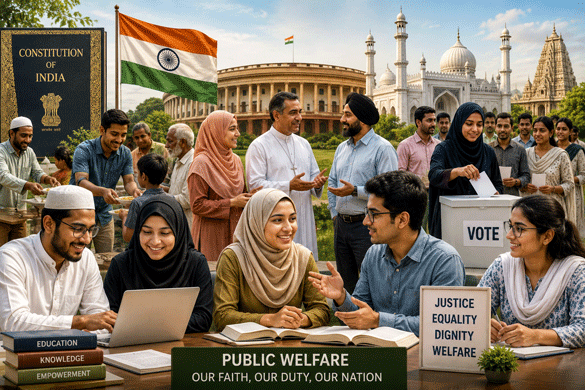
One of the most vital tools developed by classical scholars for this very purpose is the concept of Masalih Mursala, often understood as 'public interest', 'public welfare', or 'unrestricted benefit'. While this concept is centuries old, it feels more relevant today than ever, particularly for Muslims living within the democratic and pluralistic fabric of India.
For Indian Muslims, who represent one of the largest Muslim populations on earth, Masalih Mursala offers a way forward that moves beyond defensive identity politics toward constructive societal engagement. It provides a meaningful language through which Muslims can participate in nation-building, strengthen democratic institutions, pursue educational excellence, drive social reform, protect the environment, and foster interfaith cooperation, all while remaining deeply rooted in Islamic ethical traditions. Ultimately, the future of Indian Muslim thought may depend not just on how well they preserve their religious identity but on how effectively they rediscover this Islamic tradition of public welfare.
Understanding Masalih Mursala
The Arabic word maslaha refers to benefit, welfare, or the public good; its plural is masalih. The term Masalih Mursala specifically refers to public interests that are not explicitly detailed in sacred texts but are entirely consistent with the broader spirit and objectives of Islamic law.
Classical scholars recognised that the Quran and the Sunnah provide overarching moral principles rather than a granular manual for every possible future scenario. Human society is in a constant state of flux, and many contemporary situations would have been unrecognisable during the time of the Prophet Muhammad. The Quran does not contain specific guidance on digital privacy, artificial intelligence, climate change, constitutional democracy, modern universities, or social media. Yet, Muslims are still called to make ethical decisions regarding these issues.
To bridge this gap, scholars like Imam Malik developed the concept of Masalih Mursala. They argued that if a policy or action promotes the common good and does not contradict a clear Islamic mandate, it can be considered legitimate. This principle highlights a defining characteristic of Islamic civilisation: its capacity for adaptability. Islamic law was never meant to be a static relic of a specific era; rather, it is designed to promote justice, welfare, dignity, and social harmony across changing times.
The Connection Between Masalih and Maqasid
Masalih Mursala is inextricably linked to the theory of Maqasid al-Shariah, or the higher objectives of Islamic law. Classical scholars argued that the law exists to protect essential human interests, such as religion, life, intellect, family, property, and human dignity. Later thinkers expanded this to include concepts like freedom, equality, and social justice.
From this viewpoint, Islam is far more than a collection of legalistic rules; it is a moral project aimed at human flourishing. This perspective is incredibly important in contemporary India, where Muslims navigate complex challenges involving education, employment, political agency, social mobility, and communal relations. Instead of simply asking, "Does this action follow a past precedent?" The Masalih approach asks a much more profound question: "Does this action contribute to justice, welfare, and human dignity?" This shift in thinking can fundamentally transform the Muslim intellectual landscape.
Why Masalih Matters in India
Indian Muslims live in a society defined by immense diversity, democratic values, constitutional governance, and rapid social evolution. Unlike Muslims in majority-Muslim nations, Indian Muslims are in a constant state of engagement with people of different faiths, cultures, and political leanings. Their daily lives are shaped by more than just religious tradition; they are guided by constitutional institutions and a pluralistic social environment.
In this setting, Masalih Mursala provides a practical roadmap for engagement. Rather than viewing modern institutions through a lens of suspicion, Muslims can evaluate them based on their contribution to the public good. If an institution promotes education, justice, accountability, health, or social harmony, it can be seen as serving Islamic objectives, even if it is a modern creation. This approach reframes the relationship between religion and modernity. Instead of seeing democracy, scientific education, or constitutionalism as external impositions, they can be understood as vital tools for achieving public welfare.
Education as a Maslaha
Perhaps the most pressing challenge for many Muslim communities in India today is education. Achieving educational advancement isn't just an economic necessity; it is a religious imperative rooted in the Islamic tradition's deep reverence for knowledge.

Through the lens of Masalih Mursala, investing in schools, universities, scholarships, research, and professional training becomes a religious priority. While classical scholars could not have envisioned modern universities or digital learning platforms, the principle of public welfare clearly supports the pursuit of such development. The success seen in several Muslim communities in Kerala serves as a powerful testament to this truth. Investing in education has fundamentally changed lives, driving better literacy rates, professional success, and social mobility. Taking a Maslaha-orientated approach would mean encouraging Muslim organisations to direct more resources toward vital fields like science, technology, artificial intelligence, public policy, the social sciences, and critical thinking. In this light, knowledge itself becomes a form of public welfare.
Democracy as Public Welfare
For many Muslims globally, democracy is still a debated topic. However, Masalih Mursala offers a practical framework for looking at democratic participation. Democracy provides the tools for consultation, accountability, the peaceful transfer of power, and the protection of rights – goals that align closely with Islamic principles of justice and Shura (consultation).
In India, Muslims have been active participants in democratic institutions since independence. Through voting, civil society, the legal system, and public advocacy, they have helped shape the country's political landscape. A Maslaha-based view sees this participation not as a compromise of faith but as a way to promote justice and protect community interests through peaceful, constitutional means. This perspective shifts the focus away from whether democracy existed in early Islamic history and instead asks a more vital question: do democratic institutions serve the public good? For many Muslims living in diverse societies, the answer is a clear yes.
Beyond Identity Politics
One of the most powerful aspects of Masalih Mursala is its ability to push public discourse past the limits of identity politics. While identity remains important, important communities need cultural confidence and protected rights; politics focused solely on identity can become restrictive. Masalih encourages Muslims to look at broader societal concerns.
Issues like environmental protection, healthcare, educational reform, corruption, gender justice, poverty, and technological growth affect every citizen, regardless of their faith. When Muslims engage with these challenges, they aren't just helping their own community; they are contributing to society as a whole. This aligns with the Quranic vision of Muslims as contributors to the common good rather than isolated groups.
Women's Education and Empowerment
A Maslaha-orientated framework also advocates for the advancement of Muslim women. Throughout Indian history, Muslim women have played significant roles in education, social reform, literature, healthcare, and public life, even as barriers have persisted.
From a public welfare standpoint, investing in women’s education creates a ripple effect that benefits entire generations. Educated women drive economic growth, improve family well-being, enhance public health, and step into community leadership roles. Many contemporary scholars argue that many of the restrictions placed on women are rooted in historical social customs rather than essential religious teachings. Masalih Mursala provides a way to re-evaluate these practices through the lens of modern reality and the public good. The increasing presence of Muslim women in higher education and public life shows just how transformative this approach can be.
Waqf Reform and Public Welfare
India holds vast amounts of waqf property intended for charity and community support. However, many of these institutions struggle with administrative inefficiency, legal battles, and underutilisation. A Maslaha-based approach would prioritise transparency, professional management, digital record-keeping, and strategic investment.
The goal shouldn't just be to hold onto these assets but to maximise their benefit to the public. Reformed waqf institutions could fund scholarships, hospitals, research centres, housing, skill-building programmes, and social enterprises. Such changes would bring these institutions back to their original purpose: serving the public welfare.
Interfaith Relations and Social Harmony
Given India's immense diversity, interfaith relations are a matter of national importance. Masalih Mursala encourages Muslims to see social harmony as a legitimate public good. The Quran repeatedly calls for justice, kindness, and peaceful coexistence. In a society where different communities live side-by-side every day, maintaining social trust is essential.
Interfaith dialogue and community cooperation are not just social niceties; they serve the interest of public welfare. This doesn't require compromising one's theology; rather, it recognises that coexistence is a necessity for collective well-being. In many parts of India, local traditions show that religious diversity can be a source of cultural richness rather than a cause for conflict.
Environmental Responsibility as Maslaha
The environmental crises of the twenty-first century – climate change, pollution, and water scarcity – are affecting millions of people in India. While classical scholars could not have predicted these specific challenges, the principle of public welfare clearly demands environmental stewardship.
Protecting our natural resources is about safeguarding human life, health, and the future of our children. A Maslaha-based Islamic environmental ethic would promote sustainable living, conservation, renewable energy, and responsible development. In this context, protecting the planet is more than just a scientific necessity; it is a moral and religious duty.
Digital Islam and the Future
The digital revolution is fundamentally changing how we experience religious life. Islamic knowledge is now more accessible than ever through online platforms, digital libraries, AI, and social media. While this creates incredible opportunities, it also brings risks.
While access to information has exploded, so has the speed at which misinformation and extremist views can spread. A Maslaha-orientated approach emphasises the need for the responsible and ethical use of technology in this new era.
Conclusion: Moving from Survival to Contribution
For Indian Muslims, Masalih Mursala represents far more than just a legal concept; it offers a profound vision. It serves as a reminder that the heart of Islam is not merely about preserving outward forms but about actively promoting welfare, justice, dignity, and human flourishing.
In a diverse and democratic landscape like India, this principle acts as a bridge, connecting religious devotion with civic duty. It empowers Muslims to engage fully in the life of the nation without having to compromise their ethical foundations.
The struggles facing the community are undeniably significant. Issues like educational gaps, economic hardship, communal friction, and political instability are very much a reality. However, Islamic tradition itself holds the intellectual tools needed to navigate these complexities, and Masalih Mursala is one of those vital resources.
By adopting a framework centred on public welfare, Indian Muslims can move past stories of fear and marginalisation. Instead, they can become proactive drivers of progress in areas like education, economic development, democracy, environmental care, and social cohesion.
This shift isn't about walking away from tradition; it’s about rediscovering one of its most vibrant and progressive principles. The future of Indian Muslim thought may truly hinge on this transition: moving from a mindset of mere survival to one of meaningful contribution, from a narrow focus on identity to a broader commitment to the public good, and from reactive politics to a confident ethics of citizenship rooted in the timeless pursuit of the common good.
…
New Age Islam, Islam Online, Islamic Website, African Muslim News, Arab World News, South Asia News, Indian Muslim News, World Muslim News, Women in Islam, Islamic Feminism, Arab Women, Women In Arab, Islamophobia in America, Muslim Women in West, Islam Women and Feminism