
Did Kashmir Poet Soch Kral Inspire Allama Sir Muhammad Iqbal?

By Mushtaq Ul Haq Ahmad Sikander, New Age Islam
28 April 2026
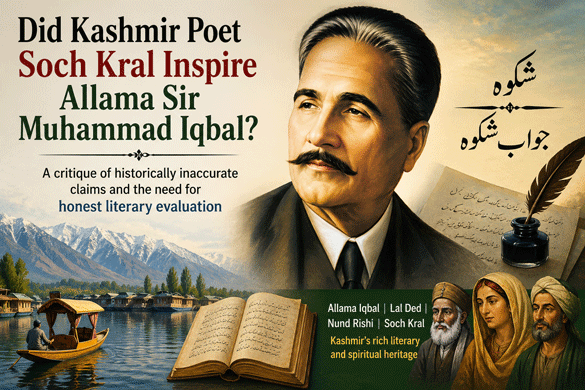
Prof. Shad Ramzan’s claim about Allama Iqbal is wrong and Kashmiri literary pride should not depend on historically inaccurate appropriation.
Main points:
· It criticizes Prof. Shad Ramzan for claiming that Iqbal’s Shikwa and Jawab-e-Shikwa were inspired by a Kashmiri poem, calling the claim historically false.
· It argues that Allama Iqbal wrote those poems before his first visit to Kashmir, so the story cannot be true.
· It says some Kashmiri language activists exaggerate the role of Kashmiri poets to build prestige for the language.
· It discusses the history of Kashmiri poetry, especially Lal Ded and Sheikh ul-Alam, presenting them as socially revolutionary and rooted in Islamic and Sufi traditions.
· It ends by calling for honest literary evaluation instead of false claims, saying Kashmir should build its literary standing through real achievement, not appropriation.
…
Recently a Kashmiri academic Prof Shad Ramzan, who happens to be a Kashmiri conveyor of Sahitya academy claimed that when Allama Iqbal visited Kashmir someone made him to listen to a Kashmiri poem of Soch Kral Dopoyam Balyaras. He was so much impressed and mesmerized by it that he wrote his famous Shikwa and Jawab e Shikwa. He related it during a podcast, to drive home the point that Kashmir has produced so strong literary stalwarts, but alas we remain oblivious towards their contribution.
https://www.facebook.com/share/r/1HopTNSBVU/
The votaries of Kashmiri language want to portray larger than life picture of minion poets. Most of the Kashmiri poets are Sufi and Rishi poets inspired by Islamic and syncretic tradition of pluralism. But to portray them as inspiration behind the poet of East is far-fetched and non-historic based on the retrogradation of real facts.
Allama Sir Muhammad Iqbal wrote Shikwa in 1901 and Jawab e Shikwa in 1913 and he visited Kashmir for the first time in 1921. This is not an obscure mistake, but a deliberate blunder by the Professor in a failed attempt to prove superiority of Kashmiri language. Allama Iqbal was proud of his Kashmiri lineage and particularly his Brahmanical Pandit Hindu roots and he expressed it genuinely but his whole philosophy was inspired by Islam and Prophetic tradition. Many people have tried to secularize his poetry by trying to delink it from its Islamic roots, something that has been attempted with Maulana Jalaluddin Rumi by the Western and European Orientalists.
The attempt by the learned Professor of Kashmir informs us of the inferiority complex Kashmiri intellectuals and nation as a whole are witnessing. Due to colonization, strong conservativism imposed by religious clique and subsequent state oppression did not let the native Kashmiris flourish. The official language due to variegated reasons in various periods was anything but Kashmiri. Urdu, was essential and official language because it helped unite all the divisions of J&K, Jammu, Kashmir and Ladakh and before partition Gilgit, Baltistan and Muzaffarabad too. However, the Kashmiri language activists did a lot of campaign and efforts to introduce Kashmiri language as a subject in schools and they were successful in the same. They had thought that it would help the language to survive, people will take pride in their past and it will help strengthen nationalism among people. But language does not only survive by being introduced in schools, unless it does not offer future economic security, it is bound to fail. After attaining higher education in Kashmiri language students are facing career stagnation or no economic stability, so few decide to invest years in such an education that reaps no academic benefits.
Also, in Kashmiri language most of literature produced is in the form of poetry and the stalwarts of that produced poetry are religious, resistant and revolutionary in nature, be it that of Lal Ded or Sheikh ul Alam known as Nund Rishi. They criticized the religious façade and exploitation by the religious clique of Brahmins and Pirs as well as condemned the caste discrimination. They were followed by scores of other Rishi and Sufi poets who expressed themselves in Kashmiri. Such was the revolutionary message that it created ripples in the society and the court historians did not mention about Lal Ded and Sheikh ul Alam in their works. After hundreds of years of their passing away, their poetry was written and compiled, although it passed down for generations through oral traditions and few compilations were done that circulated through informal networks. The religious conservatives were so much terrorized by the revolutionary message of their poetry that they did everything to stifle and persecute them. It survived, but after independence a new coterie of the language activists and academics came forward to being patronized by the state to change the revolutionary Islamic fervour of these poets and tone down their revolutionary message and portray them as everything but Islamic who were not against caste system and for egalitarianism of Islam and condemnation of religious class. So, this coterie began to find non-Islamic roots in Nund Rishi’s poetry and other poets and began to portray him as supernatural unlettered poet, who due to divine miraculous powers could write such a strong poetry. Now this myth has been shattered and biographers of Nund Rishi have discovered that he was a very well-versed scholar. Similar divine attributes have been mentioned about Sufi poets like Shamas Faqir, Soch Kral and Wahab Khar but reality is in contrast because when they engage with themes of Islamic mysticism it is because they know about it whether by reading or being trained under a master who through oral tradition informs them. Hence portraying them as unlettered is grave injustice.
The case with people like Prof. Shad Ramzan, his predecessors and successors is that they do not have an icon of international stature, whom they can present as an embodiment of Kashmiri language. It is due to various reasons particularly non availability of good translations published by reputed international publication houses. Hence, they opt for shortcuts of appropriating others. This present appropriation is example of a classic case, depicting the intellectual bankruptcy and inferiority complex of academics like Shad Ramzan. Allama Iqbal pays tribute to a poet Ghani Kashmiri who wrote in Persian, language he could understand and express knowing its complexities and nuances. This appropriation reminds me of another case, going back to 2011 Arab Spring, when Muhammad Yasin Malik, now incarcerated in Tihar jail, stated that it was inspired by the street violence of 2010 in Kashmir valley.
People like Shad Ramzan have to built a case for Kashmiri language, because their whole life and activities revolve around it. They have to justify their position in Sahitya Academy and give out Youth and other awards, while canvassing for the participants and deciding who is to be bestowed and who is denied the state awards for service towards Kashmiri language. The books, literature and poetry produced by the award winers are read and consumed by themselves or gifted to those who do not bother to read. The whole scheme of things with the Kashmiri language awards and appreciation is based on patron-client relationship and is quite hierarchical in nature. If you do not have network, you certainly cannot survive in the sump of the doyens of Kashmiri language.
The need of the hour is to come out of the intellectual dishonesty by people like Shad. There certainly is a need to critically evaluate the Kashmiri poetry and see its stature in comparison to poetry in other languages and accept the fact that we could not produce poetry and literature of international standards for variegated reasons. Once we acknowledge it, then we can work to produce better poetry rather than trying to appropriate the other poets falsely and claiming that they were inspired by Kashmiri poets, that is both factually and historically incorrect.
M. H. A. Sikander is Writer-Activist based in Srinagar, Kashmir.
New Age Islam, Islam Online, Islamic Website, African Muslim News, Arab World News, South Asia News, Indian Muslim News, World Muslim News, Women in Islam, Islamic Feminism, Arab Women, Women In Arab, Islamophobia in America, Muslim Women in West, Islam Women and Feminism