
Modernizing the Madrasa Curriculum Without Erasing Its Soul

By Mushtaq Ul Haq Ahmad Sikander, New Age Islam
25 May 2026
Modernizing madrasas through inclusive curriculum reform, linguistic and scientific literacy, and community-led change without undermining minority autonomy or religious identity.
Main Points
· It argues that madrasa students should learn modern subjects such as social sciences, English, science, mathematics, and computer education.
· It stresses that reform should come through consultation with scholars, parents, and institutions, not through coercive state control.
· It highlights the historical and social role of madrasas as centers of moral formation, identity, and accessible education for marginalized Muslims.
· It explains that multilingual and modern skills would help madrasa graduates participate more fully in higher education, public life, and employment.
· It concludes that the real need is synthesis: curricular renewal with dignity, autonomy, and constitutional respect, not institutional demolition.
The debate over madrasa education in India has once again entered the political and public sphere with renewed urgency. Recent developments in Uttarakhand, where Chief Minister Pushkar Singh Dhami announced the abolition of the state Madrasa Board and mandated that all madrasas adopt the Uttarakhand Education Board curriculum from July 2026, have intensified concerns over the future of Muslim educational institutions. The decision has been projected by its supporters as a reformist and historic step aimed at integrating modern subjects such as science, mathematics, and computer education in line with the National Education Policy. Yet beneath the language of reform lies a deeper and more troubling question: can modernization be meaningful when it comes through coercive state intervention rather than consultation with the very communities these institutions serve?
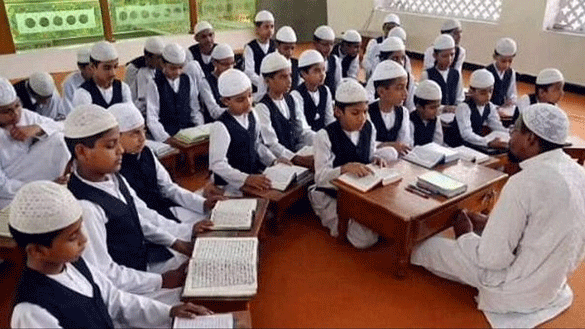
This is where the madrasa question must be approached with seriousness, intellectual honesty, and constitutional sensitivity. There is indeed a compelling case for reforming madrasa curricula in India. Social sciences, English language instruction, science, mathematics, computer education, and civic awareness should unquestionably be included in a contemporary madrasa syllabus. Such inclusion is not a betrayal of tradition but a necessary broadening of it. At the same time, however, reform cannot become a euphemism for dismantling Muslim autonomy in education. The issue is not whether madrasa students should learn modern subjects; they should. The issue is whether the state has the moral or democratic legitimacy to abolish boards, override institutional frameworks, and dictate the terms of learning in minority-run institutions without consent.
Madrasas have historically occupied a distinctive place in South Asian Muslim life. They are not merely schools in the narrow sense; they are also spaces of moral formation, religious transmission, linguistic preservation, and community identity. For large sections of socially and economically marginalized Muslims, madrasas have served as accessible centres of learning when other educational opportunities remained distant, expensive, or structurally discriminatory. To discuss madrasa reform, therefore, is to discuss not only curriculum but also dignity, identity, and the right of a minority community to shape its own institutions within the framework of the Constitution.
Yet none of this should mean that madrasas must remain frozen in time. A curriculum that limits students only to traditional religious subjects can no longer meet the needs of the present age. Students today live in a world shaped by technology, bureaucracy, public institutions, media systems, and increasingly competitive educational and professional landscapes. If madrasa graduates are denied exposure to social sciences, languages, and modern disciplines, they risk being excluded from broader intellectual, economic, and civic participation. Such exclusion weakens not only individual opportunity but also the collective capacity of the community to engage the modern world on equal terms.
Among the most urgent additions to madrasa education is the study of social sciences. History, political science, sociology, economics, and civics are essential for any student who wishes to understand the world in which they live. These subjects equip learners to think critically about society, state power, institutions, citizenship, rights, inequalities, and historical change. For Muslim students in particular, social sciences are indispensable because they offer conceptual tools to understand the structures that shape their lives, from communal politics and media representation to constitutional protections and democratic participation.
A student trained only in inward-looking religious instruction may become personally devout, but that devotion alone does not prepare them to navigate the political and social realities of contemporary India. Social sciences do. They help a student understand how laws are made, how rights are protected or denied, how history is contested, and how prejudice is manufactured and resisted. They also cultivate habits of evidence, interpretation, comparison, and reflection. In an age of misinformation, communal polarization, and ideological manipulation, such training is vital. A madrasa that includes social sciences is not abandoning faith; it is preparing its students to live ethically and intelligently in society.
English language instruction is another indispensable aspect of meaningful madrasa reform. In India and beyond, English remains a key language of higher education, administration, law, media, employment, and global scholarship. A student who lacks functional competence in English is often denied access to universities, public discourse, and professional mobility. For many madrasa students, this linguistic gap becomes one of the biggest barriers to advancement. They may possess sharp minds, strong memory, discipline, and moral seriousness, yet remain cut off from vast fields of knowledge simply because they cannot engage with English-medium material.
To advocate English in madrasas is not to glorify English or diminish Urdu, Arabic, Persian, or regional languages. It is, rather, to recognize linguistic reality. English today functions as a bridge language. It allows students to access academic texts, legal documents, digital resources, official communication, and international conversations. A healthy madrasa curriculum should therefore aim at multilingual competence: Urdu for cultural and literary inheritance, Arabic for scriptural and theological study, regional languages for rootedness, and English for wider access. Such an arrangement does not produce alienation; it produces confidence and mobility.
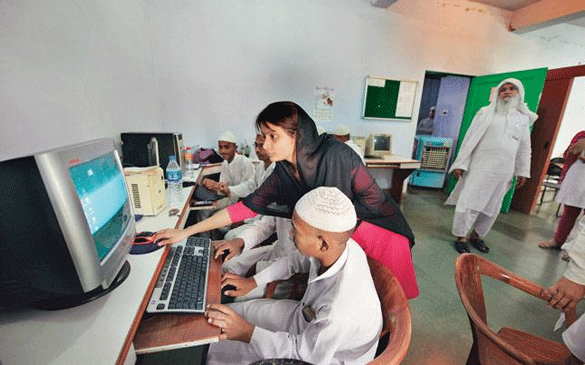
Science, mathematics, and computer literacy are equally necessary. Modern life is structured through scientific and technological systems that affect health, communication, finance, governance, transport, and information. To leave madrasa students outside this world is to confine them to avoidable marginality. Basic science develops rational inquiry and empirical thinking. Mathematics sharpens logic and precision. Computer literacy introduces students to digital tools that are now indispensable in everyday life, education, administration, and employment. A madrasa graduate in the twenty-first century should be able not only to interpret a religious text but also to use email, conduct research online, prepare a document, understand data, and navigate digital platforms.
The inclusion of these subjects should not be imagined as an attack on religious learning. The real challenge is not whether these disciplines can coexist with theology, but whether educational institutions have the imagination and will to integrate them intelligently. There is no inherent contradiction between studying the Quran and studying history, or between learning fiqh and learning mathematics. Islamic intellectual history itself is rich with scholars who engaged philosophy, medicine, astronomy, grammar, law, ethics, and political thought. The current division between “religious” and “modern” education is often exaggerated by contemporary politics. A truly confident madrasa system can combine scriptural depth with worldly competence.
However, the present political climate has made this conversation far more difficult than it should be. In principle, the inclusion of modern subjects in madrasa curricula should have emerged from sustained consultation among religious scholars, educationists, parents, minority institutions, and state agencies. Instead, in many cases, reform has been framed through suspicion, surveillance, and political dominance. The abolition of madrasa boards by governments is part of this troubling pattern.
The Uttarakhand decision must be examined critically in this context. The state government’s move to abolish the Madrasa Board and compel all madrasas to adopt the state education board curriculum has been packaged as a visionary reform. On the surface, the language appears progressive: modern subjects, better integration, educational standardization, and alignment with national policy. But the method matters as much as the goal. When a minority institution’s governing structure is dissolved by state power rather than transformed through dialogue, the process becomes deeply questionable. Reform without participation can quickly become control. Standardization without consent can become assimilation.
This is why the celebration of such measures by certain public figures must be approached with caution. Swami Chidanand Muni praised the decision as a balanced way to combine spiritual values with contemporary education. While the language of balance appears moderate, it becomes problematic when attached to a unilateral act imposed on a minority institution. Education cannot be balanced through paternalism. A truly balanced approach would have respected institutional autonomy while encouraging curricular expansion through cooperation and support.
Even more alarming is the position taken by Mahant Ravindra Puri, who has reportedly called for a nationwide ban on madrasas. Such a statement is not a contribution to educational reform; it is a direct expression of majoritarian hostility. To call for the abolition of an entire network of minority educational institutions is to attack the cultural and constitutional rights of a community. No democracy committed to pluralism should tolerate such rhetoric as normal public discourse. Madrasas may be debated, critiqued, and reformed, but to seek their disappearance altogether reveals a deeper agenda: not reform, but erasure.
This is the danger facing the madrasa debate in India today. Legitimate concerns about quality, inclusion, and curriculum are being absorbed into a broader political project that seeks to discipline Muslim institutions under the guise of modernization. The state appears eager to intervene in madrasas in a manner it does not apply equally to many other educational or religious institutions. This selective scrutiny raises serious questions. Why is reform so often spoken in the language of compulsion when it concerns Muslim institutions? Why are autonomy and cultural rights treated as obstacles when the institution in question belongs to a minority?
None of this means that internal reform should be postponed. On the contrary, Muslim scholars, community leaders, and madrasa administrators must take the lead in redesigning curricula for the present age. Waiting for the state to define reform is both risky and politically unwise. The community must itself articulate a vision of madrasa education that is rooted in faith yet open to the world. Such a vision would include social sciences, English, science, mathematics, computer education, critical thinking, and civic ethics alongside classical religious studies. It would prepare students not just for ritual leadership but for social engagement, university education, public service, journalism, teaching, law, and research.
This requires serious investment in teacher training, curriculum development, translation work, educational infrastructure, and pedagogical innovation. It requires collaboration between ulema and modern educationists rather than mutual suspicion. It also requires abandoning the false binary that suggests one must choose either tradition or modernity. The real task is synthesis, not surrender. A madrasa that equips students with both intellectual tradition and contemporary competence can become one of the most powerful models of holistic education in India.
Such reform must also be guided by constitutional values. Minority institutions have the right to administer their own affairs, and that right should not be casually curtailed in the name of majoritarian reform. The state may regulate standards, ensure child welfare, and encourage inclusion, but it must not convert itself into the owner of community institutions. There is a fundamental difference between assisting reform and commandeering it. The former strengthens democracy; the latter weakens it.
Ultimately, the future of madrasas should not be decided by politicians seeking headlines or ideological victory. It should be shaped by educators, scholars, communities, and students who understand both the demands of faith and the realities of the modern world. The inclusion of social sciences, English, and other contemporary subjects is a genuine necessity. It can expand horizons, increase opportunities, improve confidence, and foster responsible citizenship. But this educational necessity must not be used as a cover for undermining Muslim autonomy or targeting minority institutions.
Madrasas do need modernization, but not through humiliation. They need curricular renewal, not institutional demolition. They need partnership, not political conquest. The challenge before India is not whether madrasas can change; they can and they must. The real question is whether the country will allow them to change with dignity, freedom, and self-respect. A just society would answer yes.
…
M. H.A. Sikander is Writer-Activist based in Srinagar, Kashmir.
URL: https://newageislam.com/islamic-society/modernizing-madrasa-curriculum-erasing-its-soul/d/140153
New Age Islam, Islam Online, Islamic Website, African Muslim News, Arab World News, South Asia News, Indian Muslim News, World Muslim News, Women in Islam, Islamic Feminism, Arab Women, Women In Arab, Islamophobia in America, Muslim Women in West, Islam Women and Feminism