
Yaad-E-Shohada At Bada Imambara, Lucknow: Remembering Martyrs, Renewing India's Shared Moral Conscience
By Ghulam Rasool Dehlvi, New Age Islam
08 April 2026
Main Points:
· The Yaad-e-Shohda commemoration at Bada Imambara, led by Shia cleric Maulana Kalbe Jawad Naqvi and Sufi-Sunni leader Syed Babar Ashraf, with the participation of Dr Abdul Majeed Hakim, a representative of Iran’s highest religious leadership, reflects the layered identities of Indian Sufi-Sunni Muslims in solidarity with the Shias—local heritage, national belonging, and transnational scholarly memory.
· The slain supreme leader of Iran Syed Ayatollah Ali Khamenei’s remembrance in Lucknow matters for India’s Sunni-Sufi and Shia public sphere!
· More than mourning, the commemoration functioned as both a condolence gathering and a public theological forum. The event also reaffirmed the city’s role as a historic centre of Shia learning and Persianate culture. It reflected how Indian Shias and Sunni-Sufis balance local Lucknowi heritage, Indian citizenship, and transnational scholarly ties.
· From a Sufi-humanist perspective, memory became a moral discipline tied to justice and truth. The gathering also symbolised Lucknow’s Ganga-Jamuni ethos and India’s shared urban heritage thus imbibing plural civic culture with ethics of remembrance.
…
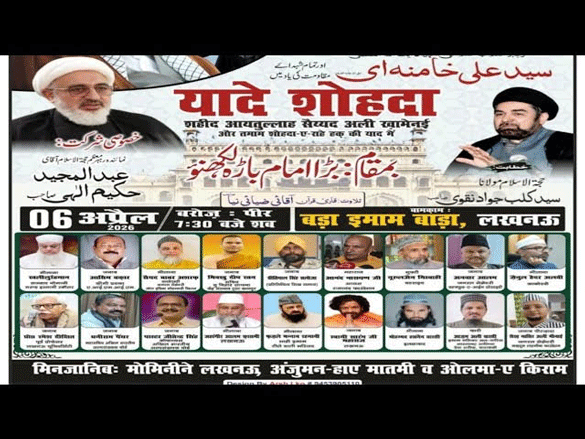
The solemn observance of Yaad-e-Shohada at Lucknow’s historic Bada Imambara Hussainabad on 6 April was far more than a memorial gathering. It emerged as a profound civic and spiritual moment in which grief was transformed into ethical remembrance, and remembrance into a renewed call for justice, coexistence and human solidarity. Thousands gathered to pay homage to the martyrs, reaffirming that the memory of sacrifice continues to shape the moral imagination of society.
In the Indo-Islamic spiritual tradition, the remembrance of martyrs is not merely an act of mourning. It is a moral pedagogy. It teaches that truth, dignity and justice often demand sacrifice, and that societies remain humane only when they preserve the memory of those who gave their lives for higher ideals. The gathering at Bada Imambara embodied precisely this ethos. Majlis, prayers, marsiya recitations and emotional tributes turned the historic monument into a living archive of collective conscience.
What made the event especially significant was its unmistakable reflection of Lucknow’s Ganga-Jamuni tehzeeb. Hindus, Muslims and Sikhs joined together in paying tribute, reminding us that martyrdom in the path of truth transcends sectarian and communal boundaries. In an age increasingly scarred by polarisation, such scenes of shared mourning acquire deeper civilisational meaning. They restore faith in India’s composite culture where grief itself can become a bridge between communities.
The presence of senior Shia scholar Maulana Kalbe Jawad, who presided over the gathering, reinforced the spiritual seriousness of the event. His emphasis that remembrance must inspire ethical action rather than remain a mere ritual resonates deeply with the Sufi understanding of zikr as transformative remembrance. To remember is not simply to look back, but to allow the memory of sacrifice to reform the present.
Equally noteworthy was the participation of Dr Abdul Majeed Hakim, described as a representative of Iran’s highest religious leadership. His remarks on justice, truth and human dignity linked the local observance in Lucknow to a wider transnational discourse on moral resistance. Yet the event’s deeper message remained universal rather than geopolitical: that every human community must preserve the sanctity of sacrifice made for truth and humanity.
The accompanying exhibition of photographs depicting martyrs, including children affected by war, gave the gathering an intensely human dimension. Such images confront visitors with the tragic cost of violence while simultaneously turning remembrance into a plea for peace. The addition of medical and blood donation camps was especially meaningful, symbolically transforming the memory of spilled blood into the gift of life for others. This was perhaps the most powerful metaphor of the day: martyrdom remembered not through anger alone, but through service to humanity.
From a Sufi-humanist perspective, the significance of Yaad-e-Shohada lies in its insistence that memory must generate compassion. The true legacy of the martyrs is not merely tears, slogans or ceremonial lamentation, but the cultivation of justice, mercy and civic responsibility. In this sense, the gathering at Bada Imambara echoed the perennial Qur’anic ethic that the sanctity of one human life stands for the sanctity of all humanity.
At a time when societies across the world are torn by war, ideological rigidity and sectarian hostility, Lucknow’s Yaad-e-Shohada offers a luminous counter-image: remembrance as reconciliation, mourning as moral awakening, and spirituality as public ethics. In that sense, the event was not just about the past. It was a reminder that the future of India’s plural civilisation depends on how faithfully we honour sacrifice with solidarity, and memory with humanity.
Lucknow, long celebrated for its deeply rooted Shia intellectual and devotional culture, witnessed an emotionally charged Yaad-e-Shohda in memory of Syed Ali Husaini Khamenei, where grief, reverence and ideological remembrance converged in a powerful public expression. Held at the historic Bada Imambara in Lucknow, the gathering drew a large number of mourners, scholars and community leaders under the guidance of senior Shia cleric Maulana Kalbe Jawad Naqvi.
The condolence gathering was marked by deep sorrow, yet it was equally defined by a sense of civilisational continuity. The address by Abdul Majeed Hakeem Ilahi, the special representative of Iran’s Supreme Leader in India, centred on Khamenei’s profound intellectual and emotional connection with India. Speaking in Persian and translated into Urdu, he recalled how Khamenei closely followed Indian scholarship, remained familiar with Indian authors, and held a special regard for the country’s spiritual and intellectual traditions.
This is particularly significant in the context of Indo-Iranian religious and intellectual exchanges that stretch back centuries. From the seminaries of Lucknow to the philosophical schools of Qom and Najaf, the Shia scholarly world has historically been bound by networks of knowledge, mourning and moral resistance. The remembrance of Khamenei in Lucknow thus carried a resonance far beyond geopolitics; it reflected a transnational culture of memory rooted in wilayat, scholarship and resistance ethics.
The presence and profound addresses of Sufi-Sunni leaders like Syed Babar Ashraf Kichauchwi, founder and president of All India Muhammadi Mission, one of Lucknow’s most prominent Sufi voices, added spiritual gravitas to the event. Known for articulating community concerns through both religious and civic platforms, Syed Babar Ashraf’s speech underscored how the Saudi-Wahhabi theological, political and cultural invasions have created damage in the wider Muslim world and have adversely affected the Indian Sunni tradition as well. In this backdrop, the Hussaini spirit, he said, serves not only as ritual commemoration but as an enthusiasm of ethical orientation and inter-community solidarity. He extensively quoted Mahatma Gandhi who famously said: “I have learnt from Imam Hussain how to achieve freedom and victory despite being oppressed”.
From a broader humanistic perspective, the gathering also demonstrated how mourning rituals continue to shape collective political consciousness. In the Shia ethos, remembrance is never passive; it is a moral act that converts grief into resolve. The Yaad-e-Shohda commemoration therefore became a space where sorrow over loss was intertwined with reflections on justice, dignity and the duty to preserve voices seen as defenders of the oppressed.
What stood out most in the Lucknow gathering was the deeply emotional recollection that Khamenei’s relationship with India was not symbolic, but rooted in a genuine engagement with its scholars, books and religious traditions. This evocation of intellectual kinship resonated strongly with Lucknow’s own legacy as a city where Persianate culture, Urdu literary expression and Shia ritual heritage has historically flourished together.
In essence, the Yaad-e-Shohda event at Lucknow’s Bada Imambara Hussainabad was not merely a condolence meeting. It was a reaffirmation of a living spiritual-political tradition in which memory becomes mission, mourning becomes moral pedagogy, and the legacy of revered leaders is carried forward through scholarship, devotion and public conscience.
…
Contributing author at New Age Islam, Ghulam Rasool Dehlvi is writer and scholar of Indian Sufism, interfaith ethics, and the spiritual history of Islam in South Asia. His latest book is "Ishq Sufiyana: Untold Stories of Divine Love".
New Age Islam, Islam Online, Islamic Website, African Muslim News, Arab World News, South Asia News, Indian Muslim News, World Muslim News, Women in Islam, Islamic Feminism, Arab Women, Women In Arab, Islamophobia in America, Muslim Women in West, Islam Women and Feminism