
Hajj As A Unifying Event Is Only A Myth
Hajj Is
Performed Only As A Religious Ritual
Main
Points:
1. The long
publicised idea of Hajj as a unifying event for global Muslims is a myth.
2. No cultural
interaction between Muslims of different parts of the world takes place during
Hajj.
1. 3.Muslims do
not shed their sectarian affiliations or beliefs during their stay in
2. Makkah.
3. Muslims wear
their linguistic, sectarian and cultural identity on their sleave.
---
By
New Age Islam Staff Writer
22 July
2022
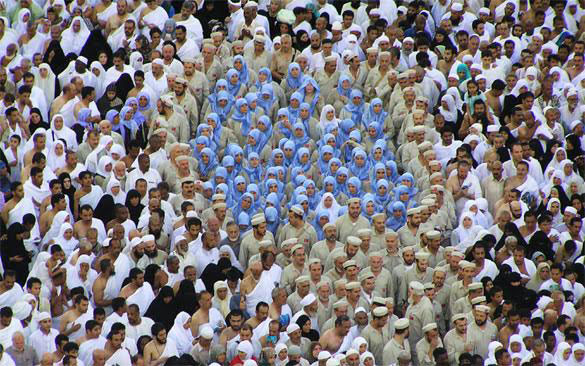
Photo by Zahid Ali Khan
-----
Faisal
Devji exposes the myth long publicised by Muslim scholars and thinkers that the
Hajj event is a unifying factor for the global Muslims.
He points
out the sectarian, cultural and linguistic differences of the Muslims
converging from different parts of the world and their pride in their own
cultural and sectarian identity. The Muslims during the Hajj are hardly able to
interact with each other because of the language barrier.
Even
Muslims from India and Pakistan do not interact with each other much because of
some inhibitions about each other. The difference between Deobandi and Barailvi
schools of Muslim religious thought becomes more prominent at a place they
should have been less invisible. Since, the main purpose of the pilgrimage is
to fulfil a lifelong religious obligation, Muslims do not have any other
purpose in mind.
Short term
bonhomie between Muslims of different countries does not bring about any
ideological change in them. For people belonging to the Barelvi sect of India,
the event is rather discomforting. They do not offer Namaz behind a Wahhabi
imam and offer their Namaz separately in their rooms. So much for the unity.
Most of their interaction is conducted in either French or in English depending
on the colony they belonged.
Urdu is
more common there because of its popularity in Gulf states as millions of Urdu
speaking Muslims have been working there for decades and because Urdu speaking
Muslims from India and Pakistan form a large contingent of pilgrims every year.
Still the sense of unity is missing. Surprisingly, Muslims appear to be united
only on the issue of blasphemy. The worldwide protests against Salman Rushdie's
book Satanic verses is an example at hand. The fatwa of death against him was
issued by the Ayatollah Khomeini, a Shia leader of Iran but the Sunni community
seconded it.
The Shias
and Sunnis of India stood united against Waseem Rizvi, a Shia politician and
activist of India who moved the Supreme Court of India for the removal of war
verses from the Quran. Such a unity is not seen on educational or political
backwardness of Muslims or on the issue of Palestine or Uyghurs. Muslims go to
Makkah or Madina on purely personal religious obligations. But some Islamic
thinkers try to project the Hajj congregation as a global congregation of
Muslims strengthening cultural and communal bonds between the Muslims.
---

By
Faisal Devji
July 12, 2016
"Even the Pilgrimage To Mecca Exposes The
Myth Of A United Islam And The Formative Power Of The Wider World"
-----
"Even
sophisticated people speak of Islam as if it is one thing. The devout, the
haters and the indifferent often share this belief in Muslim unity. And for
them all there is no greater display of Muslim unity than the Hajj.
The Hajj,
the pilgrimage to Mecca, is a grand and dramatic display of Islamic brotherhood
without racial or national bounds. Or so it appears from the outside. But this
way of seeing the pilgrimage is relatively new. It seems to have originated in
accounts by 19th-century European travellers. The most active and best
proponents of the myth of the Hajj have always been notable Western converts,
such as the Galician Jew Leopold Weiss, who became the Islamic thinker and
Pakistani politician Muhammad Asad, or Malcolm X, the activist for equality in
the United States, who wrote about the Hajj in rapturous terms. Given that Saudi
Arabia had abolished slavery only a few years before Malcolm X’s pilgrimage,
his view of the Hajj as the embodiment of a longstanding and more just
alternative society might have been a bit naïve.
Muslims
themselves have also taken up the claim that the Hajj represents a kind of
ideal society, free of the prejudices and divisions that dominate the profane
world.
Proponents
of the Hajj as a social ideal speak of the brotherhood it enacts. Brotherhood
is a common and powerful metaphor of closeness. As all brothers know, however,
brotherhood is rarely if ever about equality.
Muslim
teaching has much to say about brotherhood, and about equality. Clearly, they
are not the same thing, and can even contradict one another. Families, after
all, tend to be hierarchical and harbour various kinds of violence. They often
sacrifice some members for others. The newly fashionable term ‘Abrahamic
religions’ tries to mask such unhappiness. In the past generation, this term
has grown in popularity as an alternative to ‘Christian’ or ‘Judeo-Christian’.
By
emphasising the patriarch Abraham – the common ancestor – ‘Abrahamic religions’
is meant to express the familial relationship between Judaism, Christianity and
Islam. The patriarch Abraham’s sacrifice, according to the metaphor, makes him
foundational for all three religions. Proponents of the ‘Abrahamic religions’
want to emphasise closeness and de-emphasise conflict.
But Abraham
was ready to sacrifice one son and abandon another. This is not a simple and
happy family. Nor is it necessarily a close one.
The
historical experience of Abraham’s metaphorical descendants is simply very
different. Only a minority of Muslims, those living around the Mediterranean
basin or the Caucasus, have grown up with Christians and Jews as interlocutors
and neighbours. Historically, Islam’s primary siblings have been not Jews or
Christians but Hindus, Buddhists and Zoroastrians. Unlike their Jewish and
Christian ‘brothers’, Muslims are part of a polytheistic and non-Semitic world.
The poor ‘Abrahamic religions’ metaphor tears away the historical experience of
the majority of the world’s Muslims.
Like the
idea of the three monotheistic brothers, the idea of Muslim unity is recent,
well-meaning and highly misleading. At a deep level, both ideals – Muslim unity
and Abrahamic religions – are based on violence. But what does it really mean
to describe as violent such a seemingly benign ideal as Muslim unity?
Last
August, I was in Riyadh for a conference. It’s not so easy to get into Saudi
Arabia and, while there, I thought I might visit the sacred cities of Mecca and
Medina. The Hajj was about to begin, so the opportunity was a rare one. Thanks
to the Indian consulate in Jeddah, I managed to secure the services of guides
in both cities. And so I found myself travelling to Mecca with an Indian driver
and companion. He turned out to be a Muslim divine from the city of Deoband,
one of the great seminaries of the subcontinent.
In its
magnificently craggy desert setting, Mecca is a redeveloped place, devoid of any
historical or aesthetic character. The black-draped Kaaba, standing at Islam’s
ritual centre, lay within a corset-like framework of stairs and floors that
allow pilgrims to circumambulate it on three levels. Many circled the Kaaba
while filming themselves with mobile phones, adding a new gesture to the
ceremonies of pilgrimage. Two disasters marred last year’s Hajj: a crane
collapsed in the Great Mosque, and a stampede occurred at Mina. Both involved
hundreds of fatalities. But the only discomfort I suffered was when a pilgrim
in a wheelchair ran over my foot as I trudged my seven circles around the
Kaaba.
On the road
back to Jeddah, the driver got into an argument with the Deobandi divine. Our
driver was a fan of the Mumbai-based television preacher Zakir Naik. Naik’s
satellite TV show has made him a global Muslim celebrity. He is a conservative
televangelist whose sermons are in the model of American media figures such as
the Southern Baptist pastor Jerry Falwell, as were the orations of his
predecessor, the South African Muslim preacher Ahmed Deedat. Like Deedat, Naik
preaches in English, and his popular show espouses highly conservative views.
He wears a Western suit and a skullcap. The driver also wore Western clothes,
and clearly saw himself, like Naik, as a modern man, yet one who prized social
and religious harmony above all else. The driver said he disapproved of the
sectarian disputes among Muslims and religious conflict in India, too. He
praised the peaceable nature of the Hajj.
The
Deobandi cleric pointed out that the order and harmony of the Hajj derived from
Saudi Arabia’s monarchical form of government. The Saudis, he observed, support
one form of Islam and prohibit the public manifestation of all others. The
nature of Saudi government ensured many different kinds of believers could
mingle without open dispute. Indian democracy, the Deobandi divine noted,
entailed the absence of a state religion. Sectarian disagreement and disputes,
he observed, resulted naturally from the freedoms of a republican form of
government. Republics, he insisted, maintain their democratic character through
disagreement. They would lose it by favouring any one religion – by which of
course he meant Hinduism – even if it was to promote social harmony. Consensus,
he was saying, was not a mark of freedom but its opposite.
Liberal
Muslims commonly make this argument about the good of religious difference.
When they do, they often cite scriptural passages about the virtue of
difference and the competition in goodness it makes possible. The Deobandi
divine, however, drew his justification not from theology, but politics
construed as a realm autonomous of it. He was not interested in tolerance or
pluralism as inherently good things. Instead, the divine made a case that
conflict and contestation must be part of political life. Democracy, he was
saying, was not afraid of disagreement. On the contrary, democracy and freedom
depended not on some false consensus, but on institutional mechanisms that
helped prevent dispute from turning into violence or oppression. In other
words, democracy made living with disagreement possible.
The
channels and institutions of disagreement in India and other democracies might
not always prevent violence. During elections they can even foment it. Nevertheless,
their ideal is meant to stand as a guarantor of freedom for all citizens, not
just members of one religion or sect. By focusing on disagreement in the
political life of a democracy, my Deobandi guide was criticising the driver’s
liberal pleas for harmony and unity as anti-political and illusory in nature.
The cleric left scripture to the side. He focused on the state, and its
essential role as the guarantor of this freedom. Indeed, there is no group in
India – Muslims chief among them – that does not advocate for a secular state.
What exactly secularism means, however, constitutes one of the great subjects
of disagreement in India.
Importantly,
there is nothing peculiarly Indian about the cleric’s turn to the state and its
politics. The nation-state is inescapable when it comes to matters of
establishing and governing matters within and between religious communities.
People often see the Hajj as an example of Islam’s global, transnational
community. However, even the possibility and experience of the Hajj is shaped
entirely by nationality. It is not a melting away of national distinctions in
transcendental unity. Rather, the Hajj is a carefully managed, entirely
conventional instance of internationalism. First, quotas for pilgrims are set
by their national citizenship: one per cent of a country’s Muslim population is
given visas. Throughout the Hajj, pilgrims are marked by national identity.
They are provided name tags, backpacks, sun visors and other paraphernalia by
tour companies. All are embossed with national flags or printed in their
colours. Guides have national flags attached to their clothing.
National
languages play a crucial role in the Hajj. Housing and services provided to
Indian pilgrims are identified in Hindi, whose script is also that of
Hinduism’s sacred language. Because of the large numbers of Keralans settled in
Gulf countries, one also saw housing and other services identified in
Malayalam, the language of Kerala, in southern India. Sometimes, a dormitory in
Mecca becomes full, and a pilgrim from one part of the country must be housed
with pilgrims from another region. I am told that loud complaints about
inedible food and strange tongues always follow – as they would among the
pilgrims’ Hindu compatriots similarly housed in the holy city of Benares.
In Mecca,
pilgrims’ native tongues vary at least as much as their nationality. As a
result, very few pilgrims can communicate with those from other countries in
any language but English or French: which it is depends on their particular history
of colonisation. Thus even the experience of Muslim global unity supposedly
exemplified by the Hajj is facilitated by the languages of the Western European
coloniser.
Arabic,
English, and Urdu are the languages most conspicuous at the Hajj, visible on
signs and notices all over Mecca and Medina. Arabic is there largely for
symbolic reasons, given that there are relatively few Arab pilgrims. My guide
and I conversed in Urdu, which is both a north Indian language and the national
language of Pakistan. We often came across Pakistani pilgrims speaking the same
language. But because my guide and I were marked as Indian, never once did they
acknowledge us, nor us them. We exchanged no words of greeting at this most
sacred site of Muslim brotherhood and unity. We remained identified by our
nation-states, which defined our experiences.
The
multilingual signs of Mecca proliferate at important sites and monuments.
Illustrated with citations from Muhammad’s sayings, these notices warn pilgrims
against touching or kissing structures that the Saudis haven’t torn down, and
warn against taking back sand from the holy places as a souvenir. The Saudi
government fears that such souvenirs could engender idolatrous, un-Islamic
attachment. As a result, authorities have fenced off the areas that once held
the tombs belonging to the Prophet’s relatives and Islam’s early martyrs. Such
monuments would surely become objects of idolatry. The historic battlefield of
Uhud outside Medina, for instance, had been walled with opaque glass, but
pilgrims broke holes to peer at the wilderness within.
The Hajj is
also replete with small acts of insubordination. Signs bearing images of
forbidden practices, each crossed out by a red X, serve only to highlight these
instances of minor rebellion. The pillar outside Mecca at the site of
Muhammad’s last sermon, for example, has its top plastered with signs warning
pilgrims against paying it any devotion. But the bottom of the pillar is
covered with graffiti, which in the circumstances is not a defacement, but the
only way to recognise the site’s sacredness. In effect, the signs speak of a
city under occupation, apparent prescriptions for order imposed from above by a
foreign ruler. The Saudi royal family and its Wahhabi form of Islam, after all,
took the holy cities by force only in the 20th century, in the wake of the
First World War.
The harmony
of the Hajj is simply not based on any kind of Muslim unity of any
significance. Its order and concord derive from, on the one hand, the dominance
of Saudi monarchy and Wahhabi establishment and, on the other, mutual
indifference among Muslims.
My Indian
driver told me of a rumour about the Barelvis, great rivals of the Deobandis in
India and Pakistan. He accused the Barelvis of praying privately in their hotel
rooms. They feared, he alleged, that standing behind Wahhabi imams in the
mosque would imperil their salvation. It is true that Saudi control confers on
the Wahhabi denomination some exclusive prerogatives in the holy cities. But
the shuffling, inelegant rows of pilgrims at prayer in Mecca, each with his or
her own slightly divergent ritual tradition, are subtle demonstrations that
Islam, even in the heart of Wahhabism, even during the Hajj, can never be
brought completely under any sect’s control.
Today,
calls for Muslim unity come from so-called militants and moderates alike. Such
calls for Muslim unity do not date back much before the 20th century. To be
sure, the ideal of universal agreement in Islam might have existed before. But
it seldom constituted a political or even religious project beyond fairly
circumscribed arenas of debate. On the contrary, the internal schisms and
conflicts of Muslim societies demonstrated a sense of confidence and comfort
with disagreement as a political necessity. This recognition of disunity is
illustrated by an oft-cited saying attributed to Muhammad; in it, the Prophet
pronounced that his community would be divided into 72 sects until the end of
time, with only a single crucially unspecified one bound for salvation.
With the
rise of European empires in the 18th and 19th centuries, Muslim unity emerged
as a significant theme. In other words, this unity served as a defensive
strategy to counter the loss of Muslims’ control over their own political life.
Still, the desire remained largely theoretical, even during the heyday of
Pan-Islamism in the early 20th century. It took the rise of new global
movements and identities following the end of the Cold War for the current
visions of Muslim unity to arise.
One of the earliest
moments in the new, and now explicitly global rather than merely international,
project of Muslim unity came with mobilisations that followed the outcry over
Salman Rushdie’s allegedly blasphemous novel, The Satanic Verses (1989). The
demonstrations were not and could not be confined to a particular country,
movement, revolution or terrorist group. Made possible by television and the
sense of simultaneity and collective identification that it offered, these
reactions to a perceived affront catalysed new calls for a global form of
Muslim unity that, unlike Pan-Islamism, didn’t take a coalition of states as
its model.
This global
mobilisation presented novel opportunities and challenges for Muslim leaders.
Initially, this ‘Muslim unity’ appeared in the form of declarations signed by a
motley crew of divines, politicians and ideologues for or against the Iranian
fatwa calling for Rushdie’s murder. Some of these attempts at generating
agreement sought to corral global forms of Muslim mobilisation in opposing
ideological directions. The initial calls came in response to supposedly
insulting depictions of the Prophet. More recently, such calls are made both in
support and to counter the much less popular cause of recruiting Muslims to
Al-Qaeda or ISIS.
In some
ways, these declarations resemble the long history of Christian ecumenical
councils. But since Islam lacks an institutional basis comparable to the
Vatican, the results are even less coherent. The calls for Muslim unity are no
less, and no more, than the collective expression of a pious wish by a random
assortment of dignitaries. If pressed or asked to take any actual measures
signifying unity, even the signatories of these declarations would immediately
find themselves in disagreement about ‘Muslim unity’.
At root,
however, the problem is not the details of these calls for unity. It is the
essence, the very ideal of consensus. As a matter of course, calls for Muslim
unity customarily violate the spirit of their claims by anathematising their
Muslim opponents. Calls for unity are not high-minded but, in a word,
disingenuous, a seemingly noble pretext for anathematising or demonising
opponents.
Even more
deeply, however, the ideal of unity is inherently anti-political. The Deobandi
cleric was right in identifying the political as the sphere offering the only
real potential for peaceful accommodation of differences and disputes.
Posturing about an illusory ‘Muslim unity’ tends only to alienate Muslims from
the political world of nation-states that govern their societies. From this
perspective, Muslim militancy, too, is actually a consequence of
de-politicisation and not, as is commonly presumed, the reverse.
Whether by
Western or Middle Eastern governments, condemnations of terrorism in religious
language, in the name of Islam, are losing causes. Real problems will not be
solved on theological terrain. When liberals and advocates of tolerance too
celebrate or promote moderate Islam, it is another step away from the world of
politics and institutions, the world of progress and solutions. The quest for
harmony, for unity, is a siren song, and is to be resisted.”...
[Edited
by Sam Haselby, 2,800 words]
----
Faisal
Devji is professor of Indian history and fellow of St Antony’s College at the
University of Oxford, where he is also the director of the Asian Studies
Centre. His latest book is Muslim Zion: Pakistan as a Political Idea (2013).
Source: "Against Muslim Unity"
URL: https://newageislam.com/islamic-society/hajj-unifying-event-myth/d/127541
New Age Islam, Islam
Online, Islamic Website, African Muslim News, Arab World News, South Asia News, Indian Muslim News, World Muslim News, Women in Islam, Islamic Feminism, Arab Women, Women In Arab, Islamophobia in America, Muslim Women in West, Islam Women and Feminism