
While The Quran Cannot Be Changed, There Is Scope for Improvement in the Sharia Law, And That through Various Instruments like Maqasid-e-Sharia and Maslaha Available in Islam: Sultan Shahin Tells The Print
Not Just
Under Taliban, Data Shows Sharia Law Hardly Ever Lets Freedom Flourish
Main
Points:
1. The Sharia law
is based on the interpretation of the Quran which came about 150-200 years
after the Prophet died.
2. Sharia is
derived from the Quran and the Hadiths — the statements, actions and teachings
of Prophet Muhammad.
3. Across
different Islamic countries, the percentage of laws based on Sharia varies
widely.
1. Ulema, who
should have been the biggest defenders and propagators of human rights, are its
biggest violators across the world, says Sultan Shahin, founder-editor, New Age
Islam.
-----
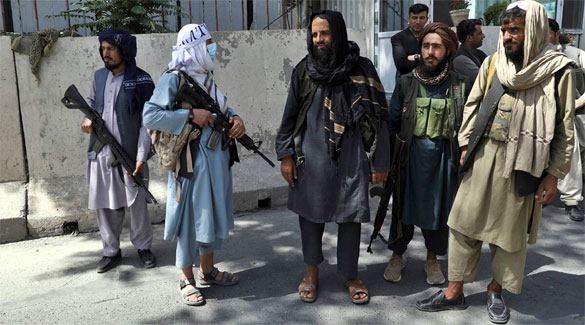
Taliban fighters stand guard at the main gate leading to the Afghan presidential palace, in Kabul, Afghanistan, Monday, Aug. 16, 2021. (AP)
------
--------------------------------------------------------------------------------------
Meanwhile, Shahin said while the Quran cannot
be changed, there is scope for improvement in the Sharia law, and that through
various instruments available in Islam, Muslim scholars can ameliorate the
situation. “If they believe that the objective of Sharia is to bring harmony
and restricting human rights is causing disharmony, they might even change the
law,” he said.
“Of course, that will only happen if Ulema
(Muslim scholars) decide to follow Islamic rules about human rights. At the
moment, Ulema, who should have been the biggest defenders and propagators of
human rights, are its biggest violators across the world,” he opined.
--------------------------------------------------------------------------------------

By
Nikhil Rampal
3
September 2021
Images of
Afghans rushing to the Kabul airport to try and get out of the country as the
Taliban recaptured power last month have been etched into the collective memory
of the world. The Taliban intend to make an Islamic emirate out of the
strife-torn country, where Sharia will be the law of the land. And dozens of
incidents in the last month alone have shown how individual freedoms are being
hampered under the religious law, despite the Taliban projecting themselves as
less hardline than before.
Sharia is
derived from the Quran and the Hadiths — the statements, actions and teachings
of Prophet Muhammad. In most Islamic countries, Sharia finds its place in
personal and legal matters. Lexico, a website powered by Oxford University
Press dictionaries, says Sharia “prescrib(es) both religious and secular duties
and sometimes retributive penalties for law-breaking. It has generally been
supplemented by legislation adapted to the conditions of the day, though the
manner in which it should be applied in modern states is a subject of dispute
between Muslim traditionalists and reformists”.
However,
critics like author Taslima Nasreen have said the Afghans, especially women,
are actually trying to flee Sharia law, and the personal freedoms it restricts.
ThePrint
dives deep into data from reputed international researchers to see whether
Sharia and personal freedoms are as mutually exclusive as Nasreen and other
critics make them out to be.
Sharia and
Personal Freedoms
Across
different Islamic countries, the percentage of laws based on Sharia varies
widely, making it difficult to gauge just how much the religious law impacts
their current rules and regulations.
But for the
purpose of this report, two data sets have been used — one, a 2013 survey by
US-based think-tank Pew Research Center, which asked respondents about their
approval for Sharia to be the official law of their country; and two, the 2016
edition of the annual Human Freedom Index released by US-based think-tank CATO
Institute, in collaboration with Canada’s Fraser Institute. The 2016 edition is
the earliest available for comparison.
The Human
Freedom Index is based on 34 personal freedom indicators and 42 economic
freedom indicators. The personal freedom index broadly measures two categories
— legal protection and security (which includes civil justice, security of
people from terror and women’s safety), and specific personal freedoms (which
includes freedoms pertaining to movement, religion, civil society, expression
and information and identity and relationships).
ThePrint’s
analysis of 23 Muslim-majority countries on these indices shows that personal
freedom and preference for Sharia are moderately correlated with each other,
with a negative relationship (coefficient of correlation = -0.57). This means
that countries where Sharia has a strong approval are also the ones where
individual freedoms are limited.
Bosnia and
Herzegovina and Albania, the two Muslim-majority countries in eastern Europe,
where individuals were freer than the global average score, had the lowest
approval for Sharia as the law of the land — less than 8 per cent.
But in the
rest of the Muslim-majority countries, people enjoyed less freedom than the
global average. Iraq, where the personal freedom score was the lowest in the
Human Freedom Index, had 91 per cent respondents favouring Sharia as their
country’s law in the Pew survey.
Egypt,
Bangladesh and Pakistan are other prominent examples of people wanting Sharia
law, and possessing low levels of freedom.
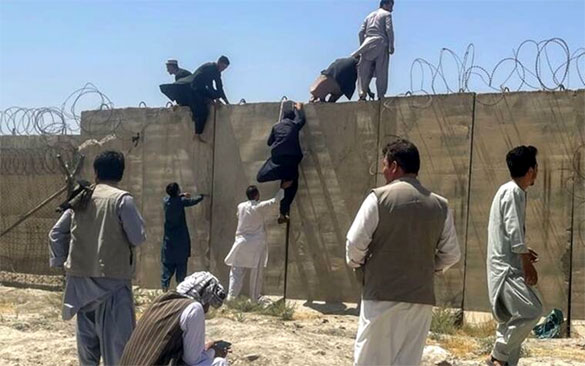
Men try to get inside Hamid Karzai International Airport in Kabul,
Afghanistan August 16, 2021. (Reuters)
------
Democracy
Essential for Freedom
The next
question to be studied is just why Islamic countries rate poorly on personal
freedoms — the key lies in the absence of democracy in many of them.
According
to a study by Mustafa Akyol, senior fellow at the CATO Institute in Washington
D.C. and expert on Islam and modernity, there exists a strong positive
correlation between democracy and human freedom. The more successful a
democracy is, the more individual freedom it offers.
The 2020
edition of the Human Freedom Index report also shows that there is a high
degree of positive correlation between human freedoms and the level of
democracy, and not just in Islamic countries. Authoritarian regimes like China,
Venezuela and North Korea have the lowest human freedom scores.
The
Economist magazine’s Intelligence Unit also publishes an annual Democracy
Index, which ranks countries based on the quality of democracy — full
democracies, flawed democracies, hybrid regimes and authoritarian regimes. In
the last four years, of the 50-55 authoritarian regimes in the index, more than
half are from Muslim-majority countries. In the 2020 rankings, about 13
Muslim-majority nations featured in the bottom 20 of the Democracy Index.
--------------------------------------------------------------------------------------
--------------------------------------------------------------------------------------
Islam and
Democracy
According
to a paper by the United States Institute of Peace, an American think-tank
working in conflict management, the reasons for the high level of
authoritarianism in Islamic countries are political, economic, cultural and
historical, more than religious.
The paper
states that a vast majority of Muslim thinkers are opposed to democracy because
it gives more value to the law created by humans over the law laid down by
Allah. But there also exists a school of thought that is in favour of new
ideas, practices and institutions. “(This school) stresses the need for
continuity of basic Islamic traditions but believes that Islamic law (Sharia)
is historically conditioned and needs to be reinterpreted in light of the
changing needs of modern society,” the paper states.
According
to Hilal Ahmed, a scholar of political Islam and associate professor at the
Centre for the Study of Developing Societies (CSDS), “Islam and Sharia and even
the notion of democracy are highly diversified concepts. This heterogeneity
should be recognised as a precondition to talk about the complex ways in which
these ideas are used in the Muslim world”.
“One may
identify two observable trends. First, the authoritarian regimes such as Saudi
Arabia evoke Sharia to legitimise their rule in the name of Islam. These
regimes suppress dissent to establish Sharia. They always take refuge in the
conventional binary between Sharia and democracy,” Ahmed told ThePrint.
Sultan
Shahin, editor of New Age Islam, a progressive website working on rethinking
Islamic postulates, said problems exist in the Sharia too. “With the concept of
‘Shura’ (consultation) placed in the Quran, Islamic countries should not have
dynasties and monarchies at all, but that’s not the case. The Sharia law is
based on the interpretation of the Quran which came about 150-200 years after
the Prophet died,” he told ThePrint.
The Arab
Spring revolutions of the last decade had produced hope that the Islamic world
would turn towards democracy, but it has proven to be a false hope. Asked how
democracy, which is essential to personal freedoms, can take hold in the
Islamic world, Ahmed said: “There is a serious lack of intellectual work as
well as political debates on this question in these countries. In my view,
there is a need to evolve a democratic system suitable for the adherents of
Islam, instead of evoking outdated intellectual claims such as the Islamic
notion of democracy.”
Meanwhile,
Shahin said while the Quran cannot be changed, there is scope for improvement
in the Sharia law, and that through various instruments available in Islam,
Muslim scholars can ameliorate the situation. “If they believe that the
objective of Sharia is to bring harmony and restricting human rights is causing
disharmony, they might even change the law,” he said.
“Of course,
that will only happen if Ulema (Muslim scholars) decide to follow Islamic rules
about human rights. At the moment, Ulema, who should have been the biggest
defenders and propagators of human rights, are its biggest violators across the
world,” he opined.
(Edited
by Shreyas Sharma)
(Courtesy:
The Print, URL: https://theprint.in/world/not-
URL: https://www.newageislam.com/islamic-sharia-laws/maqasid-e-sharia-maslaha-quran/d/125307
New Age Islam, Islam Online, Islamic
Website, African Muslim News, Arab World News, South Asia News, Indian Muslim News, World Muslim News, Women in Islam, Islamic Feminism, Arab Women, Women In Arab, Islamophobia in America, Muslim Women in West, Islam Women and Feminism