
Divine Limits, Human Claims: The Ethics of Inheritance in Islamic Jurisprudence

By Moin Qazi, New Age Islam
29 April 2026
"Inheritance is not merely a transfer of wealth; it is a test of justice, a measure of restraint, and a boundary between human desire and divine command."
Islamic law of inheritance stands as one of the most rigorously structured and morally charged domains within the broader framework of Islamic jurisprudence. Unlike many other legal systems where testamentary freedom dominates, Islamic law imposes precise limits—divinely ordained, meticulously detailed, and ethically binding. These limits are not arbitrary constraints but form part of a moral architecture designed to protect justice, prevent exploitation, and preserve familial balance.
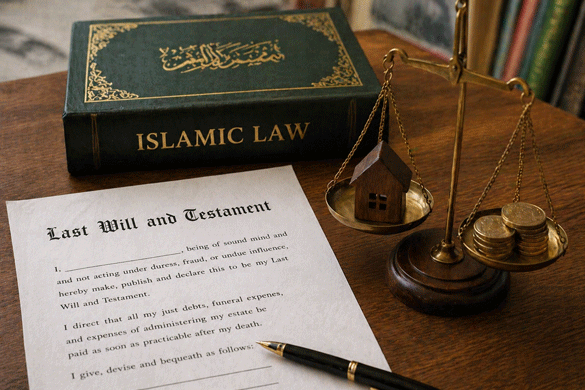
At the heart of this system lies a fundamental distinction: the difference between what a human being may wish to give and what God has already apportioned. The Qur'an speaks with striking clarity on this matter:
"Allah instructs you concerning your children: for the male, what is equal to the share of two females…" (Qur'an 4:11)
These are not advisory guidelines; they are definitive allocations. Classical exegetes such as Ibn Kathir and Al-Tabari consistently emphasise that these verses establish fixed shares (farā’iḍ) that cannot be overridden by personal discretion. The distribution of inheritance is thus removed from the realm of subjective preference and placed firmly within the domain of divine command.
Yet, Islamic law does not entirely exclude human agency. It allows for a limited form of testamentary freedom through the institution of the wasiyyah (will). However, this freedom is deliberately circumscribed. The Prophet Muhammad ﷺ set a clear boundary in a widely transmitted hadith recorded in Sahih al-Bukhari:
"One-third, and one-third is much."
This statement, addressed to Sa'd ibn Abi Waqqas, has been universally understood by jurists to establish the maximum permissible portion of the estate that may be disposed of through a will. The remaining two-thirds are reserved exclusively for the Qur'anic heirs.
This limitation serves a profound ethical purpose. It prevents individuals from disinheriting rightful heirs due to bias, resentment, or manipulation. As Al-Qurtubi notes in his commentary, the restriction serves as a safeguard against ظلم (injustice), ensuring that personal inclinations do not undermine the divinely mandated equity.
Even more significant is the principle governing who may benefit from a will. A foundational hadith, recorded in Sunan Abu Dawood and Jami` at-Tirmidhi, declares:
"There is no bequest for an heir."
This single principle carries far-reaching implications. It establishes that a person who is already entitled to a fixed share under the Qur'an cannot be given additional advantage through a will, at least not automatically. The logic is unmistakable: allowing such bequests would open the door to favouritism and disrupt the balance carefully instituted by divine law.
However, Islamic jurisprudence, in its characteristic balance, introduces a narrow but meaningful exception. If all other legal heirs, after the death of the testator, freely and without coercion consent to the bequest, it may be honoured. This condition, emphasised by jurists such as Ibn Qudamah, ensures the integrity of the system while allowing for voluntary generosity among heirs.
The result is a remarkably nuanced legal structure. On one hand, it affirms divine sovereignty over wealth distribution; on the other, it accommodates human goodwill—provided it does not infringe upon justice.
This interplay between restriction and discretion reflects a deeper philosophical truth: inheritance in Islam is not a private entitlement but a moral trust. Wealth, in this view, does not belong absolutely to the individual even in death. It is subject to obligations that transcend personal will.
The ethical tension between divine limits and human claims becomes particularly evident in contemporary contexts, where individuals often seek to extend control over their estates beyond what the law permits. Misunderstandings frequently arise when the one-third allowance is treated not as a ceiling but as an entitlement, or when heirs assume that benefiting from a will automatically entitles them to additional claims over the remainder.
Such assumptions are not merely technical errors; they represent a deeper misreading of the law's moral purpose. The Qur'anic system is designed to prevent precisely this kind of accumulation of advantage. To receive both a preferential bequest and a full inheritance share—without the informed consent of other heirs—is to undermine the equilibrium that the law seeks to maintain.
As Al-Shafi'i and later scholars across the legal schools have affirmed, the prohibition of bequests to heirs is not a minor procedural rule but a cornerstone of the inheritance system. It ensures that no individual can, through influence or proximity, secure a disproportionate share at the expense of others.
The enduring relevance of these principles lies in their ability to address not only legal disputes but moral dilemmas. Inheritance is often a site of emotional intensity—where affection, expectation, and entitlement converge. It is precisely in such moments that the discipline imposed by divine law becomes most necessary.
The Qur'an itself warns against the violation of these boundaries:
"These are the limits set by Allah… and whoever transgresses the limits of Allah has certainly wronged himself." (Qur'an 65:1)
This warning is not merely theological; it is profoundly practical. When the limits are observed, disputes are minimised, and justice is upheld. When they are ignored, the consequences are not only legal but relational—fracturing families and eroding trust.
In the final analysis, the law of inheritance in Islam is not simply a mechanism for distribution; it is a moral framework that seeks to align human conduct with divine justice. It recognises the inevitability of human bias and seeks to contain it within principled limits. It acknowledges the desire for autonomy but subjects it to a higher order of fairness.
The one-third rule, the prohibition of bequests to heirs, and the fixed Qur'anic shares together form a coherent ethical system—one that resists manipulation while allowing measured compassion. It is a system that demands restraint where temptation is greatest and clarity where confusion is most likely.
To understand this system is to recognise that justice, in Islam, is not left to human discretion alone. It is guided, structured, and, where necessary, constrained by divine command. And it is within these constraints that true fairness—durable, impartial, and humane—finds its most secure expression.
…
Moin Qazi is an Indian author and development leader who advanced dignity-centred, community-led change. A pioneer of microfinance and grassroots institutions, he fused ethics with social innovation. With deep interdisciplinary scholarship, he bridged policy, justice, and lived realities. His legacy affirms ethical leadership and people’s agency as drivers of India’s progress…
New Age Islam, Islam Online, Islamic Website, African Muslim News, Arab World News, South Asia News, Indian Muslim News, World Muslim News, Women in Islam, Islamic Feminism, Arab Women, Women In Arab, Islamophobia in America, Muslim Women in West, Islam Women and Feminism