
The Saint Delhi Forgot, But History Did Not: Hazrat Najibuddin Mutawakkil

By Syed Amjad Hussain, New Age Islam
13 April 2026
Hazrat Shaykh Najibuddin Mutawakkil lived a life of poverty, deep faith, and unwavering trust in God, inspiring generations through humility, spiritual insight, and quiet devotion beyond worldly recognition.
Main Points:
· Hazrat Shaykh Najibuddin Mutawakkil came from a noble Farooqui lineage and was raised in a deeply spiritual household.
· He lived a life of poverty with complete trust in God, embodying true tawakkul.
· He shared a close bond with Hazrat Baba Fariduddin Masood Ganj Shakar and influenced Hazrat Khwaja Nizamuddin Auliya.
· His humility, detachment from the world, and reported miracles made him stand apart.
· His life remains a source of inspiration for those seeking sincere faith and simplicity.
A Saint Remembered Through Silence and Simplicity
In the long and luminous history of Sufism in the Indian subcontinent, there are some names that shine brightly in public memory, and others that remain quietly preserved in the hearts of seekers. Among the latter stands Hazrat Shaykh Najibuddin Mutawakkil, a man whose life was not about fame or influence, but about complete surrender to God.
He was not only the real brother of Hazrat Baba Fariduddin Masood Ganj Shakar, but also his devoted disciple (mureed) and trusted spiritual successor (khalifa). Those who knew him closely, including Hazrat Khwaja Nizamuddin Auliya, saw in him a rare depth of spirituality—one that did not seek recognition, yet left a lasting imprint.
From Royal Roots to Trials of History
Hazrat Najibuddin’s family history carries both dignity and hardship. He belonged to a noble Farooqui lineage tracing back to Hazrat Umar Farooque ibn al-Khattab. His ancestors were once connected to rulership in Kabul, particularly through Farrukh Shah.
But history is rarely kind for long. With the rise of new powers and later the destructive invasions of Genghis Khan, his family faced loss, migration, and even martyrdom. His grandfather, Hazrat Qazi Shoaib Faruqi, eventually moved to Lahore and then Qasur, where the family rebuilt its life through knowledge and service.
A Childhood Shaped by Piety
He was born in Qasba Konthwal, into a home where faith was not taught, it was lived. His father, Hazrat Shaykh Jamaluddin Sulaiman, was known for his learning, while his mother, Hazratt Bibi Qulsum Khatoon, was remembered for her purity and spiritual strength.
One incident often narrated reflects her state: when a thief entered their house at night, he was suddenly struck blind. Terrified, he confessed and promised to abandon wrongdoing. With a mother’s compassion, she prayed for him, and his eyesight was restored. It was in such an atmosphere that Najibuddin grew up, where faith was real, and mercy was immediate.
The Meaning Behind ‘Mutawakkil’
People did not call him Mutawakkil without reason. It was not just a title, it was his way of life.
Despite having a family to care for, he lived through extreme hardship. There were days when there was nothing to eat at home. Yet, he never complained, never chased after wealth, and never allowed worry to replace trust in God.
There is a moving account from an Eid day when guests arrived at his home, and there was not a single morsel to offer them. He felt the pain of that moment deeply, not for himself, but for his guests and children. Yet, what followed was extraordinary. Through what is believed to be the unseen help of Hazrat Khwaja Khizr, food appeared in his home.
For him, this was not a miracle to boast about, but a reminder: that when a person empties himself of worldly reliance, divine help finds its way.
Delhi: A City of Trials and Truth
When he came to Delhi with Hazrat Baba Farid, he stayed back on his brother’s instruction while Hazrat Baba Farid moved to Ajodhan. In Delhi, he was appointed as an imam in a mosque.
But his nature was such that he could not remain silent in the face of excess. When he saw the mosque’s patron spending lavishly on a wedding, he gently advised that some of that wealth could have been used to help the poor. The advice, though sincere, was not welcomed. He was removed from his position.
For him, however, losing a role was never a loss. Compromising truth would have been.
His Relationship with Great Saints
His spiritual stature is best understood through his relationship with Hazrat Khwaja Nizamuddin Auliya. When Nizamuddin Auliya first arrived in Delhi, he lived near him and developed deep respect for him.
After the passing of his mother, Hazrat Khwaja Nizamuddin Auliya spent much time in his company. Once, he requested him to pray that he might become a Qazi. Hazrat Najibuddin quietly refused and said, “You will not become a Qazi—you are destined for something greater.”
History, of course, proved those words true.
Even more telling is the moment when Hazrat Nizamuddin Auliya wished to become his disciple. Hazrat Najibuddin declined and directed him towards Hazrat Baba Farid or Hazrat Bahauddin Zakariya Multani. It was a decision rooted in humility and spiritual discipline, not authority.
Moments of Compassion and Wit
Among those devoted to him was Hazrat Bibi Fatima Sam, who would quietly send food to his home during times of need. He regarded her like a sister.
Once, when she sent only a single roti, he smiled and remarked gently that while Allah had made her aware of their condition, kings often remain unaware, and perhaps incapable, of such understanding. It was a simple comment, yet it carried a deep truth about sincerity and power.
A Life Beyond the World
Hazrat Najibuddin’s spiritual state was such that worldly matters held little meaning for him. It is said that he did not concern himself with dates, months, or even market prices. His world revolved entirely around remembrance of Allah.
Hazrat Nizamuddin Auliya is reported to have said that he had not seen anyone in Delhi so detached from the world.
Such a state is not easy to imagine today, where life is often measured in material terms. Yet, for him, this detachment was not neglect, it was fulfilment.
Final Days and a Quiet Departure
He visited Hazrat Baba Farid many times, nineteen, according to tradition. Each time, he would ask for prayers that he might return again. But on his final visit, Hazrat Baba Farid remained silent. It was a silence that spoke of an ending.
Soon after, news reached that Hazrat Najibuddin had passed away on the 7th of Ramadan.
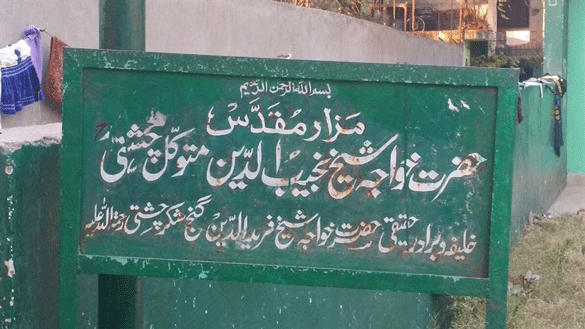
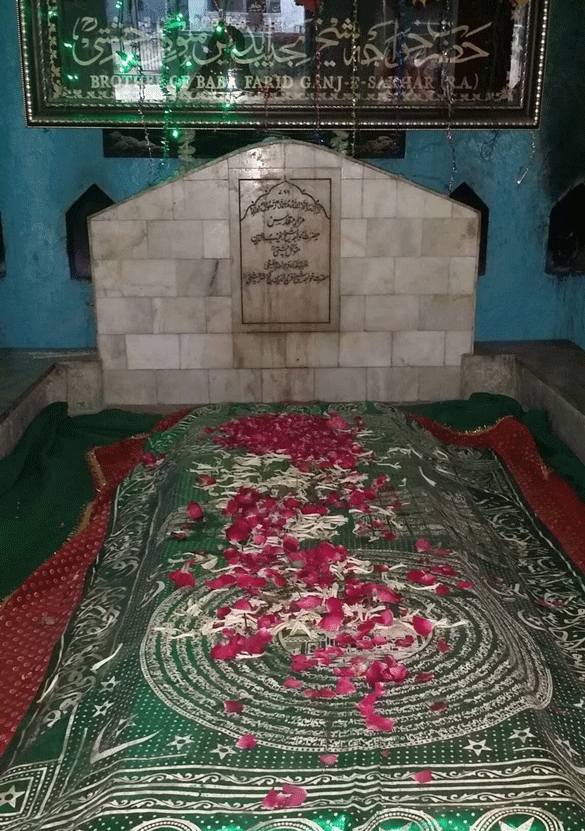
His resting place in Delhi, known as “Shaykh Najibuddin Sher-Sawaar,” remains a quiet reminder of a life lived away from noise, yet full of meaning.
Why His Life Still Matters
In today’s world, where success is often measured in wealth, visibility, and achievement, the life of Hazrat Shaykh Najibuddin Mutawakkil offers a very different perspective.
He had little, yet he lacked nothing.
He was removed from positions, yet never diminished.
He lived in hardship, yet remained at peace.
His life gently teaches that true strength lies not in control, but in trust; not in accumulation, but in letting go.
A Legacy of Faith
Hazrat Najibuddin Mutawakkil may not always be counted among the most widely known saints, but those who come across his story rarely forget him.
Because in the end, his life was not about miracles or recognition, it was about something far deeper: a heart that relied entirely on Allah, and a soul that found contentment in that reliance.
-----
Syed Amjad Hussain is an author and independent research scholar on Sufism and Islam. He is the author of 'Bihar Aur Sufivad', a bestselling research book based on the history of Sufism in Bihar.
New Age Islam, Islam Online, Islamic Website, African Muslim News, Arab World News, South Asia News, Indian Muslim News, World Muslim News, Women in Islam, Islamic Feminism, Arab Women, Women In Arab, Islamophobia in America, Muslim Women in West, Islam Women and Feminism