
Jameela Khuda Bakhsh and the Recovery of Women's Literary Heritage in Urdu

By Syed Amjad Hussain, New Age Islam
2 July 2026
This article explores the life and literary legacy of Jameela Khuda Bakhsh, highlighting her pioneering role in Urdu poetry, her connection to Azimabad's literary tradition, and her long-overlooked contribution to India's cultural heritage.
Main Points:
· Jameela Khuda Bakhsh's life and literary journey.
· Her pioneering place in the history of women's Urdu poetry.
· Her association with the Azimabad literary tradition and Shad Azimabadi.
· Her connection with the Khuda Bakhsh Oriental Public Library.
· The enduring literary and historical significance of her poetry and legacy.
Introduction
History often remembers great libraries, celebrated scholars and famous poets. Yet, hidden behind these familiar names are remarkable individuals whose contributions have quietly faded from public memory. One such figure is Jameela Khuda Bakhsh, an accomplished Urdu poet whose life brought together literature, scholarship and the rich cultural traditions of nineteenth-century India.
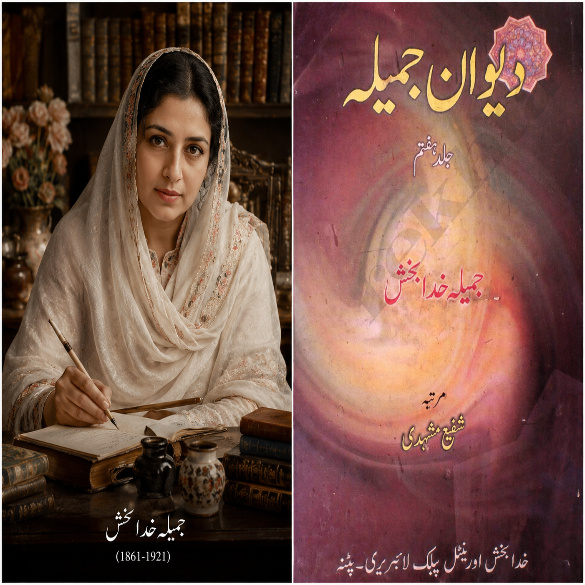
Although she lived at the heart of one of the subcontinent's most intellectually vibrant households, her own literary achievements have remained largely overlooked. Today, as scholars revisit the contributions of women to Urdu literature, Jameela Khuda Bakhsh is steadily emerging as a pioneering voice whose work deserves far greater recognition.
According to Rekhta, Jameela Khuda Bakhsh was born in Kolkata in 1861 and passed away in 1921. She was married to Maulvi Khuda Bakhsh, the visionary behind the renowned Khuda Bakhsh Oriental Public Library in Patna. More importantly, Rekhta recognises her as the first woman from Azimabad (now Patna) whose Diwan was published, a distinction that carries immense historical significance. It also records that she wrote nine collections of poetry and two masnavis, although only five poetry collections were eventually published.
These facts alone make her remarkable. But her real importance lies much deeper.
More Than a Woman Poet
It is easy to describe Jameela Khuda Bakhsh simply as an early woman poet. That, however, would be doing her a disservice.
She belonged to the respected Azimabad school of Urdu poetry, a literary tradition known for its elegance, discipline and intellectual refinement. Rekhta notes that she received guidance from the celebrated poet Shad Azimabadi, placing her firmly within the classical ustad-shagird tradition that shaped generations of Urdu poets.
In those days, becoming a recognised poet required much more than natural talent. Poetry was learnt, refined and perfected under experienced masters who carefully corrected every metre, every expression and every couplet. Jameela was part of that rigorous literary culture. Her poetry was not written in isolation; it was nurtured within one of the finest poetic traditions of its time.
A Home Where Books Were a Way of Life
Jameela Khuda Bakhsh also lived in an environment unlike any other.
Her husband, Maulvi Khuda Bakhsh, transformed his family's priceless manuscript (makhtuta) collection into what became the Khuda Bakhsh Oriental Public Library, today recognised as one of South Asia's greatest centres for rare manuscripts and Islamic scholarship.
Imagine a household where ancient manuscripts, Persian classics, Arabic texts and Urdu literature surrounded daily life. Books were not simply objects on shelves—they were part of conversation, learning and identity.
Within this extraordinary intellectual atmosphere, Jameela found her own voice.
While the library preserved centuries of knowledge, she added something equally valuable: new poetry that reflected the emotions, spirituality and literary sophistication of her age.
Breaking Barriers Through Publication
Perhaps the most extraordinary chapter of her life was the publication of her Diwan.
During the nineteenth century, very few women saw their literary works published. Many wrote poetry, but much of it remained confined to personal notebooks, family circles or handwritten manuscripts that never reached a wider audience.
Publication changed everything.
It meant that a poet's work entered the public domain, became part of literary discussion and had a chance to survive for future generations.
That is why Rekhta's description of Jameela Khuda Bakhsh as the first woman in Azimabad whose Diwan was published is so significant. It was not simply a personal achievement; it marked an important milestone in the history of women's Urdu writing.
Even more impressive is the scale of her literary output. Rekhta records that she left behind nine poetry collections and two masnavis, although only five collections were published.
This gap between what she wrote and what survives reminds us of how easily literary history can lose important voices. Countless works by South Asian writers disappeared because they were never printed, were published in limited numbers or simply faded away with time.
Jameela Khuda Bakhsh's surviving poetry therefore represents only part of a much larger creative legacy.
Poetry That Speaks Across Time
Among her surviving works, one ghazal begins with the memorable line:
"Deta hoon dil jise woh kahin bewafa na ho.
The opening immediately captures a feeling almost everyone understands—the fear of giving one's heart completely while wondering whether that trust will be broken.
From there, the ghazal moves gently through themes of longing, separation, memory and mortality. Rather than telling a straightforward story, each couplet stands on its own while contributing to a larger emotional landscape.
As the poem progresses, love gradually takes on a spiritual dimension. References to Ishq-e-Ghaus suggest that earthly affection is transforming into something deeper—an expression of mystical devotion rooted in the Sufi tradition.
This balance between human emotion and spiritual reflection is one of the defining qualities of classical Urdu poetry, and Jameela handles it with remarkable grace.
There is no unnecessary ornamentation or emotional excess. Instead, her verses rely on simplicity, precision and quiet intensity.
The World Reflected in Her Poetry
Three themes consistently emerge from her writing.
The first is trust—how fragile it can be, and how love always carries the possibility of heartbreak.
The second is mortality. Her poetry reflects an awareness that life is temporary, yet memories and emotions often outlive those who experience them.
The third is spirituality. In her ghazals, worldly love frequently merges with divine longing, echoing the influence of Sufi thought that has shaped Urdu poetry for centuries.
These themes reveal a poet who was deeply engaged with the philosophical and emotional concerns at the heart of the classical Urdu tradition.
She should not be remembered merely because she was a woman writing poetry.
She should be remembered because she wrote exceptionally well.
Why Her Story Matters Today
The rediscovery of Jameela Khuda Bakhsh is part of a broader effort to recover voices that history has allowed to fade into the background.
For too long, discussions of Urdu literature have centred almost exclusively on famous male poets and major metropolitan literary circles. Jameela's life reminds us that places like Azimabad nurtured equally rich traditions and that women actively contributed to them.
Her story also illustrates how literature survives.
Her husband's library protected manuscripts, preserved history and safeguarded knowledge.
She preserved something different but equally precious, the emotions, experiences and inner world of her generation through poetry.
Together, they left behind two complementary legacies: one built on books, the other on verse.
A Legacy Worth Rediscovering
More than a century after her death, Jameela Khuda Bakhsh continues to speak through the poems that have survived.
She was not simply the wife of a famous scholar or a footnote in the history of the Khuda Bakhsh Library.
She was a gifted poet, a respected member of the Azimabad literary tradition and one of the earliest women to achieve publication in a literary culture where such recognition was exceptionally rare.
Her surviving work reminds us that the story of Urdu literature is far richer and more diverse than conventional histories often suggest.
As researchers continue to uncover forgotten voices from the past, Jameela Khuda Bakhsh deserves to be recognised not as a marginal figure, but as an integral part of India's literary heritage, a poet whose words, despite the passage of time, still carry elegance, emotional depth and enduring relevance.
---
Syed Amjad Hussain is an author and independent research scholar with a deep interest in Sufism and Islamic history, particularly in eastern India. His work is driven by a passion for rediscovering and documenting the lives of forgotten saints and the region's rich spiritual heritage. He is the author of Bihar Aur Sufivad, a widely appreciated bestselling book that explores the history of Sufism in Bihar. Through his writing, he seeks to connect the past with the present in a meaningful and accessible manner. He is currently a student at Lovely Professional University.
Author's Note: To the best of the author's knowledge, this is the first dedicated research article on the life and literary legacy of Jameela Khuda Bakhsh.
--
Disclaimer: This is an AI-generated artistic representation. No authenticated portrait of Jameela Khuda Bakhsh is known to exist.
New Age Islam, Islam Online, Islamic Website, African Muslim News, Arab World News, South Asia News, Indian Muslim News, World Muslim News, Women in Islam, Islamic Feminism, Arab Women, Women In Arab, Islamophobia in America, Muslim Women in West, Islam Women and Feminism