
From Sheikhpura to Calcutta: The Overlooked Legacy of Urdu Journalist Shah Khalil-ur-Rahman ‘Arif’ Pachnawi

By Syed Amjad Hussain, New Age Islam
13 October 2025
Shah Khalil-ur-Rahman Arif Pachnawi, a pioneering Urdu journalist from Bihar, combined scholarship, spirituality and courage, shaping India’s literary conscience while his remarkable writings and legacy faded tragically into history’s silence.
Main Points:
1. Shah Khalil-ur-Rahman Arif Pachnawi, born in Pachna, Bihar, emerged as a leading Urdu journalist and scholar.
2. He edited major newspapers and founded Jamhur in Calcutta.
3. Spiritually inclined, he balanced intellect with faith.
4. His family faced tragedy during Bangladesh’s 1971 war.
5. Most of his writings were sadly lost.
-----
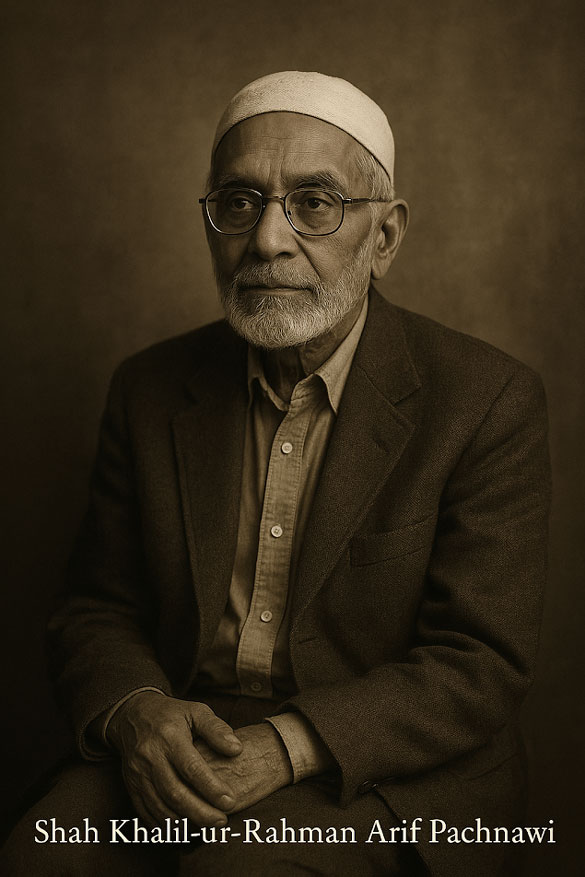
An AI-generated Image of Shah Khalil-ur-Rahman ‘Arif’
---
Introduction
From the quiet soil of Pachna, a village in Bihar’s Sheikhpura district, once rose a voice that echoed through the corridors of Urdu journalism and literature. He was born in between 1899–1901. His name was Shah Khalil-ur-Rahman Arif Pachnawi, a scholar, journalist, essayist and spiritual thinker whose life bridged three countries, several eras, and the tumult of India’s political awakening.
Today, his memory survives only in scattered references and fading anecdotes, yet his story reflects the larger saga of India’s forgotten literary pioneers.
Roots and Early Life
Shah Khalil-ur-Rahman was born in the culturally vibrant village of Pachna, then part of undivided Munger district (now Sheikhpura district, Bihar). He often signed his writings as Arif Mukhlis, a pen-name that captured both his humility and his intellect. His father, Shah Lateef-ur-Rahman, belonged to a family steeped in learning and Sufi tradition. His grandfather, the noted poet Hakeem Shah Abdul Haq ‘Saail Pachnawi’, was a respected literary voice of his time, whose verses once travelled far beyond Bihar. They are known to be the descendant of Hazrat Shaykh Shah Shuaib Firdausi Sheikhpurvi, a Sufi saint of Firdausiyya order.
In this environment of poetry, piety and scholarship, young Khalil-ur-Rahman developed a mind that would later move effortlessly between Arabic classics, English essays, and the stirring editorials of Urdu newspapers.
Recognition in the Literary World
In 1959, Professor Syed Hasan introduced Shah Khalil-ur-Rahman’s name in a special “Bihar Issue” of Sanam Patna, a respected Urdu monthly. Under the series titled “Juft Akhtar”, Professor Hasan profiled seven major literary figures of Bihar. Among those seven, the article on Professor Shah Maqbool Ahmed Pachnawi contained a detailed reference to Khalil-ur-Rahman, crediting him as one of the pioneers of Urdu journalism from Bihar.
It noted that in 1926, along with Shah Wali-ur-Rahman and Shah Afzal-ur-Rahman Jamal, he published a monthly magazine titled “Tashtari Khayal” from Patna, an early forum for thoughtful Urdu writing that combined literary creativity with social conscience.
The Making of a Journalist
From Patna, his path led naturally to journalism, a profession he pursued not for livelihood alone but as a mission. Over the years he worked with some of the most respected Urdu newspapers and journals of the country, including Madinah (Bijnor), Asr Jadid, Hind, and Azad Hind (Calcutta), among several others.
His editorial clarity and disciplined style earned him wide respect. At an age when most youngsters were still struggling with studies, the sixteen-year-old Khalil-ur-Rahman was appointed editor of the daily Madinah, Bijnor. His command over language, coupled with an instinct for fairness, made him a name to be reckoned with in the Urdu press of North India.
Scholarship and Intellectual Depth
According to Hakeem Syed Abul Fazl Islahi, Shah Khalil-ur-Rahman had studied up to the Bachelor of Arts (Graduation) in English, yet his range extended far beyond formal education. Equally at ease in Urdu, Arabic, Persian and English, he represented a rare blend of traditional and modern learning. (Ref: Tazkira Mashaheer-e-Adab Sheikhpura)
His deep knowledge of Hadith studies once brought him into an intellectual disagreement with Maulana Abdul Razzaq Malihabadi, then editor of Azad Hind, Calcutta. In time, even Maulana Malihabadi acknowledged Khalil-ur-Rahman’s interpretation as the more accurate one, a testament to his command over Islamic scholarship.
His critical insight spared none. Speaking once about Professor Abbas Ali Khan ‘Bekhud’ of Calcutta University’s Urdu Department, he remarked that the professor was “only nominally familiar with the true art of poetry and eloquence.” Such candid evaluations reflected both his uncompromising standards and his confidence as a critic.
The Spiritual Dimension
Behind the sharp intellect was a deeply spiritual man. Shah Khalil-ur-Rahman had taken spiritual allegiance (Bay’at) with Hazrat Maulana Syed Shah Muhammad Fazl, grandfather of Hakeem Abul Fazl Islahi. This spiritual bond shaped his inner world, giving his writing a calm depth that came from faith rather than rhetoric. Those who met him often recalled his composed presence — the serenity of a scholar who had seen both power and pain yet remained inwardly content.
The Calcutta Years
Calcutta became his second home and his field of work for many years. There he served at institutions such as the N. Barnabas High School and the Imtinan Daily, where he taught and wrote simultaneously. He trained students in Arabic and Urdu and was known for his disciplined yet affectionate teaching style.
An interesting incident from these years involved a debate with the noted progressive poet Parvez Shahidi. The argument, centred on a religious issue, led Shah Khalil-ur-Rahman to challenge Shahidi to a poetic contest. But the younger poet, out of regard for the elder’s stature, withdrew and apologised, a rare gesture that revealed the quiet respect Khalil-ur-Rahman commanded across ideological divides.
A Voice Against Colonial Rule
When the Muslim League launched its own newspaper from Patna, Barrister Abdul Aziz invited Shah Khalil-ur-Rahman to take charge as its editor. Later, from Calcutta, he founded his own paper titled Jamhur.
True to its name, Jamhur (meaning “the people”) was a paper of principle, fiercely independent and openly critical of British rule. His writings supported the Indian freedom movement at a time when doing so invited persecution. Eventually, the colonial government reprimanded him, forcing the closure of his newspaper. Yet the experience only strengthened his belief that journalism must serve truth, not power.
The East Pakistan Chapter and Personal Loss
In his later years, Shah Khalil-ur-Rahman moved with his family to East Pakistan (present-day Bangladesh). He had six children, four daughters and two sons. His elder son, Shah Hamid-ur-Rahman, served as a minister of Ameen Jute Mills and a C.E.M.B.A.N. officer in the government of East Pakistan.
When the 1971 Bangladesh Liberation War broke out, tragedy struck. Shah Hamid-ur-Rahman and his wife were martyred during the chaos of civil conflict. The rest of the family survived only through the compassion of a few kind-hearted Bengali Muslims who helped them reach Karachi, where Shah Khalil-ur-Rahman’s wife later passed away.
His younger son, Dr Shah Zahid-ur-Rahman, pursued medicine and eventually settled in an Arab country, though the family retained Pakistani citizenship. The daughter who had remained in Calcutta also passed away in later years, closing yet another chapter of the family’s once-vibrant life.
A Lost Literary Treasure
What remains of Shah Khalil-ur-Rahman’s literary output today is painfully little. His grandson, Shah Abdul Wahhab, recalled to Abul Kalam Rahmani that as a child he saw his grandfather write frequently, but no manuscripts were preserved. “He loved poetry and prose alike,” he said, “yet never kept his own work. Whatever writings existed were taken away by my younger uncle while he was in East Pakistan, and they were lost forever.” (Ref: Tazkira Mashaheer-e-Adab Sheikhpura)
Professor Shah Maqbool Ahmed Pachnawi, a close relative and fellow scholar, later remarked that Shah Khalil-ur-Rahman was “a high-class essayist and translator” whose unpublished writings could have greatly enriched Urdu prose. His ability to translate effortlessly between Urdu, Arabic, Persian and English was widely admired; indeed, he was the person who first introduced Dr. Abdul Rauf (later Reader, Urdu Department, Calcutta University) to the discipline of translation.
Between 1948 and 1950, a long and controversial article of his appeared in Nigar, the Lucknow monthly edited by Allama Niaz Fatehpuri. Unfortunately, despite extensive searching, even the National Library of Calcutta no longer holds that issue, a sobering reminder of how easily India’s literary heritage can vanish into oblivion.
Legacy and Significance
To rediscover Shah Khalil-ur-Rahman Arif Pachnawi is to rediscover a forgotten phase of Urdu’s journey in India, a phase when journalists were also philosophers, poets, and patriots. His life mirrored the story of an entire generation that lived through colonialism, Partition, and migration, yet never lost faith in the written word.
He represented the union of intellect and integrity, a scholar who could challenge orthodox thought, a journalist who would not bend before authority, and a mystic who remained humble despite his brilliance.
Though none of his writings survive, the testimonies of those who knew him, scattered across journals and oral memories, still speak of a man who shaped ideas quietly, without craving recognition.
Conclusion: A Name Worth Remembering
In the grand history of Urdu journalism, Shah Khalil-ur-Rahman Arif Pachnawi deserves remembrance not merely as a writer but as a conscience-keeper of his time. His editorials once stirred public thought; his debates sharpened intellect; his moral courage inspired younger journalists.
That his manuscripts are lost is a tragedy, but perhaps his true legacy lies elsewhere, in the idea that words, when written with faith and conviction, outlive even their author.
From Pachna’s modest lanes to Calcutta’s bustling pressrooms, from the fires of Partition to the silence of Karachi, his journey tells us something enduring: that truth, once spoken sincerely, remains immortal, even when the writer’s name fades into dust.
References:
Tazkira Mashaheer-e-Adab Sheikhpura by Abul Kalam Rahmani (Kolkata).
Sanam (Patna) Bihar Issue 1959
Accounts from different people of Pachna, Sheikhpura and Kolkata.
----
Syed Amjad Hussain is an author and Independent research scholar on Sufism and Islam. He is the author of 'Bihar Aur Sufivad', a bestselling research book based on the history of Sufism in Bihar.
Note: This is the first-ever research article available about Shah Khalil-ur-Rahman ‘Arif’ on the Internet.
URL: https://www.newageislam.com/islamic-personalities/legacy-urdu-journalist-shah-khalil-arif/d/137209
New Age Islam, Islam Online, Islamic Website, African Muslim News, Arab World News, South Asia News, Indian Muslim News, World Muslim News, Women in Islam, Islamic Feminism, Arab Women, Women In Arab, Islamophobia in America, Muslim Women in West, Islam Women and Feminism