
From Delhi to the Subcontinent: The Enduring Spiritual Footprint of Hazrat Shaykh Ruknuddin Firdausi

By Syed Amjad Hussain, New Age Islam
29 November 2025
Hazrat Shaykh Ruknuddin Firdausi was one of the defining spiritual figures of fourteenth-century Delhi. As the founder of the Firdausi Sufi order in India and the initiator of the formal Urs tradition.
Main Points:
1. Hazrat Shaykh Ruknuddin Firdausi grounded the Firdausi order in Delhi, shaping India’s early Sufi landscape.
2. His spiritual training under Shaykh Badruddin defined his authority.
3. The Khanqah in Kilokhri, Delhi became a major centre of learning.
4. He formalised the Urs tradition in India.
5. His Khalifas spread his teachings across India.
----
Introduction
Hazrat Shaykh Ruknuddin Firdausi emerged as one of the most influential spiritual figures of fourteenth-century India, a time marked by intense religious and mystical activity. Born into a deeply learned household as the son of Hazrat Shaykh Imaduddin Dehlvi, he combined scholarly discipline with profound spiritual insight from an early age. Under the guidance of Hazrat Shaykh Syed Badruddin Samarqandi Summa Dehlvi one of the esteemed group of twenty-two saints (22–Khwaja Ki Chaukhat) whose collective presence defined Delhi’s Sufi identity he advanced from conventional learning to a refined spiritual understanding.
Among his most far-reaching contributions was the establishment of the Urs tradition, the organised commemoration of a saint’s passing. This practice, which began under him, transformed the way Indian Muslim communities remembered their spiritual masters. His settlement at Kilokhri along the Yamuna’s sacred waters provided a structured model for Sufi teaching, strengthening the foundations of the Firdausi order. The order later expanded widely through successive Khalifas, especially Hazrat Shaykh Sharfuddin Ahmed Yahya Maneri, who guided an enormous following.
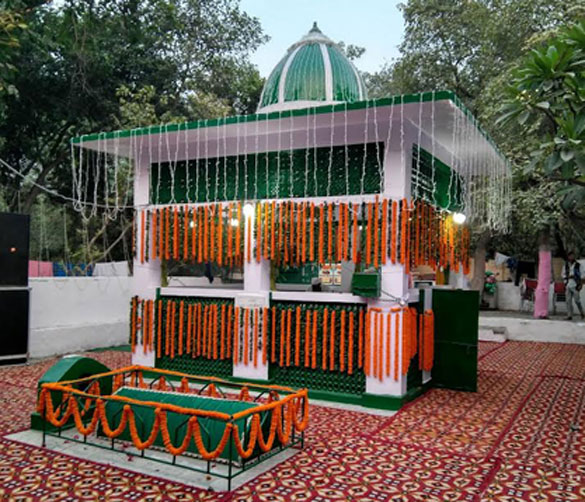
His shrine in Kilokhri, Delhi continues to draw devotees, reflecting nearly seven centuries of uninterrupted reverence for a saint whose influence helped shape Indian Sufi culture.
Early Life and Family Background
Hazrat Shaykh Ruknuddin Firdausi was born in Delhi during the reign of Sultan Muhammad bin Tughlaq, into a household known for religious scholarship and spiritual depth. His father, Hazrat Shaykh Imaduddin Dehlvi, was a respected Islamic scholar, and the family enjoyed high standing within Delhi’s learned circles. It is said that his was connected to the Prophet Muhammad Mustafa Sallallahu Ta'aala Alayhi Wassallam, strengthening his spiritual authority in the eyes of his contemporaries.
Growing up in the early Sultanate era, he witnessed Delhi’s transformation into a vibrant centre of Sufi activity, attracting scholars and saints from across the Islamic world. His stepbrother and successor, Hazrat Shaykh Najibuddin Firdausi, shared similar spiritual inclinations, and the two would later play central roles in the formation of the Firdausi order in India.
His upbringing combined firm religious discipline with exposure to Delhi’s thriving spiritual environment. Unlike many saints of his era who preferred solitude, he chose to remain actively involved in the city’s busy religious life, indicating his preference for accessible, community-based spiritual guidance. His father’s influence was decisive, grounding him in Islamic jurisprudence, Qur’anic sciences and disciplined spiritual practice. This foundation prepared him for the extraordinary spiritual journey he would undertake.
Spiritual Master and Bay‘ah
A turning point in his spiritual journey came when he encountered Hazrat Shaykh Syed Badruddin Samarqandi Dehlvi, one of Delhi’s most respected Sufi teachers. Hazrat Badruddin, who maintained his Khanqah at Firozshah Kotla, had brought with him the Firdausi teachings from Samarqand, blending Central Asian and Indian spiritual traditions.
When Hazrat Shaykh Ruknuddin pledged Bay’Ah (spiritual allegiance) to him in the Firdausiyya order of Sufism, he underwent a complete transformation, dedicating himself entirely to the discipline and guidance of his master. Recognising his exceptional spiritual potential, Hazrat Shaykh Badruddin bestowed upon him the title “Firdausi,” meaning one destined for the highest spiritual realms. Hazrat Shaykh Ruknuddin became the first Indian-based saint to formally adopt and spread this title, thereby laying the foundations of the Firdausi order in India.
His apprenticeship under Hazrat Shaykh Badruddin was rigorous and long-lasting. He mastered the esoteric sciences of Islam, absorbed the mystical interpretation of the Quran Shareef, and trained in the spiritual practices of the Firdausi Sufi order. Through this period of intense discipline, he attained high spiritual ranks and eventually received Khalifat, authorising him to guide others.
Khalifat and Spiritual Authority
After receiving khalifat, Hazrat Shaykh Ruknuddin Firdausi became one of the principal figures responsible for planting the Firdausi Sufi order in India. Along with his stepbrother Hazrat Shaykh Najibuddin Firdausi, he was among the earliest khalifas chosen to carry forward the mission of Hazrat Shaykh Badruddin.
His authority rested on both deep spiritual realisation and strong scholarly grounding. He was well versed in Fiqh, Hadith, Tafseer and the inner sciences of Tasawwuf. Because of this, he attracted nobles, scholars, traders, ascetics and ordinary people alike. He upheld a disciplined approach that balanced strict adherence to Islamic law with profound mystical understanding.
One of his most distinctive strengths was his ability to tailor spiritual practices to a disciple’s personal temperament. This personalised method became a hallmark of the Firdausi Sufi order and distinguished it from more rigid Sufi traditions of the period.
Settlement at Kilokhri and Establishment of the Khanqah
Recognising the need for an organised centre for the Firdausi order, Hazrat Shaykh Ruknuddin Firdausi first stayed in Gayaspur (modern-day Nizamuddin) before relocating to Kilokhri, situated on the sacred bank of the Yamuna, about 15 kilometres from Delhi Junction. The choice of location was deliberate, as the river carried long-established associations with purity and spiritual renewal.
At Kilokhri he built a khanqah that served simultaneously as a teaching centre, retreat space, community hub and rest house for travellers. Its architecture reflected spiritual intention: a central courtyard for collective worship, small meditation cells for retreats, a library of Islamic and Sufi texts, and residential quarters for his family and disciples.
The khanqah welcomed people from every walk of life. Supported by Waqf endowments, it functioned independently without relying on royal patronage, though he maintained respectful relations with the Sultanate. Life at Kilokhri followed a disciplined rhythm of prayer, lessons, zikr, meditation and evening gatherings where he explained ethical practices and spiritual insights. The structured curriculum he introduced guided disciples from cleansing of the heart to experiential knowledge of the Divine.
Before long, Kilokhri became a thriving centre of spiritual activity and a model for later Firdausi institutions.
The Urs Tradition and the Visit of Hazrat Nizamuddin Auliya
One of his greatest contributions was the formal establishment of the Urs tradition. Before him, remembrance gatherings were modest and unstructured. He transformed them into organised events featuring Qur’anic recitation, Manqabat (devotional poetry), Langar and collective remembrance of the saint’s teachings. This model rapidly spread across the Indian subcontinent and remains central to the culture of Dargahs today.
A well-known incident from an early Urs at Kilokhri highlights his standing. Hazrat Nizamuddin Auliya visited the Khanqah to offer respect. Hazrat Shaykh Ruknuddin’s mother, renowned for her piety, glimpsed Hazrat Nizamuddin from within purdah and remarked that this young disciple would one day become the spiritual guide of Delhi. Her words proved accurate, as Hazrat Nizamuddin Auliya later emerged as the leading saint of the city. The episode reflects the close bonds among Delhi’s great Sufi masters and the high regard in which Hazrat Shaykh Ruknuddin was held.
Disciples and Khalifa Succession
Hazrat Shaykh Ruknuddin Firdausi trained a large circle of disciples at Kilokhri, granting Khalifat only to those who demonstrated genuine spiritual maturity. His stepbrother, Hazrat Shaykh Najibuddin Firdausi, became his foremost khalifa and helped develop the early structure of the order.
Many other Khalifas later carried Firdausi teachings to distant regions including Bihar, Bengal and Gujarat turning the movement into a widespread spiritual network. The most influential successor was Hazrat Shaykh Sharfuddin Ahmed Yahya Maneri, who developed Bihar Sharif, in the Nalanda district of Bihar into a major Firdausi centre. With more than one lakh disciples and 313 Khalifas under him, he played a crucial role in expanding the order.
This chain of carefully trained successors ensured that the teachings transmitted by Hazrat Shaykh Ruknuddin remained intact for generations.
Death, Legacy and Shrine Veneration
Hazrat Shaykh Ruknuddin Firdausi passed away around 761 Hijri (1359–1360 CE) after decades of guiding seekers at Kilokhri. He was buried at the Khanqah, and the site soon became known as Dargah Sharif. The shrine continues to attract pilgrims who participate in the annual Urs, take part in Langar, recite the Quran Shareef, attend zikr gatherings and experience the spiritual atmosphere that has surrounded the place for centuries.
His greatest legacy is the Urs tradition he formalised, a practice now central to almost every major Sufi shrine in India. Historians regard him as a pioneer who helped transform Sufism in India from scattered individual masters into structured, enduring institutions. His inclusive approach, welcoming people from every background, became one of the hallmarks of the Firdausi Sufi order.
Conclusion
Hazrat Shaykh Ruknuddin Firdausi stands among the most consequential spiritual leaders of medieval India. Through the establishment of the Kilokhri Khanqah, the formalisation of the Urs tradition, the systematic training of Khalifas and a deep commitment to accessible spiritual guidance, he created a model that has survived for nearly seven centuries.
His standing among contemporaries, including the recognition he received from Hazrat Nizamuddin Auliya, reaffirmed his rank as a leading figure in Indian Sufism. Even today, the Kilokhri Dargah remains a place of solace for devotees seeking blessing and spiritual connection, reflecting his enduring belief that the presence of a saint bridges the earthly and the divine, linking individuals to community and community to a higher reality.
----
Syed Amjad Hussain is an author and Independent research scholar on Sufism and Islam. He is the author of 'Bihar Aur Sufivad', a bestselling research book based on the history of Sufism in Bihar.
URL: https://www.newageislam.com/islamic-personalities/delhi-spiritual-hazrat-shaykh-ruknuddin/d/137810
New Age Islam, Islam Online, Islamic Website, African Muslim News, Arab World News, South Asia News, Indian Muslim News, World Muslim News, Women in Islam, Islamic Feminism, Arab Women, Women In Arab, Islamophobia in America, Muslim Women in West, Islam Women and Feminism