
A Saint and His Institution: Reassessing Hazrat Shah Kabiruddin Ahmad Darvesh and The Khanqah of Sasaram

By Syed Amjad Hussain, New Age Islam
9 April 2026
Hazrat Shah Kabiruddin Ahmad Darvesh’s life traces a journey from Baghdad to Sasaram, blending faith, lineage, and quiet influence, as his khanqah grew into a lasting centre of spiritual and social life.
Main Points:
· Hazrat Shah Kabiruddin’s lineage connects him to Abdul Qadir Jilani, shaping his spiritual identity.
· His migration from Baghdad reflects wider Sufi movements into India.
· His simple, devoted life earned deep respect locally.
· Mughal patronage helped strengthen the khanqah.
· The institution grew into a lasting centre of faith and community.
Introduction
History often remembers Sufi saints as distant, almost untouchable figures, wrapped in reverence and legend. But behind that reverence are real lives shaped by movement, struggle, faith, and the world around them. Hazrat Shah Kabiruddin Ahmad Darvesh is one such figure, whose story unfolds not just as that of a spiritual guide, but as someone who helped shape a living institution in Sasaram during a changing phase of Indian history.
What we know about him comes largely from family records, khanqah documents, and local tradition. These sources may not always meet modern historical standards, but they carry something equally important: continuity of memory. When read carefully, they reveal a figure deeply rooted in both spirituality and society.
A Lineage that Carried Meaning
Hazrat Shah Kabiruddin’s identity is closely tied to his lineage, which is traced back to the great Sufi master Hazrat Shaykh Abdul Qadir Jilani of Baghdad. In the world he lived in, this was not just a matter of ancestry, but of meaning.
To be linked to such a towering spiritual figure gave a sense of belonging to a much larger tradition. It connected a local khanqah in Bihar to a wider spiritual world that stretched across regions and generations. For followers, this lineage was a source of trust; for the institution, it was a foundation of legitimacy.
From Baghdad to Hindustan
Like many Sufis before him, Hazrat Shah Kabiruddin is said to have travelled from Baghdad to the Indian subcontinent. The exact date of his arrival is not known, but the timing places him in the early eighteenth century, when the Mughal Empire was still powerful, yet beginning to show signs of strain.
He eventually settled in Bihar's Sasaram, a place already known for its historical importance. Situated along important routes, it was a town where people, ideas, and cultures crossed paths. For a Sufi, it was the kind of place where a spiritual centre could quietly grow into something meaningful.
Here, he established his khanqah and chose a life that was simple, disciplined, and deeply focused on faith.
A Life of Simplicity and Devotion
Accounts of Hazrat Shah Kabiruddin describe him as someone who kept himself away from worldly distractions. He devoted his time to prayer, reflection, and spiritual discipline. There is a certain pattern in how such lives are remembered, but that does not make them any less significant.
What stands out is that his simplicity did not make him invisible. In fact, it drew people towards him. There is something about a person who genuinely seems uninterested in power or wealth that makes others trust them more. His influence grew not because he sought it, but because people recognised something steady and sincere in him.
The Meeting with Emperor Farrukhsiyar
One of the most striking episodes linked to Hazrat Shah Kabiruddin is his interaction with the Mughal emperor Farrukhsiyar in 1717. According to the records, the emperor visited him with respect and offered a jaagir of large estate as a royal grant.
Shah Kabiruddin refused
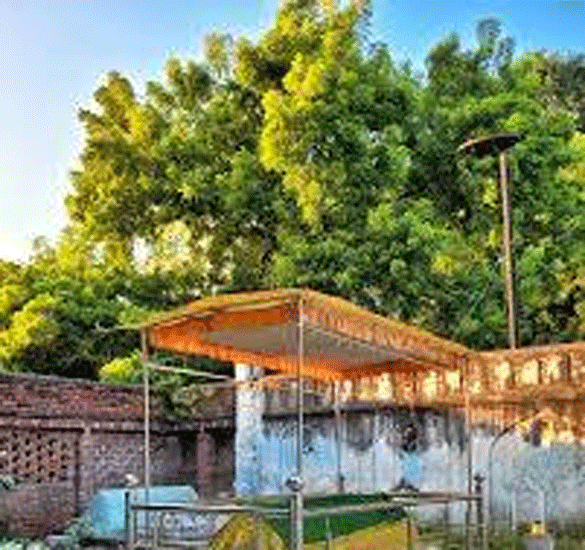
It’s the kind of moment people like to repeat, because it says something powerful without needing much explanation. A man who turns down wealth from an emperor immediately stands apart. But the story does not end there. The emperor’s envoy was instructed not to leave until the grant was accepted, and even today, it is said that his grave lies within the dargah complex.
After Hazrat Shah Kabiruddin’s passing, his son Hazrat Shah Khalilullah accepted the grant. It was a practical decision. Ideals can build respect, but institutions need resources to survive. With that acceptance, the khanqah entered a new phase, one where it could serve people in more lasting ways.
Setting the Record Straight
Over time, claims and confusions tend to attach themselves to historical figures. In this case, the preserved records clearly state that Hazrat Shah Kabiruddin had no familial connection with Shah Burhan Diwaan Firdausi. Such clarifications may seem minor, but they matter when lineage and identity are involved.
The records also make it clear that the royal grants associated with this khanqah were independent and should not be mixed with those linked to other individuals. Old documents and later legal confirmations continue to support this distinction.
After Him: A Living Institution
Hazrat Shah Kabiruddin had three sons: Hazrat Shah Khalilullah, Hazrat Shah Khairullah, and Hazrat Shah Ahlullah. After his death, Hazrat Shah Khalilullah took on the responsibility of the khanqah. Although he did not have a male heir, the line of succession continued through the extended family.
Leadership passed to Hazrat Shah Sharafuddin, the son of Hazrat Shah Khairullah and also the son-in-law of Hazrat Shah Khalilullah. This blending of family ties shows how such institutions adapted to circumstances, ensuring continuity without breaking tradition.
In the generations that followed, figures like Hazrat Shah Qayamuddin carried the legacy forward. He lived during the time of the Mughal emperor Shah Alam II, who is also said to have shown deep respect towards the khanqah and offered further support in 1762. References to this period appear in historical writings such as Sair-ul-Muta’akhirin, suggesting that the institution remained visible and relevant.
Growth Beyond a Spiritual Space
As time passed, the khanqah grew into more than a place of worship. It became a centre of learning, support, and community life. Successive custodians contributed to its development, and physical structures were added, including a notable stone building for a madrasa.
Located along the historic Sher Shah Suri Road, the khanqah became a familiar sight for travellers. It stood not just as a religious space, but as a reminder of continuity in a world that was constantly changing.
A Changing World Around It
The eighteenth century was a period of transition. The Mughal Empire was weakening, and authority was shifting in different directions. In such times, institutions like khanqahs often became anchors for local communities.
They offered guidance, stability, and a sense of order when political structures were uncertain. The story of Hazrat Shah Kabiruddin and his successors fits into this larger pattern, where spiritual centres quietly took on wider social roles.
Conclusion
Hazrat Shah Kabiruddin Ahmad Darvesh was not just a figure of devotion remembered in isolation. He was part of a living world, responding to its realities while holding on to a spiritual path. His lineage connected him to a wider tradition, his migration placed him within a changing India, and his khanqah became an institution that outlived him.
What remains is not only a story of faith, but of continuity. A life that began in detachment helped build something that stayed deeply connected to people.
----
Syed Amjad Hussain is an author and independent research scholar on Sufism and Islam. He is the author of 'Bihar Aur Sufivad', a bestselling research book based on the history of Sufism in Bihar.
New Age Islam, Islam Online, Islamic Website, African Muslim News, Arab World News, South Asia News, Indian Muslim News, World Muslim News, Women in Islam, Islamic Feminism, Arab Women, Women In Arab, Islamophobia in America, Muslim Women in West, Islam Women and Feminism