
A Dargah Built by Hindus, Revered by All: The Enduring Legacy of Pir Nargin Shah

Syed Amjad Hussain, New Age Islam
5 March 2026
In rural West Bengal's Bankura, a 400-year-old Urs at Nargin Shah’s riverside dargah brings Hindu and Muslim families together each Magh, reflecting generations of shared faith, trust and quiet communal harmony.
Main Points:
· The 400-year-old Urs at Nargin Shah’s dargah is held every first Thursday of Magh in Birshinghpur, Bankura.
· The shrine was built with support from local Hindus in a predominantly Hindu village.
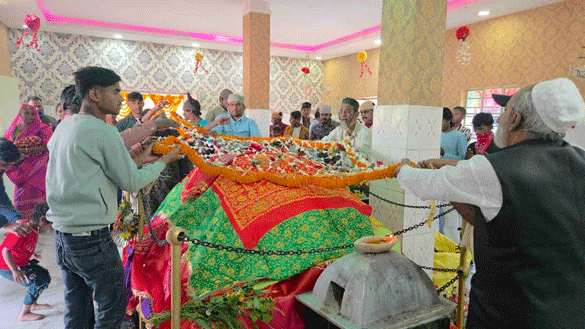
· Hindu and Muslim devotees jointly offer chadars and prayers.
· The dargah committee includes members from both communities.
· The annual riverside mela strengthens social bonds, reflecting generations of lived communal harmony.
Introduction
Four hundred years is a long time for anything to survive in the subcontinent. Empires fall. Administrations change. People argue over everything from politics to tea. And yet, on the banks of a quiet river in rural Bengal, a shared tradition simply continues.
Where the River Remembers
In Bankura district’s Onda block, in the village of Birshinghpur, a modest dargah stands beside the Dwarakeswar River. It is dedicated to Pir Nargin Shah, a Sufi saint believed to have lived nearly four centuries ago.
Each year, on the first Thursday of the month of Magh, this riverside shrine becomes the heart of something far bigger than itself. The Urs of Nargin Shah draws men, women and children from distant villages and nearby towns. They arrive not as representatives of “communities”, but as families, neighbours, believers and hopeful hearts.
In an era when the word “communal” is too often followed by “tension”, Birshinghpur quietly offers a different sentence.
Two Saints, One Settlement
Local accounts passed down through generations tell of two Sufi saints — Makhdoom Shah and Nargin Shah — who travelled from Bihar to Birshinghpur centuries ago. They came not with armies or influence, but with the quiet intention of spiritual teaching.
At the time, the area was under the rule of the Bardhaman Raj. A local revenue officer, Surjakanta (Suryakant) Dey, is said to have granted the saints a piece of land along the Dwarakeswar River for meditation and prayer. It was a simple act, but one that would echo through centuries.
When Nargin Shah passed away, he was buried at that very spot. What followed is what gives this story its emotional weight. The dargah built over his grave was constructed with the involvement and support of local Hindus, in what remains a predominantly Hindu area.
No dramatic declarations. No grand speeches. Just a shared sense that a holy man deserved a resting place.
The Meaning of Urs Here
In Sufi tradition, an Urs marks the death anniversary of a saint, seen not as an end, but as a union with the Divine. In Birshinghpur, the day is observed with reverence and warmth.
Devotees bring chadars to offer at the mazar. They bow their heads, close their eyes, and whisper prayers. Some come seeking relief from illness. Others come for employment, marriage, peace at home, or simply gratitude for a prayer already answered.
Arnab Das, standing in the queue with folded hands, put it simply: “Baba is powerful. Hindus and Muslims both come here. Whoever asks with faith, their wish is fulfilled.”
There is no theological debate at the entrance. Only belief.
A Fair by the River
The Urs is not confined to ritual. On that day, the riverbank transforms into a mela. Stalls sell sweets, toys, bangles and snacks. Children tug at their parents’ hands. Elderly villagers sit together discussing harvests, weather and memories of earlier Urs celebrations.
Anup Roy, a member of the dargah committee, explains that the committee itself includes both Hindu and Muslim members. The arrangements for the Urs and the mela are made jointly. Responsibilities are shared. Decisions are collective.
It is not presented as an “initiative”. It is simply how things are done.
Threads of History
The imam of the dargah masjid, Shaykh Ghulam Mustafa, recalls another layer of the region’s past. When the two saints arrived, the area was known for its community of weavers. Cloth woven here was said to be used during the Mughal period for turbans worn by emperors.
That detail adds texture to the story. Birshinghpur was not an isolated settlement. It was part of wider networks of craft, trade and culture. Sufi saints often found a natural connection with artisan communities, where spirituality blended easily with everyday labour.
The shrine, then, is not just a religious site. It is part of the social history of the region.
A Majority-Hindu Village, A Shared Shrine
It is important to understand that this is not an area transformed by demographic shifts. Birshinghpur remains largely Hindu. Yet, year after year, Hindu families line up to offer chadars at a Muslim saint’s dargah.
This is not conversion. It is connection
In many parts of South Asia, Sufi shrines have historically functioned as shared sacred spaces. People come not because they are asked to abandon their identity, but because they feel heard there.
In Birshinghpur, that shared sacredness has lasted generations.
Beyond Headlines
It would be easy to romanticise the Urs as a perfect symbol of unity. Reality is rarely that tidy. Differences exist. Opinions vary. Politics intrudes into everyday life.
And yet, every Magh, on the first Thursday, people still gather by the Dwarakeswar River. They stand shoulder to shoulder. They tie threads of hope to the same space. They organise the same mela. They remember the same saint.
Four centuries of continuity suggest something deeper than symbolism. They suggest habit, trust and inherited respect.
In a world that often magnifies division, Birshinghpur offers something quieter and perhaps stronger, a lived tradition of shared belonging.
On that riverbank, under winter skies, faith is less about labels and more about longing. And for one day each year, the village reminds itself that harmony does not require perfection. It only requires participation.
--
Syed Amjad Hussain is an author and independent research scholar on Sufism and Islam. He is the author of 'Bihar Aur Sufivad', a bestselling research book based on the history of Sufism in Bihar.
New Age Islam, Islam Online, Islamic Website, African Muslim News, Arab World News, South Asia News, Indian Muslim News, World Muslim News, Women in Islam, Islamic Feminism, Arab Women, Women In Arab, Islamophobia in America, Muslim Women in West, Islam Women and Feminism