
Sufi Saints of Kerala

By Sahil Razvi, New Age Islam
31 July 2026
In Kerala the Sufi saints carried forward a quiet but steady message of unity and love by living among the people and responding to their everyday troubles with care. They opened their places of guidance to whoever came seeking help, offered healing and counsel without first checking the community, and treated human suffering as something that belonged to everyone. That simple approach left a lasting mark on the social life of the region.
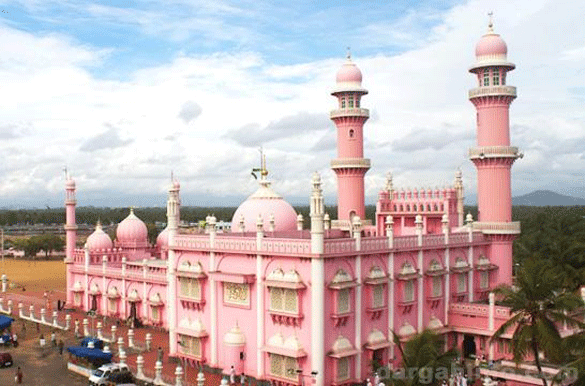
One of the most visited shrines is the Beemapally Dargah Shareef near Thiruvananthapuram. It houses the tomb of Syedunnisa Beema Beevi, remembered for her spiritual powers, along with that of her son. The annual Uroos, also known as the Chandanakudam Mahotsavam, draws thousands of pilgrims from every background. Hindus form a large part of the crowd. They come with vows for health, family matters or relief from long-standing troubles, and many return year after year after finding comfort. The festival atmosphere mixes devotion, shared food and local customs in a way that feels natural rather than arranged. Local reports and tourism accounts consistently note that people of all faiths and castes take part, turning the shrine into a living space of common hope.
The earliest and most celebrated work in Kerala’s Sufi literary tradition is the Muhyiddin Mala, a devotional poem that praises the life and miracles of the eleventh-century Baghdad-based Sufi saint Shaykh Hazrat Abdul Qadir Jilani, the founder of the Qadiriyya order. Drawing inspiration from Arabic works such as Bahja and Tahmila, as well as Tamil compositions like the fifteenth-century Muḥyiddin Andavar Mala, the poem was composed in 1604 by Qaḍi Muhammad of Kozhikode. Its immense popularity played a crucial role in spreading the Qadiriyya order throughout the Malabar region.
The Muḥyiddin Mala was widely recited in households and at family gatherings. The ability to read it was regarded as a sign of literacy, while memorizing it was traditionally considered an important accomplishment for young women before marriage. Its recitation on special occasions was also believed to bring divine blessings by protecting against illness, relieving poverty, and easing sorrow. More broadly, the popularity of malas reflects the growth of Kerala’s Sufi traditions, as different Sufi lineages used these devotional compositions to preserve and transmit their spiritual heritage
According to the website Sacred Footsteps, Syed Ismail Bukhari and his son, Syed Fakhruddin Bukhari, played a significant role in the growth and prosperity of the Muslim community in Kochi through their religious teachings and exemplary lives. Their shrine, situated near the mosque, remains a place of local reverence and is frequently visited by devotees. The shrine complex features an antechamber leading to two interconnected burial chambers, which house their respective tombs. Built in the traditional local architectural style, the shrine is a modest yet elegant structure with stone walls and a wooden roof covered with terracotta tiles.
Imam Ahmad Raza Khan’s poetry, filled with intense and pure love, often captured the kind of devoted heart that refuses to close itself off. One sentiment that runs through his verses is the complete absorption in love that softens the self and opens it toward others:
Lam Yaati Nazeeruka Fi Nazarin Misle To Na Shud Peda Jaanaa
Jag Raaj Ko Taaj Tore Sar So Hai Tujh Ko Shahe Dosra Jaanaa
(Your equal has not come in any sight, a like of you has not been born,
The crown of the world’s kingdom only suits your head, we know you as the King of both the worlds.)
This feeling of boundless love matches the open welcome found at Beemapally.
Further north in Malappuram district stands the makham of Sayyid Alavi Thangal, known widely as Mamburam Thangal. He was a spiritual guide and scholar whose life centred on teaching, healing and standing with ordinary people during difficult times. His presence became a source of strength for many in the Malabar region.
On islamonweb.net, Dr. Muneer Hudawi Mavoor writes: "Many mosques across Kerala are named after renowned Sufi masters such as Muhyiddin Abdul Qadir Jilani, Shaykh Rifa'i, and Shaykh Abul Hasan Shadhili. These are commonly known as Muhyiddin Masjid, Rifa'i Masjid, and Shadhili Masjid, respectively. The popularity of the name Muhyiddin for newborn boys and Rabi'a for newborn girls also reflects the profound influence of Sufi saints on the lives of Kerala's Muslims."
Historical notes from older records mention that the tomb attracted respect from Hindus as well as Muslims. In more recent years the annual observances at the makham have been described as occasions of communal harmony, with people from different communities joining in remembrance and shared meals. Local accounts present the shrine as a place where the older spirit of mutual regard continues.
The saints of Kerala spread their message less through long lectures and more through consistent action. At Beemapally the reputation of Beema Beevi for miraculous help drew people who needed relief, regardless of the faith they practised at home. At Mamburam the Thangal’s counsel and healing presence created a similar pull. Across Malabar, various Thangal lineages and local pirs maintained centres where spiritual guidance went hand in hand with practical support. Research on Sufi traditions in the region notes that these practices helped foster a sense of inclusiveness, emphasising common human values over rigid divisions.
Another expression of the same devoted love appears in Hazrat Imam Ahmad Raza’s poetry:
Al-Bahru Alaa Wal Mawju Tagaa Man Be Kas o Tufaa(n) Hosh Rubaa
Manjhdhaar Mai Hu Bigri Hai Hawaa Mori Nayya Paar Lagaa Jaanaa
(The Sea has risen and the waves are oppressive, I am helpless and the storm is breathtaking
I am in a whirlpool and the winds are enraging, take my boat and place it at shore.)
Even today the pattern remains clear. At Beemapally large numbers of Hindu devotees continue to join the Uroos and visit throughout the year with personal requests. At Mamburam and other smaller makhams in Malabar, people from Hindu families still come for blessings, for quiet prayer, or to fulfil vows. The visits are not formal statements; they are ordinary acts of trust in the saint’s baraka. Festival reports and local observations repeatedly describe mixed crowds that treat the shrines as shared spaces rather than exclusive ones.
Scholars who have studied the religious life of Kerala have taken note of this quality. Writings on the Mappila community and Malabar Sufism observe that the emphasis on spiritual openness and service helped create a more inclusive social atmosphere. Accounts of the Mamburam observances specifically highlight the shrine’s role as a symbol of communal harmony in recent decades. Older records also noted instances of cross-community respect at certain tombs. These observations together point to a consistent pattern: the saints’ focus on love expressed as practical care left room for people of different backgrounds to meet without friction.
What stands out is the everyday nature of the unity these figures encouraged. They did not try to erase differences. They simply refused to let those differences decide who could receive help or sit in the same courtyard. Beema Beevi’s shrine and Mamburam Thangal’s makham continue to show the result of that choice. Devotees arrive with their own burdens and leave with a sense that someone has listened. The same quiet hospitality appears at other local centres maintained by Thangal families and village pirs across the state.
…
A regular contributor to New Age Islam, Sahil Razvi is a research scholar specialising in Sufism and Islamic History. He is an alumnus of Jamia Millia Islamia.
URL: https://newageislam.com/islamic-personalities/sufi-saints-kerala/d/141016
New Age Islam, Islam Online, Islamic Website, African Muslim News, Arab World News, South Asia News, Indian Muslim News, World Muslim News, Women in Islam, Islamic Feminism, Arab Women, Women In Arab, Islamophobia in America, Muslim Women in West, Islam Women and Feminism