
Sakaladi Baba's Dargah: A Living Symbol of Maharashtra's Composite Sufi Culture

By Sahil Razvi, New Age Islam
22 December 2025
The dargah of Sakaladi Baba in Maharashtra stands as a powerful symbol of shared faith, Sufi spirituality, and communal harmony, where Hindus and Muslims together participate in rituals, mannat, and the annual urs, reflecting the region’s inclusive and secular tradition.
Main points:
The dargah of Syed Allauddin Zia Chishti in Jalna reflects Maharashtra’s long tradition of Hindu-Muslim harmony.
Devotees from all religions visit the shrine to seek mannat and spiritual peace.
The shrine is known for remarkable Karamat, especially related to sacrifice rituals and purity.
The annual urs is celebrated collectively by the entire village with langar and qawwali.
Hindu hereditary mujawars managing the dargah highlight its deep-rooted secular character.
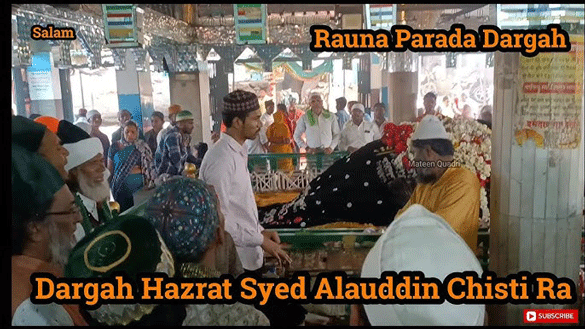
At present, I am writing about the dargahs of Allah’s saints located in Maharashtra. When I studied the dargahs of Maharashtra and read about its Sufi elders, I realised how deeply secular the people of this region have been. Here, not only Muslims but a very large number of Hindus also believe in Sufi saints. They visit the dargahs, make vows (mannat), and seek spiritual peace.
This is the main reason why, historically, there was no strong religious extremism between Hindus and Muslims in Maharashtra. People were broad-minded and believed in living together in harmony. This shared culture of mutual respect became the identity of the region.
Today, I am writing about the dargah of Hazrat Syed Allauddin Zia Chishti, popularly known as Sakaladi Baba, located in Ambar Taluka of Jalna district, Maharashtra.
Location and Historical Background
The dargah of Syed Allauddin has the largest compound among the three major dargahs in Ambar Taluka. The complex is situated right in the heart of the village, where Hindu and Muslim families live together in the surrounding neighbourhood.
The dargah is quite old. It is believed that Hazrat Syed Allauddin Zia Chishti came here from Baghdad and stayed at this place for many years. Later, during the rule of the Nizam, the dargah structure was formally constructed. The sanad (land grant) of the dargah was earlier in the name of the village Patil, who was a Hindu by faith. At present, the sanad is in the name of Sadique Ali, who resides at Mangrul Pir in Washim district.
Structure and Layout of the Dargah
The dargah is a large structure consisting of a single central chamber topped with a dome. A wide balcony surrounds the chamber on all sides. Beyond this, there is a spacious courtyard that encloses the dargah.
On one side of the courtyard, a large musafir khana has been built for devotees who come from distant places to rest and stay. There is another room on one side of the yard where the mujawar resides. Very close to the dargah, there is also a mosque.
It is said that when Baba arrived at this place, it was surrounded by dense forests inhabited by wild animals. However, due to Baba’s spiritual power, all the wild animals became calm. According to popular belief, even tigers used to clean Baba’s place with their tails.
Miracles and Spiritual Beliefs
One of the most well-known miracles associated with this dargah is that water flows within the dargah premises, yet it never touches the sacred chadar covering the tomb. Devotees firmly believe this to be a special Karamat (miracle) of Baba.
Around the dargah, there are shops selling flowers, incense sticks, sweets, and other offerings, as is commonly seen near most shrines. Many devotees sit around the dargah throughout the day. Some come with specific vows, while others come only to seek spiritual peace. On Jumme raat (Thursday), the crowd at the dargah increases significantly.
Famous Karamat and the Practice of Mannat
The Imam of the mosque and the khadims of the dargah explain:
“All devotees who come here with a mannat offer the sacrifice of goats at this very place (pointing towards a particular spot). Surprisingly, no foul smell ever comes from this area. This is considered one of the greatest miracles of Hazrat Allauddin Chishti. People from every religion come here, and when their wishes are fulfilled, they offer goat sacrifice as niyaz. The food prepared from the meat is distributed among the poor. For the last 600 years, goats have been sacrificed at this very spot. Every day, around 100 to 200 goats are sacrificed, and on Jumma and Jumme raat, the number rises to nearly one thousand.”
One devotee present at the dargah said that a very large number of goats are sacrificed here. When asked whether his wishes were fulfilled, he answered in the affirmative. He also stated that people from all religions visit this dargah.
Devotees from Distant Places
The dargah is not visited only by Hindus and Muslims of Ghansawangi; people from far-off places also come here. While local villagers do not always visit the shrine to seek boons, outsiders usually come with specific wishes.
During the visit, many childless couples were seen praying for children. Sick people also come here in the hope of healing. Generally, sweets, fruits, and flowers are offered at the shrine. Chicken, mutton, and biryani are also offered as mannat. Beef is strictly not permitted.
Although devotees visit the shrine daily, the crowd is noticeably larger on Thursdays (Jumme raat) and Fridays (Jumma).
Urs and Collective Participation
The annual urs of the dargah is held on a grand scale from the 9th to the 12th of the 11th month of the Islamic calendar. During this time, the entire village becomes active and festive. The sandal procession is taken out through the village. Langar is organised, and food is served to the public. Qawwali programmes are also arranged on this occasion.
A Living Example of Secular Tradition
From its very beginning, this dargah has had strong secular credentials. The hereditary mujawars of the shrine are Hindus belonging to Pohre village. At present, Keshu Kawre, from the Gaware caste, is the main mujawar. He is assisted by Dalpat Godraji Veshram. In addition, Hussein Amir Shah, a faqir who has been staying at the dargah for the last 35 years, plays an active role in the day-to-day management of the shrine.
During the annual urs, the entire village participates, and every family contributes funds according to their capacity. Even today, the dargah of Syed Allauddin Zia Chishti stands as a powerful symbol of Hindu-Muslim unity, shared faith, and the enduring Sufi tradition of Maharashtra.
A regular contributor to New Age Islam, Sahil Razvi is a research scholar specialising in Sufism and Islamic History. He is an alumnus of Jamia Millia Islamia
URL: https://newageislam.com/islamic-personalities/sakaladi-baba-dargah-sufi/d/138096
New Age Islam, Islam Online, Islamic Website, African Muslim News, Arab World News, South Asia News, Indian Muslim News, World Muslim News, Women in Islam, Islamic Feminism, Arab Women, Women In Arab, Islamophobia in America, Muslim Women in West, Islam Women and Feminism