
Qazi Qadan: Father of Sindhi Sufi Poetry

By Sahil Razvi, New Age Islam
22 April 2026
Qazi Qadan (1493–1551), a pious Sindhi judge and mystic from Bukkur, pioneered classical Sindhi Sufi poetry. He blended Islamic scholarship with local traditions, preaching inner gnosis and unity of existence through simple, powerful verses. His seven baits and sayings influenced Shah Abdul Latif and remain a cornerstone of Sindhi literature.
Main points:
· Served as Qazi of Bakhar, then left worldly duties for Sufi mysticism under Syed Muhammad Jaunpuri.
· First poet to express wahdat al-wujud (Unity of Existence) in pure Sindhi language.
· Famous for “Qazi Qadan Ja Sata Baita” and quotes stressing self-realisation over bookish learning.
· Praised by Mir Muhammad Ma’sumi, Maulvi Muhammad Ghausi, and Shah Abdul Karim for his spiritual depth.
· Legacy lives on as the bridge between formal Shari’ah and Sindhi folk Sufi poetry.
“The study of the Prophetic Tradition, Hanifi Law and Arabic Grammar never brought to my mind the aroma of gnosis; what I sought I found beyond this world.”
~Qazi Qadan
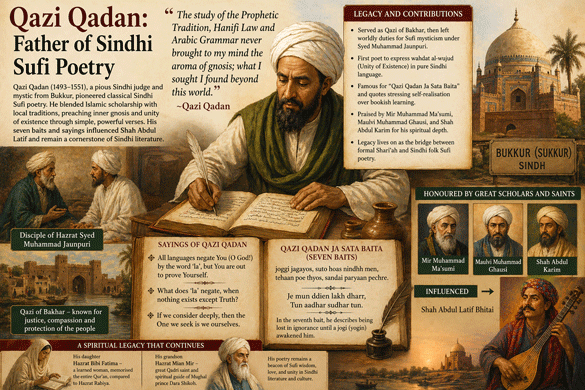
Qazi Qadan was born in Bukkur (present-day Sukkur), Sindh, during the Samma Dynasty. He belonged to a pious religious family whose ancestors had migrated from Sehwan and Thatta to Bukkur, where his great-great-grandfather Qazi Abu al-Khair had settled. His full name is recorded as Qazi Qadan ibn Qazi Said ibn Zainuddin Bakhar, and he came from a scholarly lineage known as Bakhari. Qazi Qadan served as a qazi (Islamic judge) of Bakhar and adjoining areas under rulers such as Jam Nando and later Mirza Shah Husain, where he was renowned for his piety, continence, knowledge of tafsir, Hadith, and tasawwuf (Sufism).
He administered Shari’ah justice with compassion and fairness. In his judicial role, Qazi Qadan demonstrated an astute sense of justice tempered with mercy during turbulent times, including interventions to protect civilians during sieges and invasions in Sindh. He became a disciple of Hazrat Syed Muhammad Jaunpuri (d. 1505) and resigned from his post in later years to devote himself fully to Sufi mysticism.
Historical references to him first appear in Hazrat Mir Muhammad Masumi’s Tarikh-i-Masumi (written around 1600), which describes him primarily as a religio-political figure rather than a poet. Later Persian works, such as Maulvi Muhammad Ghausi’s Gulzar-i-Abrar (composed 1605–1610) and Hazrat Mian Muhammad Raza’s Bayan al-Arifin (1630), mention him as both a scholar and a poet. Qazi Qadan is widely regarded as the first Sindhi Sufi poet and is called the “Father of Classical Sindhi Poetry”.
His work laid the foundation of Sindhi Sufi literature during the Samma era by expressing mystical ideas in the vernacular Sindhi language. He is credited with bridging formal Islamic scholarship with local Sindhi cultural and folk expressions, influencing later poets like Hazrat Shah Abdul Karim and Hazrat Shah Abdul Latif Bhitai.
His legacy extended through his family; his daughter Hazrat Bibi Fatima was a learned woman who memorised the entire Qur’an and was compared to Hazrat Rabiya al-Adawiyya, while his grandson Hazrat Mian Mir became a prominent Qadri Sufi saint and preceptor to Mughal prince Dara Shikoh.
Mir Muhammad Ma’sumi, a chronicler from Bakhar and a younger contemporary of Qazi Qadan, provided the earliest historical reference in his Tarikh-i-Ma’sumi (written around 1600). He described Qazi Qadan as a religio-political figure renowned for his piety, continence, deep knowledge of tafsir (Qur’anic exegesis), Hadith, and tasawwuf (Sufism). Ma’sumi highlighted his compassionate administration of Shari’ah justice as Qazi of Bakhar and adjoining areas under rulers like Mirza Shah Husain, as well as his interventions to protect civilians during sieges and invasions in Sindh.
Qazi Qadan’s philosophy centered on Sufi mysticism, particularly the doctrine of wahdat al-wujud (Unity of Existence). He emphasized inner spiritual realization and gnosis (ma’rifah) over mere formal religious scholarship or rituals. After completing his formal education, he lost interest in worldly learning and sought to solve the problems of the material world through a change in moral outlook by overcoming his nafs (lower self).
This led him to gain insight into the reality of things through direct experience of the Divine. His teachings promoted moral continence, detachment from worldly illusions, and the recognition that the Divine lies within the self rather than in external forms. He critiqued excessive reliance on external rituals when they lacked spiritual essence, prioritizing the path of haqiqah (Supreme Reality).
Qazi Qadan’s verses reflect a monistic view where duality is negated, and the seeker realises unity with the Divine. His approach integrated Sufi ideals with local Sindhi traditions, including references to a jogi (yogin) as a spiritual guide, showing openness to syncretic influences prevalent in medieval Sindh. Qazi Qadan expressed the essence of his teachings through verses in his native Sindhi tongue.
Some of his sayings preserved in classical Persian biographical works:
“The study of the Prophetic Tradition, Hanfi Law and Arabic Grammar never brought to my mind the aroma of gnosis; what I sought I found beyond this world.”, “All languages negate You (O God!) by the word ‘la’, but You are out to prove Yourself.”, “What does ‘la’ negate, when nothing exists except Truth?”, “If we consider deeply, then the One we seek is we ourselves.”
These sayings highlight his belief that true gnosis transcends bookish learning and formal negation, pointing instead to self-realisation of the Divine. In the context of his seven famous baits (Qazi Qadan Ja Sata Baita), he reiterated that he had not encountered the aroma of the beloved through traditional religious texts, but in a different realm altogether.
Poetry
Qazi Qadan composed his poetry primarily in the form of baits (couplets) in Sindhi. His most celebrated work is the collection known as “Qazi Qadan Ja Sata Baita” (Seven Baits of Qazi Qadan), appended to Bayan al-Arifin (1630).
These seven baits establish him as a great believer in the Unity of Existence. In the seventh bait, he describes being lost in a slumber of ignorance until a jogi (yogin) awakened him.
Additional baits attributed to him include lines such as:
“joggi jagayos, suto hoas nindhh men, tehaan poe thyos, sandai paryaan pechre.”
“se’ee sel thyaam, parhayam je paarn lanhn, akhar’u aggyan ubhri, waagon thi wariyam.”
And the well-known couplet: “Je mun ddien lakh dharr, Tun aadhar sudhar tun.”
Scholars have noted that more than a hundred additional baits by Qazi Qadan were later discovered from Haryana, though their full authentication remains a subject of scholarly interest. His poetry is preserved in collections such as Qazi Qadan Jo Kalam, edited by Hiro Thakkar. The beauty of his verses, as noted in historical accounts, lies in their original Sindhi style, which translations cannot fully capture.
Qazi Qadan passed away in 1551 (958 AH) at the age of 57–58. Some accounts place his death in Madina, Hejaz, though primary Sindhi historical references focus on his contributions in Sindh.
URL: https://newageislam.com/islamic-personalities/qazi-qadan-father-of-sindhi-sufi-poetry/d/139751
New Age Islam, Islam Online, Islamic Website, African Muslim News, Arab World News, South Asia News, Indian Muslim News, World Muslim News, Women in Islam, Islamic Feminism, Arab Women, Women In Arab, Islamophobia in America, Muslim Women in West, Islam Women and Feminism