
Hazrat Mian Mir of Sindh: A Symbol of Sufi Wisdom and Interfaith Harmony

By Sahil Razvi, New Age Islam
15 April 2026
Hazrat Mian Mir was a revered Sufi saint known for spiritual depth, simplicity, and interfaith harmony. A Qadri master, he shared close ties with Sikh Gurus and rejected worldly power, leaving behind a legacy of love, humility, and devotion to the Divine.
Main Points:
· A leading saint of the Qadri Sufi order known for deep spirituality and humility.
· Shared a strong bond with Guru Arjan Dev and Sikh Gurus, symbolising interfaith harmony.
· Lived a simple, detached life despite the height of the Mughal Empire.
· Emphasised inner purification, remembrance of God, and rejection of worldly greed.
· Revered across religions; his shrine in Lahore remains a center of devotion.
“When a Sufi becomes perfect and his heart purified of evil thoughts, nothing can harm him; he is king himself and all the worldly kings are subjugated to him.”
Hazrat Mian Mir, also known as Miyan Mir, remains one of the most beloved Sufi saints of the Indian subcontinent. A leading figure of the Qadri order, he embodied the highest ideals of Islamic mysticism while forging deep bonds of love and respect across religious lines. Revered equally by Muslims and Sikhs, his life stands as a shining example of humility, and unwavering devotion to the Divine. Born around 1550 A.D. in Sindh and passing away in 1635 A.D. in Lahore at the age of about 85, Hazrat Mian Mir lived during the golden age of the Mughal Empire yet remained completely detached from worldly power.
Hazrat Mian Mir was born as Mir Muhammad Muayyinul Islam in 1550 A.D. (some records cite 1547 A.D. or 11 August 1550) in Sevastan (also called Sivastan or Sahvan), a town in Sindh between Thatta and Bhakkar, then part of the Arghun Kingdom (modern-day Pakistan). He belonged to a pious scholarly family and traced his lineage directly to Hazrat Umar ibn al-Khattab, the second Caliph of Islam, in the 28th generation. His father, Qazi Saien Ditta (or Sayandanah) bin Qazi Qalandar Faruqi, was a respected scholar and saintly figure; his mother, Hazrat Bibi Fatima, was equally devout. Tragically, he lost his father at a tender age (around seven years in some accounts) and was raised by his learned and pious mother.
Even as a child, young Mir Muhammad showed an extraordinary inclination towards spirituality. At the age of twelve, with his mother’s blessings, he left home in search of a true spiritual guide. In the wilderness, he met Sheikh Khizr (Abdul Malkin), a great Qadri dervish and descendant in the spiritual line of Hazrat Khizr (the immortal guide). After three days of patient waiting, he was accepted as a disciple and initiated into the Qadri Silsila, tracing its roots to Hazrat Prophet Muhammad through Hazrat Sheikh Abdul Qadir Jilani of Baghdad. Under Sheikh Khizr’s guidance, he rapidly progressed through the stations (maqamat) and states (ahwal) of the Sufi path.
Around the age of twenty-five, Hazrat Mian Mir, with his Pir’s permission, moved to Lahore to deepen his knowledge of Sharia, Fiqh and rational sciences. He studied under eminent scholars such as Maulana Saadullah, Maulana Ni’matullah and Mufti Abdus Salam. Though he excelled as an ‘Alim (scholar), he shunned publicity, preferring solitude, meditation in gardens and forests, and strict adherence to the Sunnah. He lived a life of extreme simplicity, practising khalwat (seclusion), muraqaba (meditation), zikr (remembrance of Allah) and mujaheda (spiritual struggle against the ego). He ate sparingly, often missing meals, and spent nights in prayer.
In Lahore, he settled in the Dharampura (or Begampura/Baghbanan) area. To keep away selfish nobles and worldly seekers, he instructed his disciples to stand guard at his door, famously telling Emperor Jahangir (who visited him), “They are there so that the dogs of the world (selfish men) may not enter.”
Hazrat Mian Mir’s most celebrated bond was with the Sikh Gurus, especially the fifth Guru, Sri Guru Arjan Dev Ji (thirteen years his junior). He frequently travelled to Amritsar to meet the Guru and knew many verses of Guru Nanak Dev Ji and the Guru Granth Sahib by heart. Whenever Guru Arjan Dev visited Lahore (his father Guru Ram Das Ji’s birthplace), he would call upon the saint. Their friendship symbolised pure love and mutual respect.
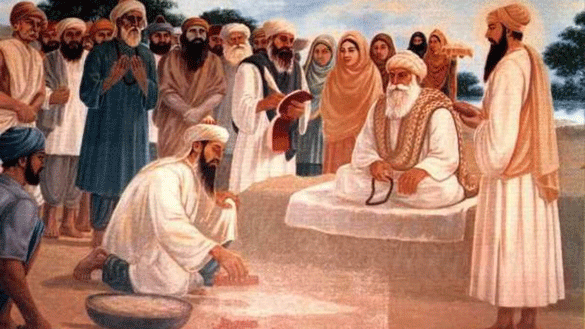
According to a well-established tradition in Sikh and later historical accounts (including Tawarikh-i-Punjab, 1848), Guru Arjan Dev invited Hazrat Mian Mir to lay the foundation stone of Harmandir Sahib (the Golden Temple) on 1st Magh, Samvat 1647 (13 January 1588 A.D.). The saint arrived in simple mendicant’s attire, embraced the Guru, and performed the ceremony with great joy, seeing the temple as open to all castes and creeds. Though some early sources like Dara Shikoh’s Sakinat al-Aulia do not mention this event, the tradition has been widely accepted in Sikh historiography and even endorsed by the Darbar Sahib authorities in 1929.
Hazrat Mian Mir shared a deep bond of spiritual friendship with the fifth Sikh Guru, Sri Guru Arjan Dev Ji. The most poignant recorded conversation took place when Guru Arjan was imprisoned and tortured in Lahore Fort on Jahangir’s orders.
Mian Mir rushed to the fort upon hearing of his friend’s suffering. He found the Guru calm and serene, completely resigned to the Divine will. Deeply moved, Mian Mir offered:
“My friend, just give me one word and I shall cause the thrones of Delhi and Lahore to come crashing down.” (Alternative accounts say he offered to raze Delhi to the ground with his spiritual powers or intercede directly with Jahangir.)
Guru Arjan Dev replied:
“I can also do that but under all conditions one must live in the will of God.”
He further forbade Mian Mir from interfering, stating that God’s will must have its course unchecked and that it was not proper to interfere with His workings. The Guru only asked for the saint’s blessings for his young son, Har Gobind.
In another related tradition, when Raja Chandu Mal’s deputy tried to dissuade Mian Mir from helping the Guru build Harmandir Sahib (by suggesting unity could be achieved on the basis of “Ram and Rahim”), Mian Mir rebuked him sharply:
“The Ram you believe in was not God himself, but a mere mortal, the son of Raja Dashrath, husband of Sita Mai and father of Luv and Kush, while God has neither parents nor children. People can be united only on the basis of the love for the one formless God, and this task Arjan Dev is doing best and so I shall help him.”
These exchanges highlight the mutual respect between the two saints and their shared emphasis on complete surrender to the Divine will.
When Guru Arjan Dev was executed in 1606 A.D. By order of Emperor Jahangir, Hazrat Mian Mir mourned deeply and rushed to offer help, even offering to intercede. The Guru refused, saying it was the Divine will. Mian Mir also helped secure the release of the young sixth Guru, Sri Guru Hargobind Ji, from Gwalior Fort and hosted him for twenty-two days in Lahore. He blessed the child Guru Tegh Bahadur as well. These acts of love transcended religious boundaries and remain a powerful testimony to his belief that “in the path of sincere effort for God, there is no difference between Hindu and Muslim” (Karni Parvan Kya Hindu Kya Musalman).
Hazrat Mian Mir followed the Qadri path with complete fidelity to Shariah while emphasising inner purification. He taught that true spirituality lies in annihilating the ego (fana), remaining in constant remembrance of Allah, and showing compassion to all humanity. Rituals without a purified heart were meaningless; detachment from the world (tajrid and tafrid) and seclusion were essential, yet one must live in society with humility.
He strongly condemned hypocrisy and worldly greed. A poor devotee once offered him a single rupee; Mian Mir directed it to Emperor Jahangir, saying, “He is the poorest and most needy of the lot. Not content with a big kingdom, he covets the Deccan.”
As Dara Shikoh’s spiritual guide, Mian Mir had several private sittings with the prince and his father, Emperor Shah Jahan. Dara describes one long discourse on kingship and spirituality:
Mian Mir counselled the emperor:
“It is imperative for a just Sultan that he should be watchful of the welfare of the people of his kingdom. Their peace and happiness should be the foremost concern and duty of the king…”
He further advised on turning one’s attention to Allah:
“When you do any good work whereby the believers be happy, pray to Allah, and beg for naught save Himself.”
On another occasion, when Shah Jahan expressed a desire for grapes as a sign of Mian Mir’s sainthood, the saint miraculously produced a basket of fresh grapes. During Dara’s prolonged illness, Mian Mir cured him by giving him blessed water and placing his hand on the prince.
Some of his profound statements, preserved in Sufi literature, include: “When a Sufi becomes perfect and his heart purified of evil thoughts, nothing can harm him; he is king himself and all the worldly kings are subjugated to him.”, “Quest for the Truth is not an easy job. Unless you become single in His quest you won’t be able to find Him.”, “Do you know what is the first prerequisite of the mystic way? It is the abdication of both the worlds with one stroke of toe.”, “Perfect Sufi is that in whose eye stone and ruby are alike. He who is with God Most High, is never indigent.”
He also composed verses criticising outward show, such as the famous rosary poem: “The rosary wondered and spoke to me in a strange tongue… Wert thou to revolve thine own heart instead, Thou wouldst know the purpose of man’s creation.”
Hazrat Mian Mir’s most illustrious disciple was Dara Shikoh, the eldest son of Emperor Shah Jahan, who compiled Sakinat al-Aulia, a detailed biography of his Pir. His spiritual successor was Mullah Shah Badakhshi. His younger sister, Bibi Jamal Khatun, also became a renowned Sufi saint.
He never accepted gifts from emperors or nobles, living on simple trust in Allah. His shrine in Mian Mir, Lahore (Hashimpur), built in red sandstone (though he wished for none), was later repaired by Maharaja Ranjit Singh. The annual Urs draws thousands of devotees from all faiths. The locality and even a hospital are named after him. His message of harmony continues to inspire in an age still torn by division.
Hazrat Mian Mir left this world on 7/22 August 1635 A.D. (17 Rabi-ul-Awwal 1045 A.H.) after a brief illness. His last words were the constant repetition of “Allah, Allah”. As per his will, he was buried in a simple grave beside his friend Mian Natha Ji in Hashimpur.
…
A regular contributor to New Age Islam, Sahil Razvi is a research scholar specialising in Sufism and Islamic History. He is an alumnus of Jamia Millia Islamia.
New Age Islam, Islam Online, Islamic Website, African Muslim News, Arab World News, South Asia News, Indian Muslim News, World Muslim News, Women in Islam, Islamic Feminism, Arab Women, Women In Arab, Islamophobia in America, Muslim Women in West, Islam Women and Feminism