
Hazrat Maulana Muhammad Nabi Bakhsh Halwai Naqshbandi and His Contributions

By Sahil Razvi, New Age Islam
24 January 2026
Hazrat Maulana Muhammad Nabi Bakhsh Halwai Naqshbandi (1850–1945) was a Lahore-based Naqshbandi Sufi, scholar, and poet renowned for his unparalleled Punjabi manzoom Tafsir-e-Nabawi of the Quran. A staunch defender of Sunni beliefs, he refuted innovations while blending spirituality with everyday livelihood through his sweet shop profession.
Main points:
· Renowned Islamic scholar and poet, best known for Tafsir-e-Nabavi, a Punjabi poetic commentary of the Qur’an.
· Born in Lahore in 1860, he earned his livelihood as a halwai while spreading religious teachings among common people.
· Constructed Jamia Masjid Hanafiya Nabaviya and funded the publication of his Qur’anic commentary through his own earnings.
· Trained under leading scholars and was a Naqshbandi Sufi, authorised in the spiritual order.
“Seeing the signs of the Lord opens the heart; in the Prophetic exegesis of the Quran, every word is light.”
Hazrat Maulana Muhammad Nabi Bakhsh Halwai Naqshbandi occupies an important place among the distinguished Islamic scholars and poets of the Indian subcontinent. He is especially remembered for his monumental work Tafsir-e-Nabavi, a unique Punjabi poetic commentary of the Holy Qur’an, which reflects his deep scholarly insight as well as his close connection with the common people.
Hazrat Maulana Muhammad Nabi Bakhsh Halwai was born in 1276 AH (1860 CE) in Lahore, into a middle-class Arain family. His father, Mian Waris Ali, lived in Akbari Mandi, within Delhi Gate, Lahore. At the young age of ten, Hazrat Maulana Muhammad Nabi Bakhsh was apprenticed to a local halwai (sweet-maker) in his neighbourhood. This halwai not only trained him in the trade but also allowed him time to learn the recitation of the Holy Qur’an. To earn his livelihood, he adopted the professions of sweet-making and selling milk, which later became the reason he was popularly known as “Halwai.”
Every morning, he would prepare halwa and sit outside Delhi Gate, where travellers heading towards the railway station would buy his sweets. Along with his trade, he would engage customers in gentle and sweet conversation, subtly imparting religious teachings and moral guidance. His livelihood thus became a means of dawah, blending daily labour with spiritual service. From the modest income earned through this honest trade, he went on to accomplish remarkable religious projects. He constructed Jamia Masjid Hanafiya Nabaviya, situated near Kotwali Police Station, outside Delhi Gate, Lahore, and also bore the expenses for the publication of his magnum opus, Tafsir-e-Nabavi.
Hazrat Maulana Halwai acquired religious education and spiritual training from the eminent scholars of his era. Among his notable teachers were Hazrat Maulana Muawan Husain Rampuri, the Khateeb of the Royal Mosque of Lahore; Hazrat Maulana Hamd Zakir Bagwi; Hazrat Maulana Ghulam Muhammad Bagwi; Pir Abdul Ghaffar Shah Kashmiri of Madrasa Ghausia; Hazrat Maulana Ghulam Qadir Bhairvi; and Hazrat Maulana Ghulam Dastgir Qasuri, under whose guidance he completed Dars-e-Nizami. From Hazrat Maulana Ghulam Dastgir Qasuri, he also received initiation (bay‘ah) into the Naqshbandi Sufi order. After the demise of his spiritual mentor, he pledged allegiance to Syed Jamaat Ali Shah Lathani Alipuri, from whom he received spiritual authorization (ijazah).
Teachings and Taleemat (Principles)
Hazrat Maulana Nabi Bakhsh's teachings emphasized unity among Sunnis, adherence to Shariah, and the inner dimensions of faith through tasawwuf. As a Naqshbandi, he stressed silent dhikr, self-restraint, and love for the Hazrat Prophet Muhammad and Sahaba. His works promote spiritual purification (tazkiyah), rejection of extremism, and making Islam relatable in vernacular languages.
He taught that true healing comes from dhikr and tawbah (repentance). The heart (qalb) must be cleansed of worldly attachments to achieve proximity to Allah. He refuted accusations against Sahaba like Hazrat Muawiya, arguing that criticizing them invites divine wrath. In Al Muawiya, he uses Hadith and Fiqh to affirm their status.
By writing in Punjabi poetry, he made the Quran accessible to common folk, blending poetry with exegesis to inspire devotion. Specific sayings are scattered in his poetic works and refutations. Here are some excerpts:
Tafsir Nabawi (on the beauty of Quranic guidance,
“Seeing the signs of the Lord opens the heart; in the Prophetic exegesis of the Quran, every word is light.” This reflects his emphasis on divine illumination through scripture. "He who slanders Muawiya should guard against the fire, for disrespecting the Sahaba invites Allah's displeasure."
This underscores his defense of Companions
On Tasawwuf (from Shifa ul Quloob): “The healing of the heart is in the remembrance of Allah; purify it from worldly love and turn to Him.” These quotes highlight his focus on devotion, orthodoxy, and spiritual reform.
Throughout his life, Hazrat Maulana Halwai made tireless efforts for the promotion, protection, and defence of Ahl-e-Sunnat wa Jamaat. He actively responded to objections raised against Sunni beliefs and practices and authored several scholarly treatises in refutation of critics and opponents. His dedication to safeguarding orthodox Sunni thought earned him respect among scholars and the wider religious community.
He also trained and inspired a number of notable students, among whom Hazrat Maulana Bagh Ali Naseem, Hafiz Muhammad Alam Silakoti, and Allama Iqbal Ahmad Farooqi (M.A.) are especially well known. In his memory, Hazrat Maulana Bagh Ali Naseem established Maktaba Nabaviya, a publishing house that continues to render valuable services to Ahl-e-Sunnat wa Jamaat, adapting to modern standards of printing and publication while preserving traditional scholarship.
Hazrat Maulana Muhammad Nabi Bakhsh Halwai was a prolific author. His writings reflect his command over Qur’anic sciences, jurisprudence, theology, Sufism, and polemical discourse. Some of his important works include:
Tafsir-e-Nabavi (Punjabi poetic commentary of the Qur’an, in 15 volumes);
Al-Imtiyaz bayn al-Haqiqah wal-Majaz (spanning nearly three thousand pages);
Jami‘al-Shawahid; Izhar Inkar al-Munkirin min Salat al-Mujibin; Al-Nar al-Hamiyah liman Dhamma Mu‘awiyah; Ittila‘ al-Nas fi Talaq al-Thalath; Ihsan al-Amwat bil-Sadaqat wal-Isqat; Sabil al-Rashad fi Haqq al-Ustad; Tahqiq al-Zaman fi Adab al-Mashaikh wal-Ikhwan; Khair al-Huda fi ‘Adam al-Jumu‘ah fil-Qaryah; Shifa al-Qulub; Risala-e-Jumu‘ah;
Risala-e-Arba‘ah; Anwa‘-e-Nabavi; and Qasas al-Muhsinin.
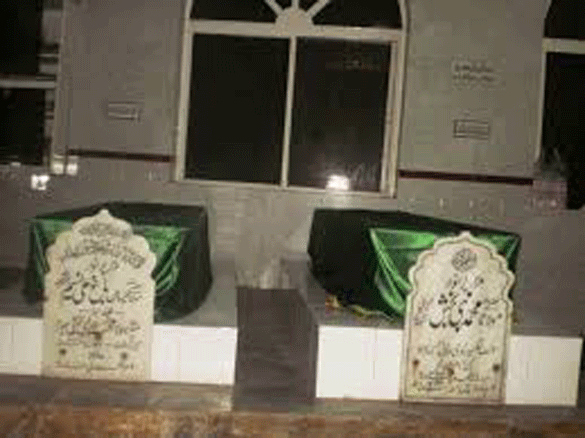
Hazrat Maulana Muhammad Nabi Bakhsh Halwai lived a long and productive life devoted to religious scholarship, spiritual reform, and the service of Ahl-e-Sunnat wa Jamaat. He passed away in 1365 AH (1944 CE). In accordance with his wishes, he was laid to rest within the premises of the very mosque he had built, Jamia Masjid Hanafiya Nabaviya, near Kotwali Police Station, outside Delhi Gate, Lahore, Pakistan.
Through his life, scholarship, and spiritual legacy, Hazrat Maulana Muhammad Nabi Bakhsh Halwai Naqshbandi remains a shining example of how faith, learning, humility, and service to society can harmoniously coexist.
…
New Age Islam, Islam Online, Islamic Website, African Muslim News, Arab World News, South Asia News, Indian Muslim News, World Muslim News, Women in Islam, Islamic Feminism, Arab Women, Women In Arab, Islamophobia in America, Muslim Women in West, Islam Women and Feminism