
Hazrat Khwaja Mohammad Baba as-Samasi: A Great Naqshbandi Saint and Spiritual Guide

By Sahil Razvi, New Age Islam
12 January 2025.
Hazrat Khwaja Mohammad Baba as-Samasi was a towering Naqshbandi saint-scholar whose inner and outer knowledge shaped generations of seekers, including Khwaja Naqshband. His teachings emphasized purity, humility, and complete devotion to Allah.
Main points:
· He was known as the Scholar of the Saints and the Saint of the Scholars.
· Mastered both external sciences and inner spiritual knowledge.
· Chosen successor of Shaikh Ali Ramitani (al-’Azizan).
· Played a pivotal role in the spiritual upbringing of Khwaja Naqshband.
· Emphasized purity of heart, lawful living, remembrance, and patience in trials.
“We must always be asking forgiveness, being careful in all our affairs, following the footsteps of the good and pious, following their internal teachings, and safeguarding the heart from all whispers.”
Hazrat Khwaja Mohammad Baba as-Samasi
Muhammad Baba as-Samasi, the distinguished student of al-Azizan, was the Scholar of the Saints and the Saint of the Scholars. He was unique in the two knowledge, the inner and the outer. His blessings permeated every nation in his time. From his desire to learn, he caused every unseen knowledge and secret to appear. He was the pinnacle of the Suns of External and Internal Knowledge of the Eighth Hijra Century. One of his miraculous signs was his Ascension from the Dome of the Rock, which was his heart, to the station of the Knower of the Knowers. From everywhere those versed in spiritual wisdom made the pilgrimage to his Garden of Knowledge and circumambulator the Ka’aba of his Guidance. He was born in Sammas, a village in the suburbs of Ramitan, three miles from Bukhara. He progressed in his journey by reading from the Sciences of the Qur’an, memorizing the Qur’an and the Prophetic Tradition (hadith), and becoming a great scholar in Jurisprudence. Then he began to study Speculative Theology, Logic, and Philosophy (‘ilm al-Kalam), as well as History, until he was a walking encyclopaedia of every kind of art and science. He followed Shaikh Ali Ramitani al-’Azizan and he was constantly engaged in struggling against himself. He was put into seclusion on a daily basis, until he reached such a state of purity that his shaikh was permitted to transmit to his heart from the Unseen Heavenly Knowledge. He became very famous for his miraculous powers and his high state of sainthood. Shaikh ‘Ali Ramitani (q) chose him before his death as his successor and ordered all his students to follow him.
It was widely believed about Khwaja Naqshband that, as mentioned earlier in connection with Hazrat Abu Hafs, once Hazrat Mahboob-e-Ilahi visited the court of Hazrat Shah Abdullah Ahsan. On that occasion, Hazrat Mahboob-e-Ilahi remarked that even then there was some special divine arrangement in the surroundings of the Khwaja. This arrangement is recorded in Qissa-e-Arifan.
From this land, a virtuous and good-natured man was destined to be born. It was close to becoming a well-known spiritual account among the saints. Once, when Malik Sharif was brought into his presence, he said that a fragrance could be sensed, indicating that the man had already been born. At that time, only three days had passed since the birth of Hazrat Khwaja Naqshband.
After this, Ahmad Chishti came to attend upon him. He took the child in his lap and said, “This is our son, and we have accepted him in our lifetime.” Addressing his companions, he added, “This is the man whose fragrance we have been sensing from the very beginning, and he will become a leading figure of his time.” Thereafter, he instructed his khalifa, Hazrat Syed Amir Kalal, saying, “Do not show any negligence in the upbringing of this son of mine. I will not forgive any lapse.” Hazrat Amir Kalal promised that if he committed any negligence, he would not consider himself worthy of forgiveness.
On Naqshbandi.org, the sayings of Hazrat Baba are recorded, in which Baba says— “The seeker must always remain firm in observing Allah’s Divine commands and must constantly stay in a state of purity. First, he should possess a pure heart that does not turn towards anything except Allah, the Almighty and Exalted. Then he must keep his inner self pure, the part that is hidden from all people, this is true spiritual vision.
Purity of the chest (sadr) lies in hope and contentment with His will. Purity of the spirit consists of modesty and reverence. Purity of the stomach depends on eating only lawful (permitted) food and practicing abstinence. This is followed by purity of the body, which means giving up base desires. Then comes purity of the hands, which lies in piety and sincere effort.
After this is purity from sins, which is shown through remorse and a broken heart over past wrong actions. Then comes purity of the tongue, which consists of remembrance (dhikr) and seeking forgiveness. Finally, one must cleanse oneself of heedlessness and laziness by developing fear and awareness of the Hereafter.”
This incident is recorded in the book Tareekh-Mashaikh-Naqshband. Hazrat Khwaja Naqshband states that when he was around eighteen years old, his respected grandfather began to think about his marriage. He sent him to the service of Hazrat Baba so that he might bring him to Qasr-e-Arifan (the Palace of the Gnostics) and that the matter could be completed in his presence.
During his attendance in the service of Hazrat Baba, he witnessed his first spiritual sign (karamat). That night a deep sense of humility and devotion overcame him. In the last part of the night, he woke up, performed ablution, and offered two units of voluntary prayer (nafl) in the mosque. A strong feeling of supplication filled his heart, and this prayer came from his lips:
“O God! Grant me the strength to bear the burden of trials and to endure the hardships of love.”
In the morning, he presented himself again in the service of Hazrat Baba. With his inner spiritual insight, Hazrat Baba became aware of the events of the night and said:
“O my son! One should pray in this manner: O God! By Your grace and mercy, keep this weak servant firm upon that path in which Your pleasure lies. Indeed, the pleasure of Allah Most High lies in a servant being tested with hardship. If, by His wisdom, He sends trials upon one of His beloved servants, then through His kindness He also grants that servant the strength to endure the affliction and makes His wisdom clear to him. It is not appropriate to seek hardship by one’s own choice; such boldness should not be shown.”
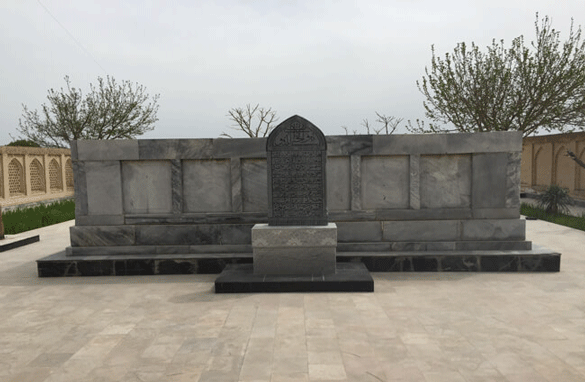
He passed away on 10th Jamada ath-Thani, 755 AH (2/3 July 1354 CE), and his mausoleum is located at Samas, a village on the outskirts of Ramitan, about 5 km from Bukhara, in present-day Uzbekistan.
...
New Age Islam, Islam Online, Islamic Website, African Muslim News, Arab World News, South Asia News, Indian Muslim News, World Muslim News, Women in Islam, Islamic Feminism, Arab Women, Women In Arab, Islamophobia in America, Muslim Women in West, Islam Women and Feminism