
Hate Politics and the Message of Hazrat Bulleh Shah

By Sahil Razvi, New Age Islam
31 January 2025
Uttarakhand is increasingly emerging as a hotspot of hate crimes, where political rhetoric and administrative actions are deepening social divisions. Reports of frequent hate speeches and the systematic targeting of dargahs have raised serious concerns about state patronage of intolerance. The vandalism of the century-old shrine of Hazrat Bulleh Shah in Mussoorie is not merely an attack on a structure, but an assault on India’s shared spiritual heritage, pluralism, and the humanist legacy of one of the greatest Sufi saints.
At the present time, Uttarakhand has become a centre of hate crimes. A few days ago, a report by a US-based think tank was released, which stated that the Chief Minister of Uttarakhand, Pushkar Singh Dhami, delivered the highest number of hate speeches in the year 2025. In 2025 alone, he gave a total of 71 hate speeches, which included terms such as spit jihad, land jihad and love jihad.
In Uttarakhand, under the protection of the government, dargahs are being continuously targeted. Sometimes the administration itself reaches the spot with bulldozers, and at other times anti-social elements arrive with hammers to demolish them. In one of his speeches, Chief Minister Pushkar Dhami himself claimed that his administration has demolished 600 dargahs. This is the official figure; apart from this, hundreds of other dargahs have already been demolished so far.
Something similar happened when, influenced by the Chief Minister’s provocative speeches, anti-social elements themselves vandalised an over 100-year-old shrine dedicated to Syed Baba Bulleshah in Mussoorie, Uttarakhand, on 24 January 2026. Approximately 25 to 30 people arrived at the shrine early in the morning and damaged the site using hammers. The group reportedly chanted religious slogans during the act, and a video of the incident has been circulated on social media. The police have taken the video as evidence for their ongoing investigation.
Perhaps the attackers do not know, O ignorant hammer-wielders, which personality’s shrine they went to demolish. They do not know who that great personality was. That shrine belongs to Hazrat Bulleh Shah, the great 17th-century Sufi, poet and philosopher.
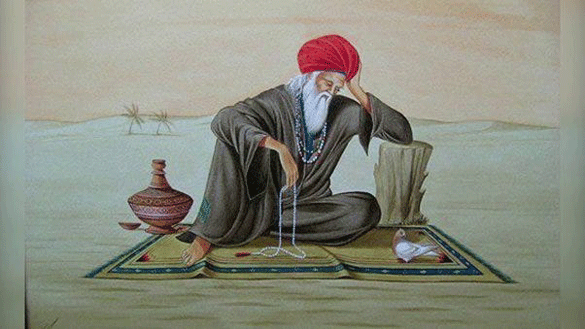
Hazrat Sayyid Abdullah Shah Qadiri, also known as Hazrat Baba Bulleh Shah, is universally acknowledged as the greatest of the Punjabi mystics. No Punjabi mystic poet enjoys wider fame and a greater reputation. His kafis have gained unique popularity. In truth, he is one of the greatest Sufis of the world, and his thought equals that of Jalal al-Din Rumi and Shams Tabriz of Persia.
About Hazrat Bulleh Shah, Shah Inayat Qadiri writes:
Hazrat Shah Inayat, may Allah have mercy on him, said:
Bullhia rabb da pan ai
edharo puttan odharo lan hai.
“O Bulleh! This is the secret of Almighty Allah: on this side He uproots, on the other side He creates.”
“This,” says the tradition, “so deeply impressed Baba Bulleh Shah that, forgetting his family and its status, he became Inayat Shah’s disciple.”
Hazrat Bulleh Shah always stood for humanity and peace. In his life, we find many such incidents that prove that he was a humanist.
He emphasised universal love, tolerance, and the transcendence of sectarian identities, viewing humanity as inherently united under a single divine essence. His teachings advocated equality and rejected caste, creed, and ritualistic barriers that separated people, especially Hindus and Muslims, during a time of communal tensions under Mughal rule.
Influenced by Sufi traditions and elements of Hindu philosophy such as Vedanta, Bulleh Shah promoted humanism, urging followers to prioritise inner spiritual connection over external religious labels, and to see God in every individual regardless of faith.
He was revered across communities, Hindus, Muslims, and Sikhs alike, for his role as a beacon of peace, denouncing dogma and social stratification while fostering fraternity and oneness.
Bulleh Shah’s time was marked by communal strife between Muslims and Sikhs. But in that era, Baba Bulleh Shah was a beacon of hope and peace for the people of Punjab. While Bulleh Shah was in Pandoke, Muslims killed a young Sikh man who was riding through their village, in retaliation for the murder of some Muslims by Sikhs. Baba Bulleh Shah condemned the murder of the innocent Sikh and was censured by the mullas and muftis of Pandoke. Bulleh Shah maintained that violence was not the answer to violence. He also hailed Guru Tegh Bahadur as a ghazi (an Islamic term for a religious warrior), which earned him the wrath of the fanatical Muslims of that time.
Banda Singh Bairagi was a contemporary of Bulleh Shah. In retaliation for the murder of Guru Gobind Singh’s two sons by Aurangzeb, Banda Singh Bairagi sought revenge by killing ordinary Muslims. Baba Bulleh Shah tried to persuade Banda Singh Bairagi to abandon his campaign of revenge. Bulleh Shah told him that the same sword which fell upon Guru Gobind Singh’s sons and innocent Sikhs had also fallen upon innocent Muslims. Therefore, killing innocent Muslims was not the answer to Aurangzeb’s oppressive rule.
Hazrat Bulleh Shah’s famous poem “Neither Hindu Nor Muslim” (original Punjabi: Na Hindu na Musalman) is a powerful critique of religious labels. This poem calls for discarding pride and walking on the path of peace, transcending binaries such as sin and virtue, or believer and non-believer, in order to embrace universal love.
Neither Hindu nor Muslim,
Sacrificing pride, let us sit together.
Neither Sunni nor Shia,
Let us walk the road of peace.
We are neither hungry nor full,
Neither naked nor clothed.
Neither weeping nor laughing,
Neither ruined nor settled.
We are not sinners nor pure and virtuous;
What is sin and what is virtue, I do not know.
Says Bulleh Shah, the one who attaches his self to the Lord
Gives up both Hindu and Muslim.
Bulleh is neither Rafzi nor Sunni,
Nor learned, nor an intellectual, nor a Jaini.
I have learnt only the lesson of the love of God.
People say: Bulleh is an infidel (kafir)
And an idol-worshipper.
But in the Lord’s court, both the momin and the kafir
(Believer and non-believer) are treated alike.
Here was Ramdas (a Hindu) and there Fateh Muhammad (a Muslim),
What an ancient quarrel there was between them,
But now their dispute has vanished,
And something new has emerged!
Makkay gayaan, gal mukdee naheen
Pawain sow sow jummay parrh aaeey
Ganga gayaan, gal mukdee naheen
Pawain sow sow gotay khaeeay
Gaya gayaan gal mukdee naheen
Pawain sow sow pand parrhaeeay
Bulleh Shah gal taeeyon mukdee
Jadon Mai nu dillon gawaeeay
~In English
Going to Makkah is not the ultimate
Even if hundreds of prayers are offered.
Going to River Ganges is not the ultimate
Even if hundreds of cleansing (Baptisms) are done.
Going to Gaya is not the ultimate
Even if hundreds of worships are done.
Bulleh Shah the ultimate is
When the “I” is removed from the heart!
This composition subverts orthodox identities and aligns with Sufi concepts such as wahdat al-wujud (the unity of being), where religious multiplicity dissolves into divine oneness, promoting interfaith reconciliation and humanistic equality.
In some of his verses, the Vaishnava colour is so dominant that one hesitates to accept them as the compositions of a Muslim. The vocabulary, metaphors, atmosphere, and thought are all Vaishnava. In the following verses, the gopis of Krishna’s devotees speak:
Murlī baj uthi aghatan, sun sun bhul gaian sab batan;
Sun sun Sham Sundar dian batan……
(Lord Krishna is playing the flute. Hearing its sound, I have forgotten everything.)
Bullhe Shah main tad birlai;
Jad di Murli Kanha vajai;
Bauri hoe ke tain val dhai,
Kaho ji kii val dast baratan.
(When Lord Krishna sounded the flute and I heard its voice, says Hazrat Bulleh Shah, I cried in agony. Since then I have been wailing in the pain of separation. Bulleh, the gopi, turned mad and ran towards Lord Krishna. The gopi asks where else she should go.)
Bulleh Shah sees God in Krishna, who grazed cows in Brindavan, and in Rama, who invaded Lanka:
Bindraban vich gauan charaen;
Lanka charh ke nad vajaen;
(O God, it was You who grazed the cows in Brindavan in the form of Krishna, and it was You who blew the trumpet of victory and invaded Lanka.)
In the verses where Islamic terminology appears, the spirit remains undeniably Vaishnava. Hazrat Bulleh Shah adored Prophet Muhammad not merely as a messenger of God, but as an incarnation of God.
He died in 1757 at the age of 77 and was buried in Kasur, where he had spent most of his life.
…
A regular contributor to New Age Islam, Sahil Razvi is a research scholar specialising in Sufism and Islamic History. He is an alumnus of Jamia Millia Islamia.
URL: https://newageislam.com/islamic-personalities/hate-politics-message-hazrat-bulleh-shah/d/138666
New Age Islam, Islam Online, Islamic Website, African Muslim News, Arab World News, South Asia News, Indian Muslim News, World Muslim News, Women in Islam, Islamic Feminism, Arab Women, Women In Arab, Islamophobia in America, Muslim Women in West, Islam Women and Feminism