
Hashim Shah: The Sufi Voice of Punjabi Mystical Romance

By Sahil Razvi, New Age Islam
04 February 2026
Hashim Shah was a prominent Punjabi Sufi poet whose poetry blended folk romance with mystical philosophy. Through works like Sassi Punnu, he expressed divine love, spiritual longing, and human suffering, transforming earthly romance into a powerful allegory of union with the Divine.
Main points:
· Punjabi Sufi poet known for mystical and romantic narratives
· Sassi Punnu, Sohni Mahiwal, and Shiri Farhad among his major works
· Poetry reflects divine love, sacrifice, and spiritual union
· Deep influence of Sufi ideology and folk tradition
· Used romance as an allegory for the soul’s journey toward Allah
"Rowan nain jinhan de karan, sun ishqa jehi tudh ne kiti. Main wich tain wich sahab mere."
(Rough translation: The eyes that weep for Him, hear the love He has bestowed. My Lord is within me, and I within Him.)
Hashim Shah was a prominent Punjabi Sufi poet born around 1753 (In some places, the date of birth is also mentioned as 1735 AD.) in the village of Jagdev Kalan, Amritsar district, Punjab. He lived his entire life in the region. Coming from a family with a tradition of Sufism, healing (hikmat), and spiritual guidance (Piri-Muridi), Hashim initially worked as a physician and carpenter. He gained recognition during Maharaja Ranjit Singh's reign, receiving patronage that allowed him to abandon manual labor and focus on spiritual pursuits and poetry.
He was the son of Kasim Shah, a carpenter of Jagdeo village in Amritsar
Hashim's Family came from Hold Madina. When they migrated out in Punjab, India, they started living at Jagdev Kalan, the biggest village of tehsil Ajnala, Amritsar district. Hashim Shah was born in Madina in 1735 and lived in that village his whole life. He wrote three stories "Kissa Kaw" named Sassi Punnu, Sohni Mahiwal, and Shiri Farhad. Hashim, besides following the family tradition of hikmat (physician), counselling and Piri-Muridi, also worked as a carpenter for sustenance. He left the profession of carpentry when Maharaja Ranjit Singh and his courtiers extended their patronage to Hashim. Thereafter, he devoted his entire life to spiritual attainments and composing Sufistic (mystic) poetry.
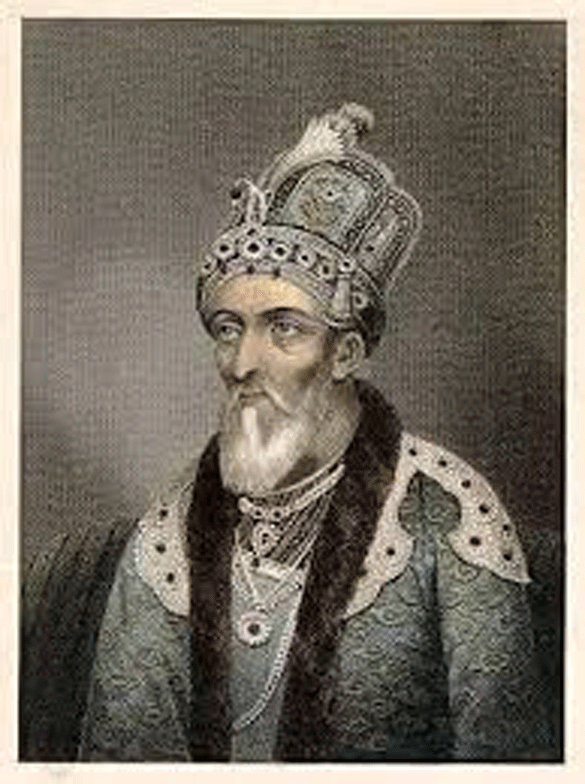
This poetic passage is part of the famous folk romance Sassi and Punnu, composed by the Punjabi poet Hashim Shah. Written in folk verse, it portrays the pain of separation and the depth of love in a powerful narrative style.
Marsa mul na mursa jan tali par dharsa
jad takk jan rahe vicc tan de marno mul na darsa
je rabb kuk sassi di sunsi ja palla us
pharsa hashim nahi shahidan hoke thal maru vicc mursa.
(Translation: I will die, but will not return at all from my path. I will place my life on the palm of my hand. So long as life remains in my body, death in the least I will not fear. If Allah will hear the cries of Sassi then I will go and seize his skirt. Or else becoming a martyr, Hashim, in sandy land I shall perish.)
The dramatic fashion in which Punnu was carried off and the counsels of her mother and others almost maddened her and she followed her beloved. The heat in the desert was unbearable, and Sassi could not continue any further; yet she would not return:
Camki an dupaihra vele garmi garm behare
tappdi va vage asmano panccchi mar utare
atash da daria khalota thal maru vicc sare
hashim pher picchah na mur di lu lu hot pukare
najak pair gulab sassi de maihdi nal shangare
balu ret tape vicc thal de jiu jau bhunnan bhathiare
suraj bhaj varia vicc badali darda lishak na mare
hashim vekh yakin sassi da sidko mul na hare.
(Translation: At midday the heat of the hot season increased. Burning air blew from the sky, felling the birds and killing them. A river of fires was flowing all over the sandy desert. Hashim, still she did not turn back, each pore of hers was calling the Hot. The delicate rose-like feet of Sassi with heena beautified, were in the hot sand of the desert like as roast barley in an oven. The sun ran, and in clouds hid himself, through fear he did not shine; Hashim, behold the trust of Sassi, in truth she did not fail.)
A short while before her death in the desert sands the helpless Sassi, losing self-control, curses the thieves of her Beloved:
Shala rahin kiamat lai nal sula de lurke
hashim maran kumaut bidesi, lun vungu khur khur ke.
(Please Allah, till resurrection’s day, with acute pains affected, Hashim, may the foreigners die an unnatural death, like salt slowly melting.)
She even curses the camels which carried Punnu away from Bhambor, and the caravan:
Orak vakat kaihar dia kuka sun patthar dhal java
jis daci mera punnu kharia shala oh dozakh vicc jave
ya us nehu lage vicc birho vang sassi jar jave
hashim maut pave karvana lukhm zamino jave.
(At last hearing the cries of woe even a stone would melt. The camel which has carried my Punnu away, please Allah, may she go to hell, or may she in love’s separation suffer and like Sassi be burnt. Hashim, may death on the caravan fall and from earth their seed disappear.)
When Punnu inquired of the shepherd about the newly-made grave he replies:
Akkhe oh fakir punnu nu khol hakikat sari
ahi nar pari di surat garmi mari vicari
japp di na punnu da ahi dard ishk di mari
hashim nam makan na jana ahi kaun vicari.
(To Punnu that faqir relates, opening the whole truth: It was a woman, image of a nymph, dead because of heat, poor thing, repeating the name of Punnu and of love’s pain she died, Hashim; her name and house I do not know, nor who the poor one was.)
(We took these couplets from Biographical Encyclopaedia of Sufis: South Asia by N. Hanif, and the translation has also been done by him.)
Hashim Shah's ideology was firmly anchored in Sufism, emphasizing spiritual enlightenment, divine love, and a humble, simple lifestyle free from material excesses. He viewed Sufism not just as a practice but as an inherited belief system, with his poetry often allegorically representing human longing for the divine through tales of earthly romance. His verses promote detachment from worldly attachments, inner purity, and unity with Allah, blending Punjabi cultural elements with influences from Persian, Arabic, and Hindi vocabularies. Themes of suffering, devotion, and transcendent love recur, portraying love as a path to spiritual union.
Hashim's poetry, often in forms like dohre (couplets), siharfi (acrostic poems), and qissas (narrative epics), is rich in Sufi symbolism.
From his dohre (couplets), emphasizing divine presence and love:
"Rowan nain jinhan de karan, sun ishqa jehi tudh ne kiti. Main wich tain wich sahab mere."
(Translation: "The eyes that weep for Him, hear the love He has bestowed. My Lord is within me, and I within Him.")
"'Main main' karan sohne bakrote, majnu dar diwana leli. Mahi yar aram na mainu, mahi vangu fahi mahi."
(translation: "Saying 'I, I' like beautiful goats, Majnu became mad at the door. My beloved gives me no rest, like a noose around the beloved.")
Highlights the madness of divine love, drawing from folk lovers like Majnu.
From Sassi Punnu
“Sau dukh teri jind nit jardi, jerrha palag na jave jarya. Bhari zakham jigar da hoya, dekh khoon akhien vich bharya. Mera haal pichane majnon, jis dukh vich main sarya."
(Rough translation: "A hundred pains afflict your life daily, which the body cannot endure. The liver's wound is filled, see the blood in the eyes. Recognize my state, Majnu, in this pain I am immersed.")
Building on Hashim Shah's Sufi roots, his ideology further emphasizes the transience of worldly life, the inevitability of divine will, and love as a transformative force that demands sacrifice and detachment from ego. In his works, suffering is portrayed as a necessary trial for spiritual growth, where earthly love mirrors the soul's yearning for Allah. He often invokes themes of fate, redemption through mercy, and the ineffability of the divine, critiquing material pursuits while advocating surrender to Allah's plan. These ideas are woven into folk narratives like Sassi Punnu, using romantic tragedy to allegorize mystical union.
Hashim Shah died in Ajnala, with sources differing on the year of his death, either 1823 or 1843. He was buried in Tharpal village in the Narowal District, where his Urs was traditionally observed every year on or around the 21st of Jeth (late May to early June).
…
New Age Islam, Islam Online, Islamic Website, African Muslim News, Arab World News, South Asia News, Indian Muslim News, World Muslim News, Women in Islam, Islamic Feminism, Arab Women, Women In Arab, Islamophobia in America, Muslim Women in West, Islam Women and Feminism