
The Cosmology of Love and Discipleship in the Chishtiya Tradition: Insights from Shah Kareemullah Chishti's Legacy

By Rehan Ahmed Khan, New Age Islam
24 November 2025
Hazrat Shah Kareemullah Chishti a resonating Hyderabad Sufi saint dislocated worldly life for divine love, received spiritual training in Ahmedabad, guided many disciples, and performed miracles, one of them relating to a prophetic well-left behind an enduring Chishtiya legacy in devotion, humility, and service to humankind.
Main Points:
1. Allah created, loved, and honoured humanity as His vicegerent.
2. Spiritual greatness of Prophet Muhammad and his companions
3. Shah Kareemullah Chishti's renunciation of worldly rank for divine love.
4. His training under Hazrat Mahmood Miya Chishti.
5. His miracles, which include the blessed water well.
-----
Introduction
In the vast tapestry of India's spiritual heritage, the luminous traditions of Sufism stand as enduring symbols of divine love, human refinement, and spiritual wisdom. Among the many saints who deepened the fragrance of this tradition, Hazrat Maulana Shah Kareemullah Chishti, reverently known as Aashiq-e-Khaja Barkas Hyderabad, remains a towering figure. His life, anchored in devotion to Allah, reverence for the Prophet Muhammad (peace be upon him), and service to humanity, continues to inspire countless followers. This research article explores his journey, teachings, miracles, and the larger spiritual legacy that shaped a significant chapter of Deccan's Sufi history.
The Divine Foundation: Creation, Love, and Human Purpose
Islamic tradition begins with this eternal truth: Allah, the Most Merciful, is without resemblance, partner, or similarity. The two worlds, seen and unseen, appeared from His order “Be”. Humanity was created from a handful of dust and yet honored as the mirror of divine greatness. The Quranic affirmation “I have made man a vicegerent on Earth” made human beings the representative of Allah, and the verse “Bow before Adam” (Surah al-Baqarah:34) confirmed this divine assignment.
Explaining it further, the Sufis said the world was created for love, as Allah first loved the Prophet Muhammad, and through that love, creation came into being. Classical sayings resound with this: “Your existence was a hidden treasure, so I loved it,” and “If not for you, I would not have created the universe.” Such expressions, deeply rooted in Sufi metaphysics, form the spiritual backdrop of Indian Sufism.
Praise to the Prophet and His Companions
The Sufi tradition regards the Prophet Muhammad (peace be upon him) as the perfect manifestation of divine light, purified from sin, a bearer of revelation, and endowed with miracles that include splitting the moon. The companions closest to him were Hazrat Abu Bakr, Hazrat Umar, Hazrat Usman, and Hazrat Ali, celebrated as gleaming jewels on his blessed hand, each outstripping the others in loyalty, bravery, and wisdom.
Sufis maintains that it is beyond the limitations of the human tongue to praise Allah and His Prophet since, as the sacred Hadith says, “La Uhsi Thana’an Alayk” means “I cannot enumerate Your praise.” Humbleness before divine greatness thus became a cardinal principle for the later saints of Islam, including Hazrat Shah Kareemullah Chishti.
Early Life and Turning Point
He was born as Muhammed Abdul Kareem, son of Hazrat Maulvi Ghulam Mahdi, and was brought up in Hyderabad Deccan with learning, devotion, and spiritual inclination. He served in the Hyderabad Kingdom Government as an officer and had a rank as Mansabdar with a meagre stipend of rupees 10 per month. After completing his education, he joined the newly opened railway department at Gulbarga and later rose to the rank of assistant director. His competence even caught the attention of Nawab Mukhtar Mulk Bahadur, who recommended further promotions.
Yet, in that worldly progress, a deeper call stirred within him: the overwhelming love of Allah. Finding spiritual progress far out valuing worldly gain, he refused the promotions and retired from official life. The Nawab, with some concern for this strange detachment, sent Dr. Mirza Ali to examine him, but no prescription was possible for the love of Reality. Eventually, the doctor intimated that his disposition was not malady but a godly state.
Search for a Spiritual Master
He gave up worldly riches, status, and relations to undertake a spiritual journey to Ahmedabad. There, he became the disciple of Hazrat Shaikh Mahmood Miya Chishti Qadri Naqshbandi Suhrawardi Gujarati, a scion of the great lineage of Hazrat Nasiruddin Chiragh Dehlavi and Khwaja Hameeduddin Nagori, both great spiritual successors of Khwaja Moinuddin Chishti. After undergoing all the different stages of spiritual discipline, he was given the title Shah Kareemullah and formal Khilafat in 1296 AH.
Upon receiving instructions, he went to Ajmer Sharif, before returning to Hyderabad upon paying homage at the threshold of Khwaja Gharib Nawaz's tomb, to continue the Chishti line of succession.
A Life of Simplicity, industry and independence
He was self-supporting. As his spiritual stature grew, Hazrat Shah Kareemullah Chishti never lived on offerings. He practiced different trades with perfection in each trade he handled: industry, craftsmanship, and various commercial pursuits. Whatever offering he could get was kept specifically for the annual Fateha of Khwaja Moinuddin Chishti.
His verse gives expression to this principle:
"My state is such that I live through the strength of my own arms,
For I know not reliance upon worldly wealth.”
His all-night worships, rigorous spiritual practices, and steeping in divine love produced verses that showed his mystical ecstasy:
"Today with ecstasy I drank the wine of love divine:
And therewith vanished piety and abstinence alike.”
Caliphs and Disciples
Hazrat Shah Kareemullah Chishti groomed 14 caliphs, of whom 12 outlived him. Their names are retained in his Diwan: Shah Aleemullah, Shah Naimullah, Shah Rahimullah Sadiq, Haji Shah Shamimullah, among others. Many among them were eulogized even before they attained Khilafat. These disciples continued his mission of love and service in the Deccan and elsewhere, creating a dynamic spiritual nexus based on the Chishti ideals of love, compassion, and service.
Miracles And Prophetic Foresight
Among the most important events recorded is the prophecy of his own death, which Hazrat had foretold as early as 16 years in advance. He had foretold that he would die on 10th Rajab, 1320 AH, at precisely 4 o'clock on a Monday and indeed, the prophecy was fulfilled right to the letter.
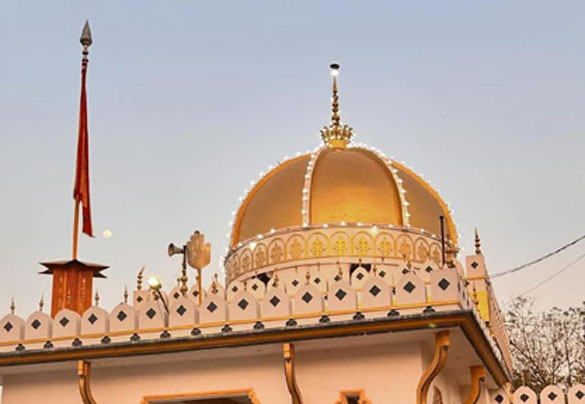
Before he left, he arranged to have his burial place selected near Pahadi Sharif; he ordered the construction there of lampstands, a flag platform, and structural foundations for a future dome.
The Miracle of the Water Well
One of the most remarkable events took place during the construction of the shrine. Repeated efforts by engineers and officers including Captain Jannisar Baig Jung Bahadur failed to find water within the surrounding rocky terrain. However, Hazrat appeared in a disciple's dream, guiding where a well should be dug. Having dug only a yard deep, a spring of plentiful water welled up, adequate for all building purposes and still flowing today through the dry seasons of the year. Because this well is on high ground where water was geographically unlikely, the well has been considered a miracle and a testimony to the spiritual power of Hazrat.
Recognition Beyond Hyderabad
The list of people who witnessed spiritual visions included the mother-in-law of Jannisar Yar Jung, a frequent visitor to Ajmer Sharif. She had, in a dream at Khwaja Gharib Nawaz’s shrine, seen a divine light emerging from Hyderabad’s Barkas region and heard the message: "My beloved dwells in Hyderabad; your coming is accepted therein." This dream reinforced the belief of the devotees that Hazrat Shah Kareemullah Chishti was the favoured one of Khwaja Gharib Nawaz himself.
The Compiler and His Relationship to the Saint
The biographical account we draw from was prepared by Shah Kareemullah Adeem, originally Mohammed Abdul Kareem, who was accepted as a disciple when he was 29 years old in 1304 AH. Over a period of more than 16 years, Hazrat raised his spiritual status and finally awarded him his personal belongings - his staff, crown, Zafar pillow, and handwritten Diwan - along with Khilafat in four main Sufi orders : Chishtiyya, Qadriya, Suhrawardiyya, and Naqshbandiyya.
Conclusion
The life of Hazrat Maulana Shah Kareemullah Chishti represents a resplendent chapter not only in the spiritual history of Hyderabad but also of the Indian subcontinent. Rooted in divine love, dedicated to the path of the Prophet, and illuminated by the teachings of the Chishti order, his journey reflects the transformative power of faith. His miracles, foresight, piety, and unwavering humility continue to inspire scholars, devotees, and seekers even today. The legacy, kept alive through disciples, writings, and other living traditions of Sufism, stands to remind one that spiritual greatness is born not of worldly status but of surrender, love, and service unto the Creator.
-----
Rehan Ahmed Khan is an Independent Research Scholar specialising in Muslim Personalities and Communal Harmony.
New Age Islam, Islam Online, Islamic Website, African Muslim News, Arab World News, South Asia News, Indian Muslim News, World Muslim News, Women in Islam, Islamic Feminism, Arab Women, Women In Arab, Islamophobia in America, Muslim Women in West, Islam Women and Feminism