
Nawab Abdul Lateef: Wisdom Of a Muslim Scholar with A Vision Between Faith, Empire, And Nation
By New Age Islam special correspondent
24 March 2026
Abdul Lateef was, in his day, revolutionary not as an army's commander or mass-action organizer. Instead, he was the deep thinker whose focus was on changing Muslim society’s mind. His contribution to the Indian Muslim theory at the beginning of the 20th century was profound.
Abdul Lateef initiated processes that usher a new era by redefining religion, politics, education, and the concept of living together among Indian Muslims.
Major points:
· Born into a high Muslim family in 1828 in Bengal of pre-modern India, which had already seen great British colonial advances, Abdul Lateef experienced drastic economic, social, and political upheavals. Older power apparatus was breaking down, and new modes of control were emerging.
· As one of his most prominent reasons, Abdul Lateef declared that India itself was Darul Islam, the territory of Islam.
· The legacy he left is a perfect example of how ideas are partially responsible for the wonderful things historical periods have seen. They are the silent geniuses who change the destiny of a nation in distress.
· In the great uncertainty of complex challenges confronting India in the present age, the form of his thoughts gained substantial revision not because of any boutique intellectual exercise but because of pressing ones in the same environment.
...
In the background of Indian Muslim business-oriented life, some figures elude memory not because they were violent or held swords high, but because they shook minds in their society. Nawab Abdul Lateef illustrates this point. The 19th-century Muslims were embedded in an Indian society that was under British colonialism. In this scenario, Abdul Lateef initiated processes that usher a new era by redefining religion, politics, education, and the concept of living together among Indian Muslims.
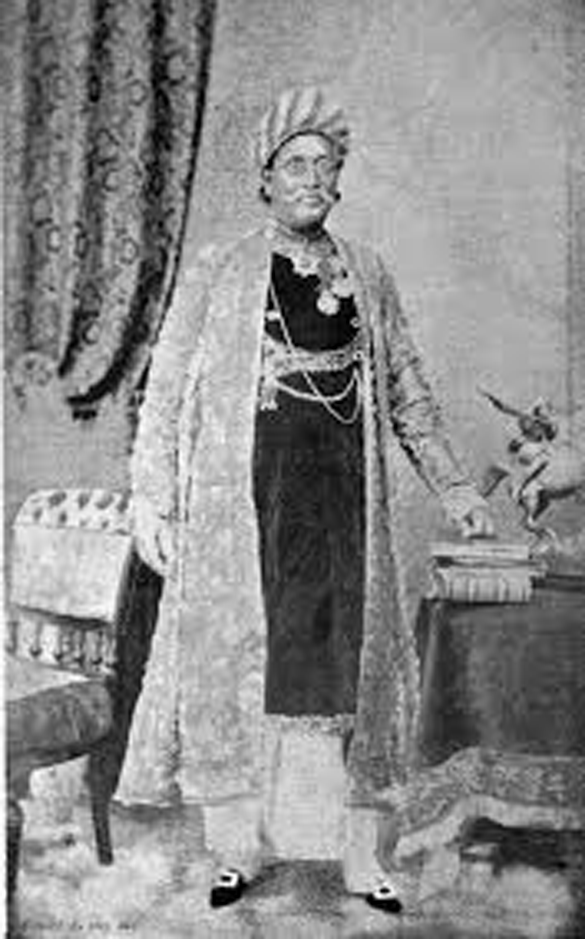
This was the time when the scars of the 1857 uprising were still fresh, and the mistrust between the Muslim and British communities was still at its peak. Abdul Lateef struck a balance that managed not to bow to the British while avoiding confrontational attitudes. Instead of that, he engaged in reform — social, educational, and intellectual. His teachings of India as Darul Islam, anti-jihad against the British, stressing the importance of modern education, and concern for religious comprehension made him one of the frontrunners in the reformation of Muslims in India under the colonial rule.
This article tries to narrate his personal and political life, thoughts, and objectives, in a commoner’s phrase that throws light on why his ideas remain rational even today.
Early Life and Background
Born into a high Muslim family in 1828 in Bengal of pre-modern India, which had already seen great British colonial advances, Abdul Lateef experienced drastic economic, social, and political upheavals. Older power apparatus was breaking down, and new modes of control were emerging.
Abdul Lateef, who hailed from nobility through a purely traditional Muslim family, to a degree, was educated through an Islamic school. This provided him with a more comprehensive level of knowledge that he later complemented with the Western model of education. This dual learning and knowledge-building marked his intellectual position. He was neither only a product of the madrasa learning nor was he shaped completely by the colonial education; rather, his identity was due to a blend of both cultures.
When he joined the colonial administration and was given authority, he gained insight into British rule and the nature of society in India during the colonizing period. Moreover, as a high official, he was able to act as an unofficial communication bridge between the British administrators and the Muslim masses living in the Indian subcontinent.
The Crisis of Indian Muslims After 1857
Abdul Lateef undoubtedly was a mark of the crisis that emerged in the Indian Muslim community after the 1857 Revolt. To comprehend Abdul Lateef’s vision behind this great legislative act, one has to first understand the crisis of Indian Muslims after the Revolt of 1857.
The revolt, usually called the First War of Independence, had substantial Muslim restrictions, mostly combat and military leadership, as against the British. The British suppressed the revolt; they considered Muslims with suspicion. Many Muslims publicly felt themselves politically defeated, economically marginalized, and socially disoriented.
The disintegration of the old order meant that traditional institutions like madrasas were giving way to those latest in the line. Persian, which in the previous era was the official language, was replaced by English. Muslims who were previously the elite during Mughal rule had become irrelevant in the present social fabric.
This created a deep sense of anxiety:
Was British rule acceptable in the light of Islamic terms?
Should Muslims alter violence or moderate it?
Did the comprehensive educational system help infuse or compromise the faith and identity of the Muslims?
Abdul Lateef’s discipline enabled him to question these questions clearly.
India as Darul Islam: A Strategic Reinterpretation
As one of his most prominent reasons, Abdul Lateef declared that India itself was Darul Islam, the territory of Islam.
While the classical Islamic jurisprudence mostly categorized the world into Darul Islam (the place of Islam) and Darul Harb (the place of struggle), or in other words, war, some pundits in 19th-century India held that British-fueled Dominion now belonged to the latter category, and it made jihad against the colonial rule permissible or even mandatory based on religious grounds.
Abdul Lateef held a hard-line stance against this proposal.
He argued that India could not be termed as Darul Islam anymore as all the previous assets and religious freedoms had been chopped off. The old places of worship (mosques) were surface for show and name; religious rites were carried out; Sherry could only be followed in personal affairs. Hence, the basis for Darul Islam, the freedom for the practice of religion, was retained.
This was not just a theological argument; it was a strategic intervention. By declaring India as "Darul Islam," Abdul Lateef:
Undermined calls for violent rebellion
Provided religious justifications for coexistence
Encouraged Muslims to focus on reform rather than resistance
Such interpretation, in fact, led to a society peaceful, relieved by the edge of confusion and chaos.
Fatwas Against Jihad: A Call for Pragmatism
His idea of India as Darul Islam was considerably connected with his most crucial idea of defining Jihad considering the British atrocities against the Muslim populace.
After 1857, against the ripening of the tree of freedom, some religious leaders uttered fatwas asking for a jihad. As the calls were rooted in some fundamental problems—the loss of authority, decline of the economy, and cultural alienation—however, I thought that it was not to the point and was harmful.
Conversely, he was favorable to any fatwa that rejected the notion of violence in the name of jihad in India during colonial domination, and the issue was crystal clear;
1. Religious freedom exists
The liberty to practice Islam was clearly there, showing that the overall need for struggle was missing.
2. Incapacity, Insufficient Assets
The sovereignty no longer belonged to the natives, but the political control and military strength went on with the constant people’s struggle. Struggling against this situation would bring more disasters to the people of the country.
3. Adoption of Reforms
The challenge that the native was to first defeat and overcome was not the foreign domination as the Muslims thought, but the internal backwardness. That is, illiteracy, economic failure, and social stagnation.
4. Avoiding Collective Repression
The uprising implies the disappearance driving down the conditions, rendering the Muslims limited chances.
On Abdul Lateef's part, "colonialism" was not actually what he endorsed, but rather a refusal to be co-opted or put on a path that came into conflict with the preservation of Islamic values. He was critical enough to understand that survival and progress required flexibility.
Advocacy of Colonial Education
What particularly marks Abdul Lateef in the greatest way is his defense of a more current, English-based educational system.
In a time when the majority of Muslims thought of being of English Language Education positively, seeing English as a means of embracing a new age of chemicals and biomedical science—he was arguing that it was essential for existence.
Through his foundation of the Darul Uloom in 1866 (Calcutta), he instructed the promotion of modern education in the last decade of the 19th century. The society, through lectures and discussions and publishing, became a space of strong intellectual interchange.
Hence, Abdul Lateef agreed with:
Education as a means of reviving social class integration
The industrial equilibrium of society was achieved when English was studied
The scientific and mystical basis of the developed civilization
He did not perceive faith-based education for Muslims as conflicting with the principles provided by traditional secular education. Rather, he saw the former as being interwoven into the latter, thus enabling Muslims to practice their faith notwithstanding the type of education they received.
Instead of being a substitute for Islamic education, his approach was aimed at becoming a supplemental part of it. He encouraged Muslims to:
Ensure that religious values do not overpower secular subjects
Utterly embrace the new knowledge and the emerging sciences in the world
Participate actively in the social, political, and economic systems of their society
His compromise and ultimate solutions helped to abolish the intense resistance of the educated Muslim society to the Western educational system in Bengal.
Religious Harmony and Social Coexistence
Moreover, his philosophy highlighted the issue of religious co-existence. Among his ideas, he preached the importance of living in peace with one another’s religion, especially in a diverse community.
Here he lived in a world where various religions such as Hinduism, Muslims, and other communities existed together. He argued that whether these communities would be able to live together peacefully or not was an issue of not if but when.
Key Elements of His Approach
1. Mutual Respect
The quality of religions should be shown mutual truce of one another's beliefs and practices.
2. Shared Interests
Whether they were Muslims or other religions , the common social and economic problems of Indians served as a bridge to narrow the gap.
3. Avoiding Sectarian Conflict
Rather than engaging in the communal tensions, they only made the community disoriented and unsure of everything.
4. Cooperation with the state
Copying with the British government peacefully would give a chance to all communities to improve their lives.
He located the commonalities rather than the contradictions he saw in being a Muslim faithful to Islamic teachings but also in a moderate role as a member of pluralistic societies.
Relationship with the British
From historical accounts, many times Abdul Lateef is criticized because he walked down the line while holding the allies’ hand. But the truth remains that there were multiple sides to his relationship with colonial authorities.
He was optimistic that:
The process of working together with the British may in turn create opportunities for reformation
Positive engagement produces more positive outcomes than negative engagement
At the same time, the Muslims did need to rebuild the confidence of the British toward them as well.
In his role as an intermediary, he was conveying Muslims’ anxiety to authorities and introducing government policies to this community.
He gave his loyalty by involving himself, but his was never compromised. In fact, he was just ahead of his time and using the strategy as a way of enhancing the Muslims’ position.
Comparison with Contemporary Reformers
One can draw a contrast between Abdul Lateef’s thoughts and the ideas of other reformers who lived during his time frame.
Sir Syed Ahmad Khan
Although Lateef's beliefs are unique to his time, Abdul Lateef shared with Sir Syed modern education, anti-jihad against the British, and collaboration with the colonial authority.
However, while Sir Syed worked mainly in Husnabad, in the Deccan, Abdul Lateef directed his activities mostly in Bengal. Both were more or less joint forces in the broad base of the so-called Muslim modernist movement.
Deoband School
However, the allegiance of Deoband was more towards:
Primary emphasis on the sanctity of traditional Islamic educational methods; and
The reformation primarily emanates from the mother of all classical scholarship in Islamic teachings.
But while demands were also opposed to any unjust and Batun (non-juristic) rebellion, the nature of their reform approach was different from the approach that Abdul Latif took by focusing more on western education.
Wahhabi and Jihad Movements
Some others regarded violent revolt as the recommended action to take. Abdul Lateef was quite vocal in his support of non-violent germination of the Muslim power; and thus he argued convincingly why such forms of resistance (violent movements) were neither pertinent nor practical in the context of the Indian dispute.
Long-Term Impact
Abdul Lateef’s teachings have been an essential part of the Indian scene for many decades.
His sustained striving may have been the main factor that led to the offing of the resistance on the part of many talented Muslim youngsters to enroll in schools, especially in Bengal.
His voice was heard in the shift from politics to power, social development, and ideologies.
His outlook on Darul Islam and his anti-war views sought to enter a more logical as well as nonviolent regime of religion.
Relevance in Contemporary India
More than a century after his death, his teachings still maintain utmost validity.
1. Rethinking Religion and Politics
With reference to the current world, quarrels encircling the loyalty of political authorities to religion exist. He states that it was possible for one to have an allegiance to their religious connotation even if they were not Muslim and the political leadership was run primarily by non-Muslims.
2. Rejecting Extremism
In this, his fatwa shows how imperative it is to understand the context in a text while you are interpreting what happened. In turn, struggling with these dooms of fellow religions that surged from the same books at the same time speaks volumes and serve as a warning that religion is not to be justified.
3. Importance of Education
His emphasis on modern education is still as important today as it was the day he wrote this essay, important for instance, in confronting the plight of partition of minds and culture among the underprivileged.
4. Promoting Harmony
So as not to encourage civil strife, his doctrine of peaceful coexistence and mutual respect needs to be emphasized more than ever.
5. Pragmatic Form
Underpinning this religious supremacy to reform religious practices and beliefs signifies that the path for progress does not call for discarding that but rather amends to fit the time.
Conclusion
Thus, Abdul Lateef was, in his day, revolutionary not as an army's commander or mass-action organizer. Instead, he was the deep thinker whose focus was on changing Muslim society’s mind. His contribution to the Indian Muslim theory at the beginning of the 20th century was profound.
Such a thinker did Islamic the Muslim subservient status over the British as he brought attention to the fact that Hindu as well as Japanese societies had managed to regain their status from Soviet occupation. The very foundation that was laid for being a Dar-ul-Islam (the land of peace) and feeling surprised of any internal conflicts by imparting education of modern science and thought led to stability. And, for establishing a society along with harmony that stemmed from many ways of thinking and belief which could be the differentiating for Muslims rather than disuniting them was one of the visions of Abdul Lateef.
The legacy he left is a perfect example of how ideas are partially responsible for the wonderful things historical periods have seen. They are the silent geniuses who change the destiny of a nation in distress. In the great uncertainty of complex challenges confronting India in the present age, the form of his thoughts gained substantial revision not because of any boutique intellectual exercise but because of pressing ones in the same environment.
URL:
New Age Islam, Islam Online, Islamic Website, African Muslim News, Arab World News, South Asia News, Indian Muslim News, World Muslim News, Women in Islam, Islamic Feminism, Arab Women, Women In Arab, Islamophobia in America, Muslim Women in West, Islam Women and Feminism