
Nasira Sharma, A Living Symbol of Hindu-Muslim Unity

By Afroz Khan, New Age Islam
23 May 2026
Nasira Sharma is a celebrated Hindi writer known for portraying Partition, identity, women’s struggles, and Hindu-Muslim harmony. A Sahitya Akademi Award winner, she championed social reform through literature and personal life, becoming a symbol of courage, secularism, and women’s empowerment in Indian society.
Key Points
· Nasira Sharma is a renowned Hindi novelist and storyteller.
· She promoted Hindu-Muslim unity through her life and writings.
· Her works deeply portray Partition, identity crisis, and women’s issues.
· She received the Sahitya Akademi Award for Parijat.
· She was the only South Asian woman journalist to interview Ayatollah Khomeini during the Iranian Revolution.
“India suffers more from social backwardness than from political and religious rigidity.”
Nasira Sharma
In today’s times, when religious intolerance and controversies surrounding interfaith marriages have become increasingly common, one writer not only entered into an interfaith marriage but also nurtured it with remarkable grace and dignity. Nasira Sharma stands as a living symbol of Hindu-Muslim unity.
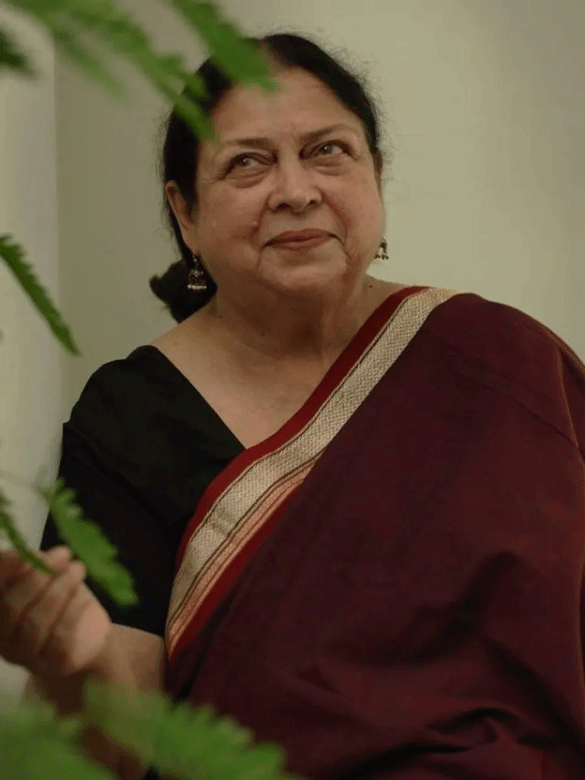
Nasira Sharma was born on 22 August 1948 in Allahabad (now Prayagraj), Uttar Pradesh, into a Shia Muslim family. Her mother’s name was Nazneen Begum and her father, Professor Jamin Ali, was not only the Head of the Urdu Department at Allahabad University but also a progressive-minded poet.
Nasira Sharma received her early education at St. Anthony’s Convent School in Allahabad. After the untimely demise of her father, her mother enrolled her at Hamidia Girls’ College. Her mother became her first teacher and instilled in her a deep passion for education. Nasira Sharma completed her B.A. from Allahabad University and later earned an M.A. in Persian Language and Literature from Jawaharlal Nehru University. She is proficient in Hindi, Urdu, Persian, English, and Pashto.
Nasira Sharma entered into a love marriage with a man from a traditional Brahmin family. Her husband, Ramchandra Sharma, was himself a professor as well as a widely respected and successful writer. There was no opposition or controversy in either family regarding the marriage. Both families were educated, dignified, and progressive in their outlook, and they accepted the relationship with warmth and respect.
Speaking about this, Nasira Sharma once said:
“I had the unique privilege of experiencing the joy of belonging both to a Muslim parental home and a Brahmin marital family.”
Describing her beautifully blended family further, she said:
“I consider a Hindu like a fragrant flower and a Muslim like a blossoming jasmine tree.”
Nasira Sharma believes that Hindus and Muslims have lived together harmoniously for centuries and that they are incomplete without one another.
As her father himself was a renowned poet and literary gatherings and mushairas were regularly held at home, Nasira Sharma naturally developed an inclination towards writing from a young age. However, her formal literary journey began in 1975 when her stories “Butkhana” and “Takaza” were published in the prestigious magazines Sarika and Manorama respectively.
Having deeply experienced the tragedy of Partition, Nasira Sharma portrayed with remarkable sensitivity the emotional and psychological impact it had on Indian Muslims, particularly those who migrated to Pakistan. Her celebrated novel “Zinda Muhavare”, published in 1994, explored how Muslims who migrated to Pakistan in search of a homeland were labelled as “Muhajirs” and often treated as second-class citizens there. The novel remains a deeply moving account of the mental, social, and cultural disintegration caused by the Partition of 1947.
Besides this, in another of her stories, “Sarhad Ke Is Paar”, Nasira Sharma poignantly portrayed the sense of alienation, psychological conflict, and identity crisis experienced by Indian Muslims after Partition through the character of Rehan. The story shows how society repeatedly questions the loyalty of Muslims living on this side of the border, and how such suspicion leaves an ordinary Muslim emotionally hurt, angered, and psychologically disturbed. Through the character of Rehan, the story presents a vivid and realistic depiction of this emotional turmoil.
In 2011, Nasira Sharma’s novel “Parijat” was published. The novel stands as a vibrant reflection of India’s composite culture and beautifully portrays harmony among different religions and civilisations. In it, she addressed issues such as the miserable condition of widowed women, oppression by in-laws, and mismatched marriages. At the same time, she strongly advocated widow remarriage, women’s empowerment, and women’s self-reliance. For this novel, she was honoured with the Sahitya Akademi Award in 2016.
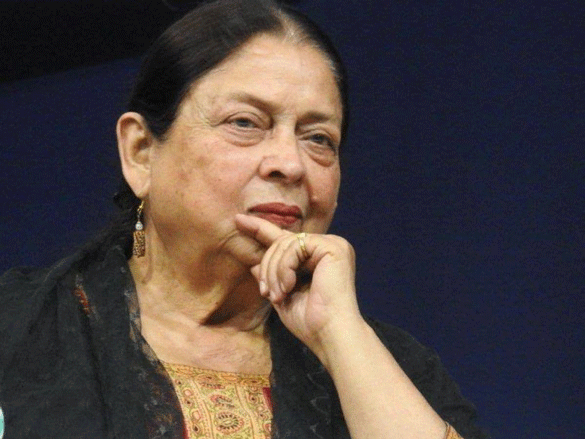
In 2019, Nasira Sharma received the Vyas Samman for her novel “Kagaz Ki Naav.” She was also honoured with the UK Katha Award for another of her novels, “Kuiyanjaan.”
Some of her major novels include Shalmali, Theekre Ki Mangni, Zero Road, Akshayvat, Ajnabi Jazira (based on the devastation of war and the crisis in Iraq) and Alpha-Beta-Gamma.
Apart from novels, Nasira Sharma has written several acclaimed short stories, including Patthar Gali, Doosra Taj Mahal, Ibne Maryam, Sabina Ke Chalis Chor, Insani Nasl, Butkhana, Shami Kagaz, Sangsar, and Meri Priya Kahaniyan. Through these stories, she sensitively highlighted the struggles of marginalised communities, the inner conflicts of women, and the impact of global changes on society.
Nasira Sharma believes:
“A writer has no religion. A writer does not work within the limits of any single ideology or faith. A true writer walks alongside the whole world and humanity at large.”
She has also made significant contributions to children’s literature. Her notable works for children includes Azadi Ka Gumnaam Sipahi Batakh Miyan, Azadi Ke Gumnaam Sipahi Maulana Ahmad Ullah Shah, Gullu, and Nanha Picasso.
During the Iranian Revolution in 1979, when monarchy came to an end and Ayatollah Khomeini rose to power, Nasira Sharma became the only woman journalist from South Asia to interview him. At a time when Iran was passing through a period of intense turmoil and violence, and when it was considered extremely dangerous for foreign journalists, especially women, to enter the country, she carried out her work with extraordinary courage and fearlessness.
Literary critics of Hindi literature remarked on her achievement:
“What Nasira Sharma accomplished was nearly impossible even for a male war correspondent of that era. She had the courage to work under the shadow of guns and still write the truth fearlessly.”
Through both her writings and her personal life, Nasira Sharma transformed her ideals into reality and consistently tried to bring meaningful change to society. She emerged as a powerful symbol of women’s empowerment, fearlessness, and Hindu-Muslim unity, a courageous woman who brought change through both her life and literature.
…
Afroz Khan is a teacher by profession who writes on women, politics, communal harmony, and Islam. She holds a master’s degree in Education.
New Age Islam, Islam Online, Islamic Website, African Muslim News, Arab World News, South Asia News, Indian Muslim News, World Muslim News, Women in Islam, Islamic Feminism, Arab Women, Women In Arab, Islamophobia in America, Muslim Women in West, Islam Women and Feminism