
Allama Mashriqi’s Funeral – One of the Largest in World History
By Nasim Yousaf, New
Age Islam
17 August
2024
Mashriqi's Political
Life Was Marked by Constant Struggle. In 1958, At The Age of 70, He Was
Imprisoned Under False Murder Charges Related to The Killing of Former Chief
Minister of West Pakistan, Dr. Khan Sahib, During President Iskandar Ali
Mirza's Government. Despite Lieutenant Colonel Ilahi Bakhsh—Who Had Been
Mohammad Ali Jinnah’s Doctor During His Final Days—Informing The Court of
Mashriqi’s Serious Illness, Mashriqi Was Still Brought to Court Handcuffed,
Mistreated, And Mishandled During His Confinement
-------
Allama
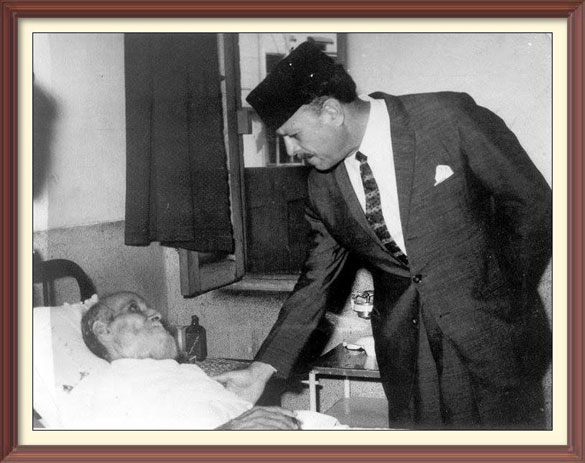
Inayatullah Khan Al-Mashriqi (1888-1963), a valiant freedom fighter and founder
of the Khaksar Movement, passed away on August 27, 1963. His funeral, which I
witnessed at around the age of 10 on August 29, 1963, in Lahore, was one of the
largest in world history, with estimates of the crowd ranging between one hundred
thousand and one million mourners. This article commemorates the 61st death
anniversary of Mashriqi and offers a detailed account of the funeral attended
by his devoted followers and admirers.
Mashriqi's
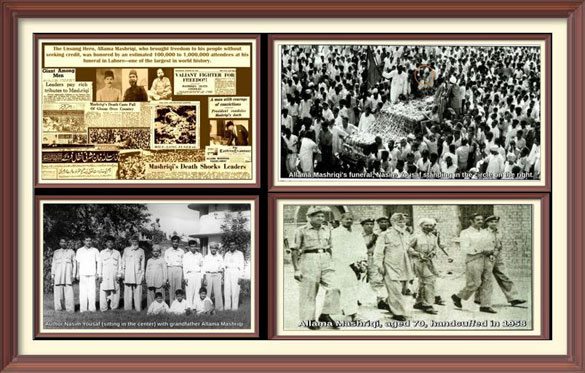
political life was marked by constant struggle. In 1958, at the age of 70, he
was imprisoned under false murder charges related to the killing of former
Chief Minister of West Pakistan, Dr. Khan Sahib, during President Iskandar Ali
Mirza's government. Despite Lieutenant Colonel Ilahi Bakhsh—who had been
Mohammad Ali Jinnah’s doctor during his final days—informing the court of
Mashriqi’s serious illness, Mashriqi was still brought to court handcuffed,
mistreated, and mishandled during his confinement. Due to poor food, mental and
physical torture, and inadequate medical treatment, his health continued to
deteriorate. Ultimately, no evidence was proven against him, and on November
17, 1958, Mashriqi was honourably acquitted of the murder charge. Upon his
release, Mashriqi stated:
“The undesirable torture I have been put to by
the previous Government for uncommitted crimes will remain a landmark in the
history of corruption and tyranny for all time...My suffering almost to the
point of death that I had to face at the hands of the political tyrants, has
not gone in vain and I am happy that truth and righteousness have at last won a
battle like of which has, perhaps seldom happened in the history of the defeat
of evil.”
Despite the
challenges he faced, including a deadly disease, he remained resilient. Yet,
his once-strong body grew weak and accustomed to pain. I vividly remember my
visits to his house—how I would press my beloved grandfather's legs and feet,
hoping to bring him some relief from the aches that burdened him. Those moments
were my small way of comforting him.
The
intention behind implicating Mashriqi in a murder case was to execute a
judicial murder disguised as a legal process, aiming to secure his execution
through a court verdict. However, the evidence against him was exceedingly
weak. The police's main witness, Khursheed Khalid, a prominent Khaksar, had
been beaten and coerced into testifying against Mashriqi. When Khalid later
recanted his statement, admitting that it was false and made under duress, the
entire case collapsed like a house of cards. I have covered this fictitious
case in detail in my 450-page book titled “Allama Mashriqi Narrowly Escapes the
Gallows: Court Proceedings of an Unpardonable Crime Against the Man Who Led the
Freedom of the Indian Subcontinent."
Though
Mashriqi was freed, as time progressed, his health continued to
deteriorate. On August 8, 1963, he was
admitted to Albert Victor Hospital, which was part of Mayo Hospital in Lahore.
News of Mashriqi’s condition was reported daily in newspapers across the
country. Dignitaries, along with a large number of Khaksar followers and
admirers, began visiting the hospital to see their ailing leader. Many offered
blood donations and volunteered to nurse him. Letters and phone calls inquiring
about his health poured in from across the country and abroad, ringing in the
hospital, Mashriqi’s home, and among his relatives and followers. Special
prayers were held both within Pakistan and abroad for his early recovery.
On August
12, President Mohammad Ayub Khan called the hospital to inquire about
Mashriqi's health and offered him medical treatment in Switzerland at the
government’s expense. However, Mashriqi politely declined the offer, as it was
against his principles to use public funds for personal treatment.
Additionally, he remarked, “I do not want to die in a foreign land.” On August
24, the President, accompanied by the Governor of West Pakistan, Amir Mohammad
Khan, visited the hospital. Mashriqi thanked them for their concern, saying, 'Aap Ka Bohat Shukriya' (Thank you very
much). Ayub replied, 'Khuda Khair Karay'
(May God make you well).
His time
came, and Mashriqi passed away on the night of August 27 at six minutes past
nine, at the age of 75. The Pakistan Times dated August 28, 1963 reported “A large
number of Khaksars, who had . . . been in the surrounding lawns of the hospital
since the Allama was admitted and had prayed for the recovery of their leader
were shocked into silence. But the first shock at once wore out and the
hospital suddenly echoed with sounds of weeping, wailing men and women, the
late leader’s relatives and his devoted followers.”
Upon
announcing his death, newspapers immediately published special supplements that
were distributed across Pakistan. The news was also broadcast on Radio
Pakistan, All India Radio, BBC, and other news channels around the world. The
news of Mashriqi’s passing spread like wildfire. The next day's reports made
headlines in major newspapers across the country, with articles and editorials
describing him and his movement.
The
Khaksars arranged a ceremonial burial for Mashriqi. On the night of August 27,
at approximately 10:00 p.m., his body was wrapped in the red Khaksar flag,
placed on a stretcher trolley, and taken to the mortuary, which was about 300 yards
from his hospital room. The trolley, with two Khaksar flags mounted on the
sides, was pushed by prominent Khaksars, while others marched in front of and
behind the trolley, calling out “Chap
Rast, Chap Rast,” the marching command used for synchronizing Khaksars’
steps like military soldiers. The followers of the late leader remained silent
as they escorted him to the mortuary, but the monotony of the marching commands
was interspersed with suppressed sobs. The sound of their shoes on the metaled
road of the hospital broke through the stillness of the night. Inside the
mortuary, only a few selected Khaksars accompanied the body. Khaksar guards
were stationed at the doors of the mortuary and at various points around the
building, where they were to remain for twenty-four hours until the body was
taken to its final resting place.
At the
hospital, the Khaksars raised the red Khaksar banner, adorned with the white
star and crescent moon, in honour of their late leader. They chanted passionate
slogans, proclaiming that while the leader was dead, the movement remained
alive and would endure forever. In accordance with Mashriqi’s wishes, he was to
be buried at the headquarters of the Khaksar Tehreek, adjacent to his house in
Ichhra, Lahore, where he had launched his Movement 33 years earlier.
Trains,
planes, buses, trucks, wagons, cars, and taxis, all packed with Khaksars and
mourners, arrived in the city to attend his funeral. Khaksar camps were set up,
including one at the Mochi Gate, where Khaksars from all over the country
stayed.
On the day
of the funeral, Mashriqi’s wooden coffin was covered with flowers and floral
wreaths and placed on an open-roofed vehicle with two Khaksar flags on the
sides. The funeral procession began from Mayo Hospital at 8:00 a.m. on August
29, 1963, for its ten-mile journey to Ichhra.
A group of
uniformed Khaksars marched in front of and behind the vehicle. Starting from
Mayo Hospital, the procession passed through areas such as Bunse Bazaar, Shah
Alam Market, Rung Mahal, Chowk Naugaza, and reached the Badshahi Mosque. All
business centres, including Shah Alam Market, Azam Cloth Market, Akbari Mandi,
Kashmiri Bazaar, Dabbi Bazaar, Alamgir Market, Shoe Market, Furniture Market,
Bunse Bazaar, and others, remained closed as a mark of respect for the late
leader and to mourn his death.
Around 9:45
a.m., the procession reached Badshahi Mosque for the funeral prayers. The
mosque and its courtyard were completely filled, so the masses gathered outside
wherever they could find space to join the prayers. The funeral prayers were
led by Maulana Abdus Sattar Khan Niazi at 10:00 a.m. Thereafter, the procession
began again, heading for its final destination. From the mosque to Ichhra, the
procession route included Chowk Naugaza, Tehsil Bazaar, Bazaar Hakiman, Bhatti
Gate, Circular Road, New and Old Anarkali, Lytton Road, Mozang crossing,
Ferozepur Road, and then to Ichhra. Along the way, people chanted slogans such
as Allama Mashriqi Zindabad, Khaksar-i-Azam Zindabad, and Mujahid-i-Azam
Zindabad. Zindabad means Long Live.
The funeral
procession, overflowing with mourners as far as the eye could see, moved very
slowly. While I was standing on the funeral vehicle, I was pushed off into the
crowd. Fortunately, some Khaksars immediately picked me up and placed me back
onto the vehicle. Had they not rescued me, I would have been crushed under the
ocean of faces; there was no room to carve out a space of one's own.
It was
attended by people from all walks of life, including political and religious
leaders, members of the National and Provincial Assemblies, cabinet ministers,
the Parliamentary Secretary, and other dignitaries. People lined both sides of
the roads for the entire route of the procession, and though traffic was
rerouted, there were still traffic jams everywhere. Men, women, and children of
all ages were on the sidewalks, rooftops, balconies, trees, poles, and anywhere
they could find a place to stand. I also saw men and women, children of all
ages, crying, sobbing, and beating their chests out of emotion and love for
Mashriqi; some of them even fainted. Braving the sweltering heat, the
procession participants continued marching, and people stood for long periods
to pay homage and take their last glimpse of the departed leader. Throughout
the funeral route, people had made arrangements for cool water for those in the
procession. Among the crowd were also families whose sons, brothers, and
husbands had either been killed during the freedom movement or had suffered the
brutalities of prison during the Khaksar struggle for freedom.
There were
a number of very intense moments throughout the procession. As the procession
reached Chowk Naugaza, the site of the Khaksars' massacre, guns were fired, and
the martyrs of March 19, 1940, were saluted. Khaksars who had lent support to
those involved in the massacre were present among the mourners. Another
powerful and emotional moment occurred when the funeral reached near the
Borstal Jail on Ferozepur Road, the prison where Allama Mashriqi had once been
confined. People chanted slogans similar to those mentioned earlier as a
tribute to Mashriqi.
All along
the route, people were reciting verses from the Holy Quran and showering him
with petals in an effort to bid farewell to the departing leader. The abundance
of flowers on Mashriqi’s body was so overwhelming that his face could hardly be
seen, and the entire route was covered with a carpet of blooms.
The
procession eventually reached Ichhra. At that time, out of their love for
Mashriqi, the mourners and Khaksars continually kissed me on the head and
hugged me, seeking consolation and solace for their grief through their
embrace. The Khaksar Tehreek’s flag at the headquarters was flown at half-mast.
Before the burial, Khaksars honored Mashriqi with a 101-gun salute, and he was
laid to rest with full honors.
The solemn
scene at the time of the burial reached its peak when all the men, women, and
children began to cry hysterically and sob as Mashriqi was laid into his grave
at 2:05 p.m. Mashriqi’s death “ended the illustrious career of a person who
fought valiantly throughout his life against the British…by organizing the
Khaksar Movement,” wrote the Civil & Military Gazette on August 30, 1963.
The nation
seemed to be in a state of shock. The Urdu and English newspapers covered the
funeral with these words: “The remains were laid to rest with streaming tears
and shaking hands…a shower of flowers at the funeral,” "Mashriqi's Death
Casts Pall of Gloom Over the Country,” and “Mashriqi’s Death Shocks Leaders.”
Another called Mashriqi a “Giant Among Men,” and “Lahore's atmosphere once
again echoed with the sounds of Chap Rast.” The papers carried condolence
messages from the President, former Governor General, and a large number of
other prominent people. Articles and editorials were also written describing
him and his Movement.
It is
important to remember that at the time of his death, not only was Mashriqi's
role in ending the British Raj still fresh in the public’s memory, but also the
attempts to crush him both in British India and later in Pakistan. Mashriqi was
arrested about six times in British India and at least nine times in Pakistan.
While he faced fewer arrests and less overall confinement under British rule,
he endured more frequent arrests and imprisonment in Pakistan, despite his old
age. In May 1962, despite suffering from cancer, he was imprisoned in District
Jail Rawalpindi, located opposite the Rawalpindi District Courts, which I
visited with my parents. This vindictive behavior, which began right after
Pakistan’s creation, continued in the country. These experiences, among the
reasons, garnered him significant sympathy and admiration, leading to large
crowds at his funeral to pay their respects.
According
to two newspapers, the funeral procession was one mile long, with 100,000
people in attendance. However, the Khaksar circle reported that the entire
10-mile route was jammed with mourners, estimating the crowd to be up to one
million. The Khaksars believed that the state-controlled media often presented
distorted facts and figures, which is entirely correct. I recall seeing someone
in the crowd, possibly a journalist, trying to film the funeral and being
aggressively stopped by the police. This is why no video recordings of Allama
Mashriqi versus his contemporaries have ever surfaced. The British
establishment, which had significant influence in Pakistan and held a grudge
against Mashriqi for forcing their exit from India, sought to suppress his
promotion. This suppression of filming was part of efforts to prevent the true
scale of the event from becoming widely known. Given the scale of the funeral
and the intense emotions involved, I can confidently say that I have yet to
witness such a large funeral, which supports the Khaksars' account of the crowd
size. For more details about the anti-British stance against Mashriqi and the
fabrication of facts by historians and professors, refer to my published works,
including my latest article from July 2024, titled “Allama Mashriqi’s Order:
300,000 Khaksar Soldiers Reach Delhi and the Sudden Collapse of British Rule.”
His death
was mourned for a long time, with people constantly sending messages and making
phone calls not only to Mashriqi’s house but also to our home, his relatives,
and the Khaksars. They would praise him and regard him above any of his
contemporary leaders, recounting stories of his bravery, including how Mashriqi
ended British rule—details that I have also included in my published works.
Great and
remarkable was a man whose life guided humanity, embodying the principles he
preached with a saintly purity. Though he is gone, his writings and speeches
continue to inspire and direct us. His admirers still mourn his death, feeling
a profound sense of loss. In 2023, his funeral was featured in the documentary
I produced, titled "The Road to Freedom: Allama Mashriqi's Historic
Journey from Amritsar to Lahore." Also visit the Facebook page “Nation
Mourns Death of Legendary Freedom Fighter, Allama Mashriqi”.
----
Scholar Nasim Yousaf, a biographer of Allama Mashriqi and other legends
in his family, has dedicated 28 years to documenting the history of the Indian
subcontinent, beginning his research in 1996. He has authored 19 books and
digitized 19 rare works. In addition to his 2.5-hour documentary on Allama
Mashriqi, his monumental contributions include digitizing Mashriqi’s historic
and rare journal Al-Islah and writing a book on Khaksar women. Detailed
information about the scholar’s biography and the world-renowned libraries that
carry his books can be found online.
Copyright © 2024 @NasimYousaf
New Age Islam, Islam Online, Islamic Website, African Muslim News, Arab World News, South Asia News, Indian Muslim News, World Muslim News, Women in Islam, Islamic Feminism, Arab Women, Women In Arab, Islamophobia in America, Muslim Women in West, Islam Women and Feminism