
Rethinking Alauddin Khilji: Power and Its Shadows

By Moin Qazi, New Age Islam
07 May 2026
The figure of Alauddin Khilji stands at the intersection of history and memory, where fact is continually reshaped by interpretation, and interpretation is often sharpened by the demands of the present. To approach his reign responsibly is not to reduce it to a moral slogan, whether of condemnation or celebration, but to enter a layered historical world in which power, survival, ambition, and contingency were deeply intertwined. The temptation to cast him either as a civilizational destroyer or an improbable saviour reflects less the texture of the medieval past and more the anxieties of modern identity-making. History itself resists such neat moral closures.
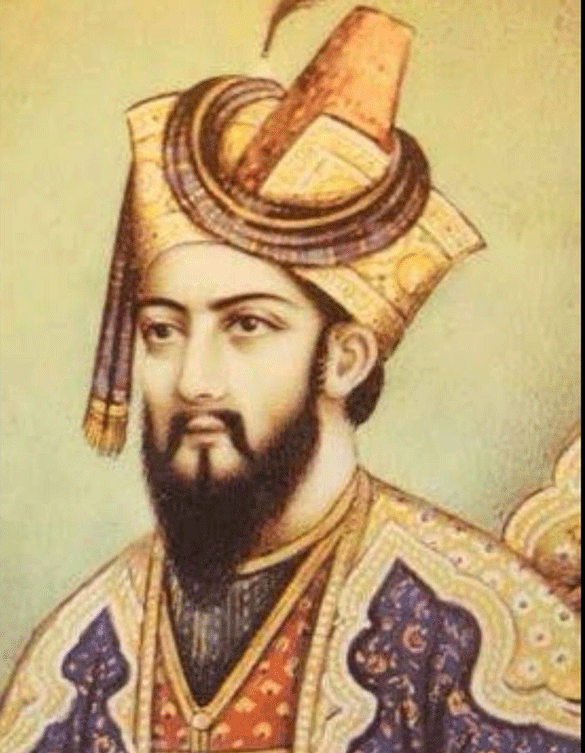
The Khalji dynasty marked a decisive transformation in the political evolution of the Delhi Sultanate. Founded by Jalal-ud-Din Firuz Khalji, a seasoned military commander who rose from outside the entrenched Turkish aristocracy, it disrupted established hierarchies and reconfigured access to sovereignty. His accession was itself a moment of institutional tension, as older elites struggled to reconcile themselves with a ruler perceived as socially and politically marginal. Jalal-ud-Din’s relatively conciliatory approach briefly softened this rupture, but his authority remained fragile. It was within this unstable environment that Alauddin Khilji emerged, first as a powerful provincial governor and eventually as a usurper who eliminated his uncle to claim the throne.
Alauddin’s reign unfolded in a political world defined by constant military pressure and precarious legitimacy. His ambitions were unmistakably imperial. Through calculated, sustained campaigns, he subdued key fortresses such as Ranthambhor and Chittor and extended his authority into central India. He incorporated the wealthy Deccan kingdom of Devagiri into the Sultanate’s fiscal and strategic orbit. These conquests were not merely territorial expansions; they were mechanisms for extracting wealth, asserting dominance, and stabilising a rapidly growing state. His general, Malik Kafur, carried this expansion further into the southern peninsula, returning with immense spoils that strengthened the regime’s economic foundations and reinforced Delhi’s position as an imperial centre.
Yet military conquest alone does not define Alauddin Khilji’s historical significance. His reign coincided with one of the most formidable external threats in Eurasian history—the Mongol expansion. Having already reshaped vast regions of Asia and Europe through rapid and often catastrophic campaigns, Mongol forces repeatedly targeted northern India. The Indo-Gangetic plains, with their economic density and relatively open terrain, represented both an opportunity and a vulnerability. It was in this context that Alauddin’s administrative and military reforms became decisive. By maintaining a large standing army, strengthening frontier fortifications, and ensuring rapid mobilisation systems, he was able to repel repeated Mongol incursions. These defensive successes preserved the political continuity of the Sultanate at a moment when collapse would have had far-reaching consequences for the region’s stability.
However, interpreting these defensive measures as part of a deliberate project to protect a single religious tradition is historically misleading. Alauddin Khilji did not govern as a theological agent, nor did his policies operate within a framework of religious guardianship. His orientation was fundamentally pragmatic. The logic of his rule was anchored in sovereignty—maintaining control over territory, ensuring the flow of revenue, and neutralising both internal dissent and external threats. Contemporary accounts even suggest that some religious jurists of his time criticised him for not adhering strictly to doctrinal prescriptions in governance, underscoring the gap between ideological expectations and political reality.
Economic Sustenance
This pragmatism is most clearly visible in his economic restructuring. To sustain an enlarged military apparatus and continuous defensive readiness, Alauddin introduced stringent revenue reforms. Agricultural taxation was increased and rationalised, market regulations were imposed, and price controls were instituted to stabilise the prices of essential goods. These measures created a tightly managed economic system that prioritised state capacity over market freedom. While the burden of taxation was significant and deeply felt in rural agrarian communities, it was not designed to target a specific religious group. Rather, it reflected the structural demands of maintaining a centralised, militarised state in a volatile geopolitical environment.
At the same time, the social consequences of these policies were complex. By restricting the discretionary power of local intermediaries and standardising revenue collection, the state reduced certain forms of arbitrary exploitation that had existed in earlier fragmented systems. However, these reforms also intensified direct state extraction, which placed considerable pressure on cultivators. The result was not uniform oppression or relief, but a reconfiguration of existing burdens within a more centralised administrative order.
The nature of warfare during this period further complicates modern moral readings. Military campaigns were often accompanied by the destruction of fortified centres of authority, which included temples, granaries, and administrative hubs. Such acts, while frequently interpreted through a religious lens today, also had strong political and economic dimensions. Temples, in particular, often served as repositories of wealth, land, and legitimacy. To strike them was not only a symbolic act but also a strategic one aimed at dismantling the power structures embedded within them. The violence of the age was severe and unmistakable, but it operated within a broader logic of premodern state formation rather than within the categories of modern ideological conflict.
Modern analytical frameworks such as “genocide” or systematic civilizational annihilation are difficult to apply cleanly to this context. Medieval polities did not generally pursue the total eradication of populations. Instead, they sought incorporation, subordination, and revenue extraction. The survival of a state depended on its ability to mobilise labour, agricultural surplus, and local administrative cooperation. Even harsh regimes were structurally compelled to preserve the very populations they taxed and governed. This does not diminish the reality of suffering, but it does complicate narratives that frame violence as absolute or exterminatory in intent.
At the level of lived experience, however, conquest was often deeply disruptive. It could mean displacement, loss of autonomy, destruction of local institutions, and the humiliation of established elites. Such experiences naturally generated enduring memories of trauma and resistance. Over time, these memories were transmitted, reshaped, and embedded within broader cultural narratives that gave them symbolic weight far beyond their immediate historical context. Memory, in this sense, becomes both testimony and transformation—preserving fragments of experience while reinterpreting them across generations.
Continuity and Expansion
Yet alongside disruption, there was also continuity. The societies that experienced these upheavals did not disintegrate. They adapted, reorganised, and continued to evolve. Cultural practices persisted, religious traditions endured, and new forms of political and social organisation emerged. This resilience was not the absence of trauma but the capacity to absorb it and continue. Civilizational continuity, therefore, was not the result of any single ruler’s intentions, but of the cumulative adaptability of communities over time.
The Khalji dynasty itself embodies this paradox of expansion and fragility. Alauddin Khilji’s empire achieved extraordinary territorial and administrative reach, yet it remained deeply dependent on his personal authority and coercive capacity. Following his death in 1316, the structures he had built rapidly began to destabilise. Succession struggles, factional rivalries, and court intrigues weakened central control, and within a short span, the dynasty began to decline. Malik Kafur’s brief and turbulent dominance after Alauddin’s death further illustrates the instability inherent in power systems built on rapid expansion and concentrated authority.
In reassessing Alauddin Khilji, the central challenge is to move beyond inherited binaries. He was neither a civilizational guardian nor a singular agent of destruction. He was a ruler operating within the constraints and possibilities of his time—ambitious, pragmatic, often ruthless, and deeply embedded in the logic of medieval sovereignty. His actions shaped the trajectory of the Delhi Sultanate, but they did not define the entirety of the society it governed.
Ultimately, civilisations are not the creations of rulers alone. They are sustained by the everyday endurance of people who adapt, negotiate, and persist through changing political orders. No single reign can determine its destiny in totality. To read history with clarity is therefore to resist both myth and simplification, and to recognise a more demanding truth instead: that power is transient, but societies endure through continuity, adaptation, and the quiet accumulation of lived experience across generations.
In recent years, Padmavat and its source, Padmavat, have reignited fierce debates about Alauddin Khilji. Popular portrayals often reduce him to a one-dimensional villain—an oppressive ruler and cultural antagonist. Yet such portrayals obscure a critical historical reality: Khilji’s decisive role in repelling repeated Mongol invasions at a time when much of the known world was collapsing under their devastation.
Mongol Invasion
To appreciate this, one must first understand the scale of the Mongol menace. Under Genghis Khan and his successors, the Mongols created the largest contiguous land empire in history. Their campaigns across Central Asia, Persia, and Eastern Europe were marked not merely by conquest but by annihilation. Cities such as Nishapur and Merv were depopulated, while the catastrophic Siege of Baghdad (1258) led by Hulagu Khan effectively ended the Abbasid Caliphate and shattered a flourishing intellectual world.
The Mongol method of warfare was brutally systematic: submission ensured survival, resistance invited extermination. Their invasions left behind demographic collapse, economic ruin, and cultural erasure. Regions like Kyivan Rus endured centuries of stagnation under Mongol dominance. Against this backdrop, the Indian subcontinent stood as a potential target of similar devastation.
It was during this volatile period that Alauddin Khilji ruled the Delhi Sultanate (1296–1316). Unlike many rulers who capitulated to Mongol pressure, Khilji chose resistance. During his reign, the Mongols—particularly from the Chagatai Khanate under Duwa Khan—launched multiple large-scale invasions into northern India. These were not minor raids but formidable military campaigns, sometimes involving tens or even hundreds of thousands of cavalries.
Khilji’s response was marked by strategic clarity and military discipline. In 1298, his generals repelled a major Mongol force, inflicting heavy losses. The following year saw another invasion culminating in the Battle of Kili, where Khilji’s forces, despite internal challenges, managed to halt the Mongol advance. Even when caught off guard during the 1303 invasion—soon after his exhausting campaign at Chittor—Khilji adopted defensive innovations, fortifying Delhi and holding out under siege until the Mongols withdrew.
Subsequent invasions in 1305 and 1306 were met with decisive counterattacks, leading to crushing defeats for the Mongol forces. These repeated successes were not accidental; they reflected Khilji’s administrative reforms, a well-financed standing army, and effective leadership from commanders such as Malik Kafur and Zafar Khan. By the end of his reign, the Mongol threat to Delhi had been effectively neutralised.
What makes Khilji’s achievement remarkable is that few contemporary powers could claim similar success against the Mongols. From China to Eastern Europe, even strong states crumbled under their assault. That the Delhi Sultanate not only survived but repelled multiple invasions suggests a level of military competence and resilience that deserves recognition.
However, acknowledging Khilji’s military accomplishments does not require sanitising his rule. Contemporary chroniclers like Ziauddin Barani depict him as a harsh and often ruthless ruler. His taxation policies placed immense burdens on agrarian populations, and his punishments were severe. Yet these measures appear to have been driven more by political pragmatism than religious zeal. Khilji sought to consolidate power, prevent rebellion, and maintain a war-ready state amid constant external threats.
This distinction is important. While later narratives sometimes frame him as a religious bigot, historical evidence suggests that his policies were not systematically aimed at religious persecution. Instead, they reflected the logic of medieval statecraft, where survival often demanded coercion and control. In fact, Khilji himself reportedly prioritised state stability over adherence to religious law when the two conflicted.
The larger issue, then, is not whether Khilji was a “hero” or a “villain,” but how history is interpreted and simplified. Modern discourse often seeks clear moral binaries, projecting present-day identities onto premodern contexts. In doing so, it overlooks the complexity of figures like Khilji, who embodied both destructive and protective impulses.
Had the Mongols succeeded in conquering northern India, the consequences might have been catastrophic. Given their record elsewhere, it is plausible that large swathes of the subcontinent’s urban, cultural, and intellectual life would have been destroyed. That this fate was averted owes much to Khilji’s resistance—even if his motivations were rooted in self-preservation rather than any conscious desire to “save” Indian civilisation.
Evaluation of Alauddin Khilji
In the end, Alauddin Khilji stands as a reminder that history resists simplification. He was neither a saviour in the moral sense nor merely a tyrant devoid of redeeming qualities. Rather, he was a product of his time: a formidable ruler whose actions, driven by ambition and necessity, had consequences that extended far beyond his intentions.
To understand him—and history itself—requires moving beyond slogans and acknowledging the uneasy coexistence of power, violence, and unintended legacy.
The reign of Alauddin Khilji (r. 1296–1316) of the Khalji dynasty occupies a complex and heavily debated place in medieval Indian history. Emerging from a Turco-Afghan ruling elite, Alauddin consolidated power in Delhi after eliminating his predecessor, Jalaluddin Khilji, and went on to build one of the most centrally administered and militarily assertive regimes of the Delhi Sultanate.
His rule is often characterised by expansionist campaigns into Gujarat, Rajasthan, and the Deccan, led by generals such as Malik Kafur. These expeditions brought immense wealth into the Delhi Sultanate and extended its political influence deep into peninsular India. At the same time, they involved the defeat of several regional kingdoms, the extraction of tribute, and episodes of temple desecration recorded in some Persian chroniclers such as Ziauddin Barani and Wassaf. However, modern historians note that these sources were courtly or literary in nature, and often shaped by the political and rhetorical conventions of their time, making it difficult to separate ideological framing from historical fact.
Alauddin is also remembered for sweeping administrative and economic reforms. He introduced market controls, fixed price regulations, and a highly centralised revenue system designed to maintain a large standing army capable of resisting Mongol incursions. His military measures against repeated Mongol invasions into North India were among the most significant defensive successes of the Delhi Sultanate period.
Culturally, his court was a centre of Persian literary production, associated with figures such as Amir Khusrau, whose works blended Persian and Indian traditions and shaped the intellectual life of the period. The reign also saw the rise of influential military figures, such as Malik Kafur, whose southern campaigns expanded the Sultanate’s reach.
Sites such as the Somnath Temple became symbolic in later historical memory, with layered narratives of destruction, reconstruction, and political contestation over centuries. Contemporary scholarship generally emphasises that such events must be understood within the broader context of medieval warfare, where temple wealth often functioned as political and economic capital, rather than through exclusively religious or civilisational lenses.
historiographical, Alauddin Khilji remains a contested figure. Some traditions portray him as a ruthless conqueror, while others highlight his administrative genius and military resilience. The historical record reflects both the violence inherent in medieval state formation and the complexity of interpreting sources shaped by their own political and literary agendas.
Ultimately, Alauddin Khilji’s legacy is neither singular nor simple. It is embedded in the broader evolution of the Delhi Sultanate as a powerful medieval empire that reshaped the subcontinent’s political, economic, and cultural landscape.
…
Moin Qazi is an Indian author and development leader who advanced dignity-centred, community-led change. A pioneer of microfinance and grassroots institutions, he fused ethics with social innovation. With deep interdisciplinary scholarship, he bridged policy, justice, and lived realities. His legacy affirms ethical leadership and people’s agency as drivers of India’s progress…
New Age Islam, Islam Online, Islamic Website, African Muslim News, Arab World News, South Asia News, Indian Muslim News, World Muslim News, Women in Islam, Islamic Feminism, Arab Women, Women In Arab, Islamophobia in America, Muslim Women in West, Islam Women and Feminism