
Mirza Abul Qasim - Kashmir’s Forgotten Marsiya Poet

By Altamash Ali, New Age Islam
23 April 2026
Mirza Abul Qasim was one of the rare Kashmiri poets of the 19th century. He not only preserved the tradition of marsiya (elegy) but also made it richer with his personal pain, spiritual depth, and moral teachings. His poems connect the story of Karbala with the soil of Kashmir and are still recited in Muharram gatherings today.
Main Points:
· 1.19th-century Kashmiri marsiya poet who mixed his exile pain with Karbala’s grief.
· 2.His philosophy turned Karbala into a lesson of faith and courage: turn grief into strength.
· 3.Born in Gund Khwaja Qasim, Kashmir; exiled in 1840s; settled in Karbala, Iraq.
· 4.Wrote in Kashmiri, followed Khwaja family tradition; marsiyas still recited in Muharram.
· 5.Died around 1853 in Karbala and buried there; his grave links Kashmir’s pain with Karbala.
Leaving my estate behind in the soil of Kashmir,
I set out like Hussain on an unknown journey from Medina.
The pain of forced exile feels like the journey to Kufa,
Yet in the grief of Karbala, my personal sorrow finds its eternal home.
For him, the grief of Karbala was not just tears but an example of true faith. It gives us strength to stand against injustice. By connecting his own sorrow with Imam Hussain’s journey, he taught that even in every exile a greater truth is hidden. Mixing Quranic verses and the Prophet’s teachings in his marsiyas, he said life should be righteous and just. Every marsiya is a message of guidance, we should cry, but not only cry; we should learn and act. By linking Kashmir’s pain with Karbala, he said a community’s resilience is its real identity. Do not just watch Karbala, become part of it. This is true faith.
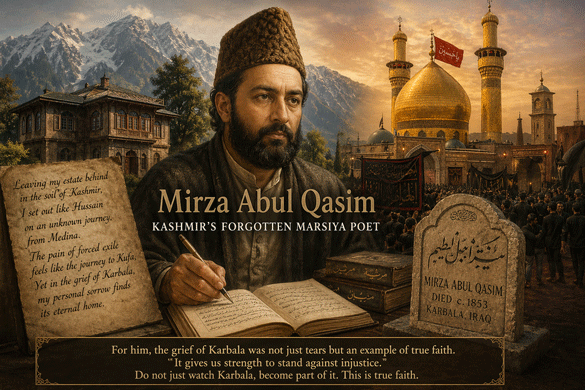
In his philosophy, Karbala was not just a historical event but a living lesson for life. He turned marsiya into a tool for moral education where personal pain, community suffering, and religious messages all come together. His poems teach that turning grief into strength is the real worship. He developed the muqam-bandh style beautifully, mixing the sweetness of Kashmiri language with Persian influence and local traditions.
Mirza Abul Qasim was born in Gund Khwaja Qasim (Parspore), Kashmir. He came from a rich family and owned estates and houses (some remains can still be seen there). In the early 1840s, due to a dispute with a local rival named Asad Joo and others, he had to leave Kashmir. His family was robbed while passing through Tosa Maidan. After this exile, he moved to Lucknow, which was a major centre for Urdu marsiya at that time. From there, to fulfil his spiritual wish, he went to Karbala in Iraq. There he served the pilgrims and spent his last days.
Mirza Abul Qasim is considered one of the most productive and popular Kashmiri marsiya poets. He wrote in the Kashmiri language and beautifully mixed Persian influences with local traditions. His marsiyas express not only the grief of Imam Hussain and his companions but also his own pain of exile and leaving his estate. That is why his words are still alive in Muharram gatherings in Kashmiri Shia communities.
The main focus of his philosophy was the “message of guidance”. Every line gives moral teaching, Quranic wisdom, Hadith, and the message of a good life. It was not just mourning but a lesson of courage, justice, and faith. He had a deep connection with the Khwaja family of Gund Khwaja Qasim (Khwaja Muhammad Baqir Gundi and his son Khwaja Abdullah). He was a student and successor of that tradition.
He did not publish any single book because Kashmiri marsiya is mostly an oral tradition. But in the 1970s, Syed Anis Kazmi collected, recorded, and compiled all his marsiyas (including “Meeras”). This collection saved his legacy. Today these poems are still recited in gatherings. His works were also recorded by Hakim Ghulam Safdar in the journal “Al-Irshad” in 1962. Scholars and poets are now reviving his poetry. He had strong links with Lucknow and Karbala, where he completed his literary and spiritual journey.
His study was not any formal degree. His whole life was his education. Inspired by Persian, Urdu, and Kashmiri literary traditions, he connected his personal experiences with Karbala. His message was always the same: turn grief into strength and give moral and spiritual light to the community. Today his marsiyas are an important part of Kashmiri Shia identity, resilience, and cultural memory. He is called an “unsung elegist”, but recent efforts (articles, collections, and recitations) are keeping his memory alive.
One more poem
When Hussain’s caravan moved towards Karbala,
My heart also left Kashmir on the same path.
Even in the storm of oppression, the lamp of truth kept burning,
This immortal story written in blood kept moving.
Crying is not just mourning, it is the call of faith,
The lesson of Karbala is to stand against every oppressor.
Mirza Abul Qasim died around 1853 in Karbala, Iraq. After his exile from Kashmir and stay in Lucknow, he chose Karbala as his final destination. There he devoted the rest of his life to serving the pilgrims of Hazrat Imam Hussain. His greatest spiritual wish was to be buried in Karbala, and this wish was fulfilled. He passed away in the midst of exile, grief, and deep devotion to Karbala. His grave in the holy land of Karbala still stands as a symbol of his legacy, where he permanently joined the pain of Kashmir with the sorrow of Karbala.
…
Altamash Ali is a sufi writer and a student at IFTM University..
New Age Islam, Islam Online, Islamic Website, African Muslim News, Arab World News, South Asia News, Indian Muslim News, World Muslim News, Women in Islam, Islamic Feminism, Arab Women, Women In Arab, Islamophobia in America, Muslim Women in West, Islam Women and Feminism