
Abu Ali Hasan IBN AL-HAYTHAM (965'1040): The First Scientist
By M. Basheer Ahmed, M.D, New Age Islam
24 January 2026
Introduction
In 2015, UNESCO declared the "International Year of Light," a global initiative aimed at highlighting the transformative power of light-based technologies in addressing challenges in energy, education, agriculture, and healthcare. This year also marked the 1,000th anniversary of the completion of Kitab al-Manazir (The Book of Optics), the magnum opus of the brilliant Muslim scholar Ibn al-Haytham. Often hailed as the "first scientist," Ibn al-Haytham revolutionized our understanding of light, vision, and the natural world. His pioneering use of experimentation and empirical evidence laid the groundwork for the modern scientific method, influencing generations of thinkers from the Islamic Golden Age to the European Renaissance and beyond. Al-Haytham’s legacy offers powerful call to reignite rational inquiry in our contemporary world.
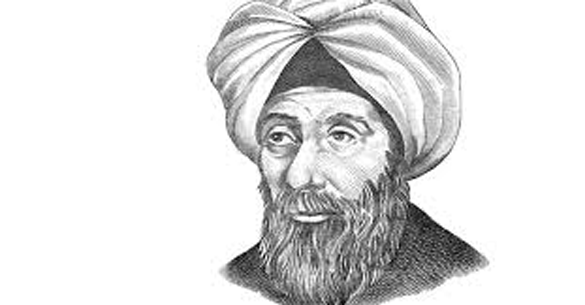
Centuries before Galileo and Newton reshaped Western science, Ibn al-Haytham articulated and practiced a systematic approach to knowledge that we now recognize as the scientific method. In an age where ancient authorities—particularly Greek philosophers like Aristotle and Ptolemy—were often accepted uncritically, Ibn al-Haytham disagreed. He believed that to find the truth, one must test ideas through physical evidence’. He famously said: “If learning the truth is the scientist’s goal, then he must make himself the enemy of all that he reads.” This statement encapsulates his conviction that skepticism and rigorous testing are essential to genuine understanding.
Unlike his predecessors, Ibn al-Haytham insisted that theories must be validated through tangible, repeatable experiments. This empirical approach distinguished him from ancient philosophers as he established a new paradigm for investigating the natural world. His work exemplifies the transition from philosophical speculation to evidence-based science, a shift in the Scientific Revolution in Europe. By insisting that “one must test ideas through physical evidence,” Ibn al-Haytham laid the intellectual foundation for all modern scientific inquiry.
Early Life and the Golden Age of Learning
Ibn al-Haytham was born in 965 in Basra, Iraq, during the zenith of the Islamic Golden Age—a period marked by extraordinary advancements in science, medicine, mathematics, and philosophy. During this time, students in Baghdad and other Muslim cities had access to libraries and scholars who taught various subjects, including science, medicine, and philosophy. Scholars enjoyed discussing ideas from newly translated ancient manuscripts and expanding upon the works of Greek, Indian, Persian, and Chinese scholars.
Initially trained in theology and law, Ibn al-Haytham served as a judge in Basra. However, disillusioned by the political and religious conflicts of his time, he turned his focus entirely on science. A polymath of remarkable breadth, he made significant contributions to astronomy, mathematics, engineering, and physics. His intellectual journey reflects the interdisciplinary spirit of the era, where the quest for knowledge cross boundaries.
The Nile Incident: That Made Ibn al Haytham a True Scientist
The Fatimid caliph al-Hakim, ruler of Egypt, invited him to Cairo to design a dam to control the flooding of the Nile River—a problem that had plagued Egyptian society for millennia. After careful study, however, Ibn al-Haytham concluded that the technology of his time was insufficient for such an ambitious engineering feat. Fearing the caliph’s notorious wrath, he pretended madness to avoid punishment. As a result, he was placed under house arrest, where he remained for nearly a decade until al-Hakim’s death in 1021.
This period of forced isolation became the most productive of his life. Confined to his home, Ibn al-Haytham devoted himself entirely to research, conducting experiments and composing his groundbreaking work on optics. His decade of house arrest could have been a period of despair. Instead, he transformed it into an opportunity for profound discovery. It was in this setting that he made some of his most profound discoveries.
Discoveries in Optics
Ibn al-Haytham’s most enduring legacy lies in his revolutionary work on light, vision, and optics. Prior to his investigations, the dominant theory of vision in the West was the “emission theory,” advanced by Euclid and Ptolemy, which suggested that the eye emitted rays of light to illuminate objects. Through meticulous experimentation, Ibn al-Haytham disproved this ancient notion. He demonstrated that vision occurs when light rays reflected from objects enter the eye, and form an image on the retina, which is then transmitted via the optic nerve to the brain for interpretation. He was the first scientist to suggest that vision happens in the brain, not the eye.
Ibn al-Haytham dissected animal eyes to study their anatomy, identifying key components such as the cornea, lens, and retina. He also explored the behavior of light through experiments with mirrors, lenses, and pinholes. His observation of light projecting an inverted image through a small aperture led to his detailed description of the camera obscura—a precursor to the modern photographic camera. This device became a vital tool for later artists and scientists, including Leonardo da Vinci and Johannes Kepler.
In Kitab al-Manazir, a seven-volume treatise written during his house arrest, Ibn al-Haytham systematically detailed his findings.
Volume I establish the empirical basis of his inquiry, arguing that light behaves consistently regardless of its source and introducing his theory of vision.
Volume II examines visual perception and the psychological aspects of seeing.
Volume III analyzes the conditions for clear vision and optical errors from a mathematical perspective.
Volumes IV and V develop the theory of reflection, exploring how light bounces off surfaces.
Volumes VI and VII investigate errors due to reflection and refraction, respectively.
His classification of light into primary (emitted directly from luminous bodies like the sun or lamps) and secondary (reflected from objects) provided a foundational framework for understanding illumination. He even correctly theorized that atmospheric light causes the sky to brighten before sunrise—an insight that demonstrated his keen observational skills.
The Transmission of Knowledge to Europe
The impact of Ibn al-Haytham’s work extended far beyond the Islamic world. By the 13th century, Kitab al-Manazir had been translated into Latin under the title De Aspectibus and circulated widely across Europe. Scholars such as Roger Bacon, Witelo, and later Kepler and da Vinci studied his writings intensively. For nearly 500 years, his optics remained the authoritative text on the subject, earning him the name Tolemaeus Secundus (“The Second Ptolemy”).
Ibn al-Haytham’s emphasis on experimentation deeply influenced the development of European science. Roger Bacon, often credited with advocating empirical methods in medieval Europe, drew directly from Ibn al-Haytham’s ideas. Similarly, Kepler’s work on the retinal image and the optics of the eye built upon the foundations laid in Kitab al-Manazir. This transmission of knowledge highlights the role of Islamic scholars in preserving and advancing ancient learning during Europe’s so-called Dark Ages.
A Legacy Neglected and Rediscovered
It is sad to say that Ibn Al-Ibn Al-Haytham's writings were more influential in Latin than Arabic. While European scientists appreciate and admire the scientific work and discoveries of great medieval Muslim scientists, unfortunately, Muslims abandoned teaching science and technology.
Beginning around the 11th century, political instability, theological conservatism, and shifting educational priorities led to a decline in scientific inquiry across many Muslim societies. By the 14th century, institutions that once championed rational sciences had curtailed or eliminated such subjects from their curricula. The great vizier Nizam al-Mulk, for instance, argued that excessive focus on philosophy and science could weaken the empire, leading to reduced funding for scientific research. By the 17th century, Many Muslim students did not even recognize the names of great Muslim medieval scholars.
It was only in the late 19th and early 20th centuries, through the efforts of Western historians and Orientalists, that his work was reintroduced to the Muslim world. Today, Ibn al-Haytham celebrated globally, the Alhazen crater on the Moon and asteroid 59239 Alhazen bear his name. Professor Charles Falco of Optical Sciences at the University of Arizona, an expert on Ibn al Haytham’s optics, said: “Visual literacy is not limited to the narrative and symbolic qualities of pictures and images, but it is also rooted in the scientific and cultural study of optics and the visual system. The genesis of this concept goes back to work of the 11th century Arab polymath Ibn al Haytham.”
Ibh Haytham’s story also tells us the consequences of neglecting empirical inquiry.
The Interplay of Faith and Reason Ibn al-Haytham’s was a devout Muslim who saw his scientific pursuits as an extension of his religious commitment to seeking knowledge. The Quranic injunction to “reflect on the creation of the heavens and the earth” (3:191) resonated deeply with him, inspiring a view of science as a form of worship—a means of understanding God’s creation. In his writings, he expressed humility before the complexity of the universe, arguing that the pursuit of truth brings one closer to the Divine.
This perspective challenges the false dichotomy often presented between religion and science. Ibn al-Haytham demonstrated that intellectual curiosity and spiritual devotion can coexist and even enrich one another. His example is particularly relevant today, as societies worldwide grapple with questions about the relationship between faith and rationality.
Lessons for the Modern World
Ibn al-Haytham’s legacy offers profound lessons for our contemporary era: In an age of information overload, where misinformation can spread rapidly, Ibn al-Haytham’s admonition to be “the enemy of all that one reads” is remarkably pertinent. Scientific literacy requires not just acquiring knowledge but also developing the ability to question, test, and verify claims.
The Importance of Experimental Verification: His insistence on empirical evidence reminds us that scientific progress depends on rigorous methodology. Whether in addressing climate change, public health crises, or technological innovation, solutions must be grounded in observable, reproducible data.
The decline of scientific scholarship in the Muslim world after the 14th century serves as a reminder that intellectual advancement is not inevitable. It requires sustained investment in education, open discourse, and institutional support. We must recognize that the pursuit of knowledge is both a privilege and a responsibility. Governments, educational institutions, and communities must prioritize science, technology, engineering, and mathematics (STEM) learning from an early age. This includes fostering hands-on experimentation and critical thinking skills.
Ibn al-Haytham showed that you don’t have to choose between your faith and your logic. For him, studying the laws of light and nature was a way to better understand the world. This balance helps break down walls and shows that science is a home for everyone, regardless of their background or beliefs.
The history of science is filled with contributors from varied backgrounds whose stories have been overlooked. By celebrating figures like Ibn al-Haytham, we can inspire a new generation of scientists from all walks of life.
Ibn al-Haytham dared to challenge centuries-old theories. Similarly, today’s researchers must have the courage to question established paradigms and explore unconventional ideas.
Ibn al-Haytham was not merely a “first scientist” in a historical sense; he embodies: skepticism, perseverance, and a profound reverence for truth. One of the most incredible parts of his story is that he did some of his best work while under "house arrest" in Cairo. Even when his world became small and dark, his mind stayed wide open. It showed us that you can spark a revolution of ideas even in the toughest circumstances.
A thousand years after the completion of Kitab al-Manazir, we live in a world transformed by the very principles Ibn al-Haytham championed. From the lasers that power our communications to the medical imaging that saves lives, his insights into light and vision continue to resonate. He proved that true progress is born not from passive acceptance, but from courageous, questioning.
Let us draw inspiration from Ibn al-Haytham’s legacy. Let us commit to fostering a global culture that values evidence over dogma, inquiry over indifference, and collaboration over division. By doing so, we honor not only the pioneers of the past but also the potential of future generations to build a brighter, more enlightened world. Ibn al-Haytham's story is not just a chapter in history; it's a powerful narrative about human curiosity, resilience, and the universal quest for truth.
Bibliography
· Bradley Stephens. The Prisoner of Al-Hakim. Clifton, New Jersey. Blue Dome Press (2017)
· Bradley Stephens. First Scientist Ibn Al-Haytham. Clifton, New Jersey. Blue Dome Press (2021)
· Jim Al-Khalili "Book of Optics, by Ibn al-Ibn Al-Haytham.
· https://www.britannica.com/biography/Ibn-al-Ibn Al-Haytham
· https://pubmed.ncbi.nlm.nih.gov/18822953
…
M. Basheer Ahmed, M.D., is a physician, humanitarian, and advocate for interfaith understanding and global peace. He is a former professor of psychiatry at UT Southwestern Medical School in Dallas, TX. He has written extensively on Muslim unity, interfaith dialogue, and Middle East policy
URL: https://newageislam.com/islamic-personalities/abu-ali-hasan-ibn-al-haytham-first-scientist/d/138577
New Age Islam, Islam Online, Islamic Website, African Muslim News, Arab World News, South Asia News, Indian Muslim News, World Muslim News, Women in Islam, Islamic Feminism, Arab Women, Women In Arab, Islamophobia in America, Muslim Women in West, Islam Women and Feminism