
Hazrat Shah Mohammed Qasim: The Revered Founder of the Abulolai Sufi Silsila in Deccan

By Adnan Faizi, New Age Islam
29 November 2025
Hazrat Shah Mohammed Qasim lovingly known as Hazrat Shaykh Ji Hali, was a pious and revered Sunni Sufi saint born in 1175 Hijri in Jhinjhino, Rajasthan. Under the spiritual guidance of Hazrat Izzat Allah Abulolai (Miya Sahab), he mastered mysticism and founded the Abulolai Sufi chain. Arriving in Hyderabad during the Nizam II era, he profoundly influenced the spiritual and social landscape through his teachings, disciples, and enduring legacy.
Main Points:
1. Hazrat Shah Mohammed Qasim founded the Abulolai Sufi silsila in Deccan, spreading Sunni spirituality.
2. He was born in 1175 Hijri, son of Hazrat Ghulam Mohammed of Ansari lineage.
3. Bayah taken under Hazrat Izzat Allah Abulolai, mastering mysticism and spiritual disciplines.
4. Known for humility, spiritual ecstasy in Sama, and leadership in Hyderabad during Nizam II reign.
5. His mausoleum in Urdu Sharif, Hyderabad, remains a pilgrimage site with continuing Urs celebrations.
-----
Introduction
Among the luminous saints who shaped the Deccan’s spiritual consciousness, Hazrat Hazrat Shah Mohammed Qasim stands as one of the most compelling figures of the 18th–19th century. With noble roots trace directly to Hazrat Abdullah Ansari, deep training in the Naqshbandi and Qadriya Silsila, and extraordinary spiritual refinement under his Murshid Hazrat Izzat Allah Abulolai, he became the founding pillar of the Abul Alai Sufi chain in Deccan. His journey from a humble child in Jaipur to one of Hyderabad’s most influential Sufi saints is filled with discipline, sacrifice, miracles, divine states (Ahwal), and a legacy preserved through disciples, malfuzat, and his remarkable mausoleum near Charminar.
Early Life and Family Background
Hazrat Shaykh ji Hali was born as Hazrat Shah Mohammed Qasim in 1175 Hijri in Jhinjhino village, Jaipur district, Rajasthan. He was the beloved son of Hazrat Ghulam Mohammed, a man esteemed in the royal court for his righteousness and descent from the noble Ansari family, tracing lineage back to Hazrat Abdullah Ansari. This heritage endowed the family with a deep spiritual and religious stature. During his formative years, Hazrat Shah Mohammed Qasim demonstrated an early predilection for devotion and piety. At the tender age of four, a ceremonial Bismillah (commencement of Qur’anic learning) was undertaken, marking the beginning of his rigorous Islamic education. Contrary to some misrepresentations, he was not unlettered; by the age of twelve, he had already memorised the entire Qur'an and was well versed in prayer and fasting.
From an early age, Hazrat Shah Mohammed Qasim was immersed not only in Islamic scholarship but also in disciplined spiritual training. Under the profound mentorship of Hazrat Izzat Allah Abulolai (Miya Sahab), he was introduced to the inner sciences of Sufism dua, dhikr, spiritual purification, and ascension. His humility, obedience, and devotion were so exceptional that he was soon recognised as a Khalifa and spiritual guide. In 1209 Hijri, during the era of Nizam II, he arrived in Hyderabad, dedicating himself to guiding disciples and strengthening Sunni Sufi traditions. His personal austerity, deep mystical insight, and the spiritual ecstasy he evoked particularly during the Tuesday Sama gatherings earned him reverence across social groups. Despite his exalted spiritual rank, he consciously lived with humility, often concealing his saintly stature to avoid praise.
Spiritual Training and Establishment of His Hyderabad Khanqah
Around the age of 14–15, Hazrat Shah Mohammed Qasim was taken by his father to the eminent Sufi Hazrat Shah Mohammed Izzat Allah Abulolai (Miya Sahab) in 1189 Hijri. This meeting became a turning point in his spiritual journey. His father entrusted him to the Murshid’s discipline, and Hazrat Shah Mohammed Qasim received Bay‘ah in two distinguished Sufi Silsila first in the Naqshbandiyya silsila and later in the Qadriyya. Miya Sahab placed him under a structured routine of Wazaif and trained him through three core practices: Mujahida, Riyazat, and Zikr. Under this disciplined guidance, he progressed rapidly, developing a deep understanding of the inner sciences of Sufism. His master occasionally embraced him as a sign of spiritual transmission, and through the chain of Hazrat Abul Ala Akbarabadi, he eventually attained a recognised spiritual rank.
After completing his period of training under Miya Sahab, Hazrat travel to Hyderabad, where his spiritual presence gradually evolved into a recognised centre for seekers. He first spent time in quiet meditation at the mosque in the Kaman of Elchi Baig before moving to Gulzar Khan’s villa. There, he began conducting regular Tuesday Sama gatherings, which soon became widely known in the city. People from different background scholars, nobles, soldiers, traders, and ordinary resident gathered to benefit from his teachings and devotional sessions. During these gatherings, his focus and humility left a strong impact on attendees, often drawing them towards commitment and Bay‘ah. Even individuals who initially approached him with doubts or criticism found themselves influenced by his sincerity and depth, with some eventually joining as devoted disciples.
Some of his disciples are named as follows: Hazrat Qutubuddin, Hazrat Fazal Allah, Hazrat Khan Qader Yar, and Hazrat Qader Nawaz Khan. Through his balanced approach rooted in spiritual discipline, quiet leadership, and accessible teachings his Hyderabad circle grew into a respected spiritual hub that continued shaping lives long after his time.
Final Days, Mausoleum, and Lasting Legacy
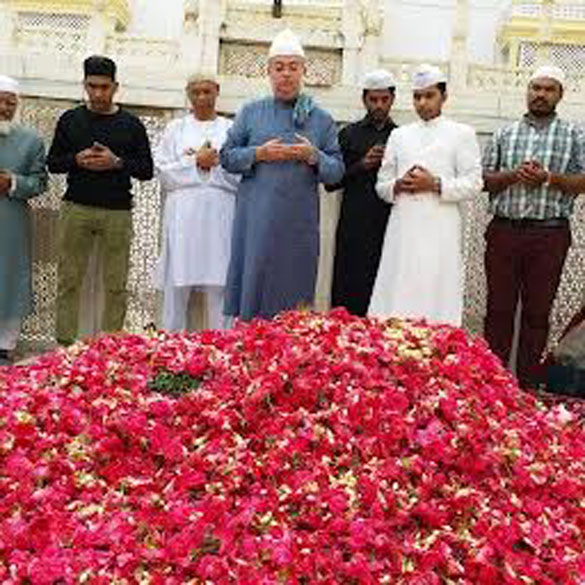
In 1238 Hijri (1823 CE), Hazrat Shah Mohammed Qasim fell seriously ill, and the prolonged sickness noticeably weakened him. As the time of departure drew near, a disciple softly reminded him to recite the Kalima. With slow, faint breaths, he recited it two or three times before passing away at the age of 63. His funeral was conducted with due respect, and he was laid to rest in the Urdu Sharif locality near Charminar, Hyderabad. Nearly fifty years later, in 1872, his first successor Hazrat Syed Umar Shah constructed a formal mausoleum over his grave. He sourced fine white marble jali stone from Makran in Rajasthan and installed it at the shrine a feature that continues to distinguish the Dargah for both its craftsmanship and historical value.
Today, the mausoleum of Hazrat Hazrat Shah Mohammed Qasim stands as a cherished spiritual centre in Hyderabad. Devotees, seekers, scholars, and admirers of Sufism visit regularly, drawing inspiration from his preserved teachings, noble character, and the traditions maintained at his Dargah. His life reflects a blend of humility, disciplined spiritual practice, deep insight, and a quiet yet far-reaching influence that continues to illuminate hearts across generations.
-----
Adnan Faizi is a Peace and Harmony activist based in Delhi. He is an alumni of CCS University, Meerut.
URL: https://www.newageislam.com/islamic-personalities/hazrat-shah-qasim-abulolai-sufi-silsila/d/137811
New Age Islam, Islam Online, Islamic Website, African Muslim News, Arab World News, South Asia News, Indian Muslim News, World Muslim News, Women in Islam, Islamic Feminism, Arab Women, Women In Arab, Islamophobia in America, Muslim Women in West, Islam Women and Feminism