
Hazrat Shah Makhdum Ruposh: The Saint Who Transformed Bengal's Heart Into an Islamic Sanctuary

By Adnan Faizi, New Age Islam
26 December 2025
Hazrat Shah Makhdum Ruposh, born as Abdul Quddus Jalaluddin in early 13th in Baghdad and known as Rupos for his devotional face-covering practice, journeyed across the Islamic world to Bengal. As a Chishti Sufi and pioneering preacher, he transformed Rajshahi's Varendra region from Hindu dominion into a thriving Islamic centre through miracles, mercy, and institutional legacy.
Main Points:
· Hazrat Shah Makhdum Ruposh, son of Hazrat Azala Shah, descended from Hazrat Abdul Qadir Gilani.
· With elder brother Hazrat Ahmad Miran Shah, migrated to Bengal after Hazrat Shah Turkan's martyrdom.
· He established khanqahs in Noakhali, Bagha, and Rampur Boalia, spreading Chishti Sufism through disciples.
· Hazrat led three battles against Raja Angsu Deo, triumphing through dervish courage.
· He died in 27 Rajab 1313 CE; his shrine became Mughal-patronised pilgrimage site.
Introduction
Among the architects of Bengal’s spiritual awakening, Hazrat Shah Makhdum Ruposh stands out as a figure of rare depth and balance at once a saint, a warrior, and a builder of society. He was born in 1216 CE in Baghdad, His father, Hazrat Azala Shah was a renowned scholar and saint, and through him Hazrat Shah Makhdum traced his lineage to Hazrat Abdul Qadir Gilani, surrounded by learning and devotion from childhood, he could easily have remained within Baghdad’s famed madrasas. Instead, he felt a inner calling—one that drew him far from his birthplace to Bengal’s forests, where Islam was still unfamiliar to vast populations. He was a Chishti Sufi saint, rigorously devoted to the discipline and spiritual ethics of the Chishti order; a military commander, fearless and resolute when circumstances demanded strength; and an administrator with vision, capable of turning unsettled wilderness into organised, living communities.
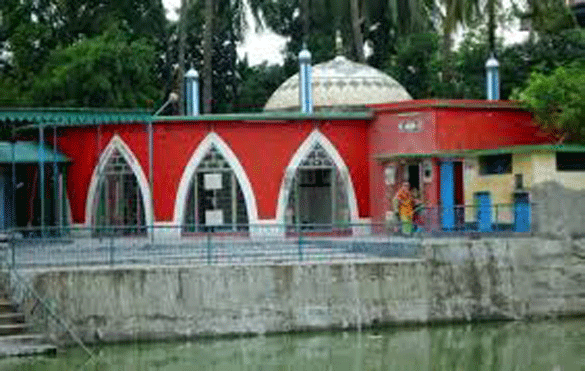
His title “Ruposh”, derived from his practice of covering his face with a cloth, followed a tradition observed by certain Chishti saints and reflected his deep inner discipline and humility. Hazrat's life offers a lesson: true spirituality does not require withdrawal from the world. In Hazrat Shah Makhdum Ruposh, devotion walked alongside action where struggle became service, authority became responsibility, and worldly engagement became a path to lasting spiritual influence.
Early Life and Family Background
Hazrat Shah Makhdum Ruposh was born in 1216 CE in Baghdad, then the centre of Islamic learning and Sufi spirituality. His father, Hazrat Azala Shah (also known as Hazrat Azallah Shah), was a highly respected scholar and saint, directly descended from Hazrat Abdul Qadir Gilani, the spiritual authority whose lineage and teachings gave rise to the Qadiriyya Sufi order. He was raised in an environment where knowledge, devotion, and missionary purpose were part of everyday life. Despite political instability, early 13th-century Baghdad remained a vibrant intellectual hub, and Hazrat Azala Shah’s household was deeply engaged with the wider Islamic mission. His father believed Islam should spread not only through debate, but through the personal example of spiritually refined saints.
To fulfil this vision, Hazrat Azala Shah entrusted the task of eastward missionary work to his three sons. The eldest, Hazrat Syed Ahmad Miran Shah (also known as Hazrat Ahmed Ali Tannari or Hazrat Miran Shah), was assigned Bengal, accompanied by Hazrat Shah Makhdum Ruposh and their younger brother Hazrat Syed Monir Ahmed. Their clear mission was to establish Islam in the eastern regions of India, where Muslim presence was still limited.
This journey was a deliberate spiritual command from their father, whose authority as a descendant of Hazrat Abdul Qadir Gilani carried unquestioned weight. After assigning this mission, Hazrat Azala Shah returned to Baghdad, leaving his sons to carry Islam into 13th-century Bengal, a land largely Hindu-ruled and Hindu in religious composition. Their story reflects a central Sufi idea: that family bonds themselves can become instruments of divine purpose, transforming personal relationships into vehicles of historical change.
Spiritual Path, Disciples, and the Spread of the Chishti Order
Hazrat Shah Makhdum Ruposh’s spiritual identity was rooted in Islam and shaped through his initiation into the Chishti Sufi order, which traced its lineage through Hazrat Ali to the Prophet Muhammad and emphasised love, service, humility, and direct remembrance of God. From this discipline emerged his title “Ruposh.” Following a Chishti practice, he covered his face with a cloth, symbolising detachment from outward identity and affirming that true selfhood lies in divine remembrance. Alongside mystical devotion, he maintained strict adherence to Islamic law embodying the Islam synthesis of Shari‘ah and Tasawwuf. His authority was reinforced by his lineage to Hazrat Abdul Qadir Gilani through his father and by his own disciplined spiritual practice. Settling in the Rajshahi and Varendra regions, he played a pioneering role in firmly establishing the Chishti order where it had previously lacked strong institutional presence. His influence endured through his disciples and khalifas, trained as spiritual leaders. Hazrat Syed Shah Abbas, Hazrat Syed Dilal Bukhari, Hazrat Shah Sultan, Hazrat Syed Karam Ali Shah, and Hazrat Nusrat Shah, each authorised to establish centres of Islamic teaching and Sufi practice. Among them, Hazrat Syed Karam Ali Shah is especially notable.
A 1582 CE copperplate inscription records his close collaboration along with three other named dervishes in Hazrat Shah Makhdum Ruposh’s foundational work. He later established a shrine at Biraldaha, about seventeen kilometres from Rajshahi, which became a major pilgrimage centre and extended his master’s influence across Bengal. Under Hazrat Shah Makhdum Ruposh’s guidance, a network of khanqahs developed across Rajshahi and Varendra. Each functioned as a mosque, hospice, school, Sufi training centre, and administrative base for Islamic law. This institutional model ensured continuity beyond personal leadership. By the end of his life, he had firmly rooted Islam in Rajshahi and laid lasting foundations that would shape Bengal’s religious landscape for centuries.
Journey to Bengal and Settlement in Rajshahi
Hazrat Shah Makhdum Ruposh entered Bengal by sea, arriving at Lakshmipur in the Noakhali region, accompanied by his elder brother Hazrat Ahmad Miran Shah. This long journey from Baghdad was a major undertaking, reflecting deliberate sacrifice rather than chance migration. Noakhali, a coastal zone linked to wider Islamic trade networks, served as their first base of missionary activity. In Shyampur village (Noakhali), he established his first khanqah, which functioned simultaneously as a mosque, hospice, school, and residence for disciples. For two years, he engaged in active da‘wah, drawing followers through personal piety and spiritual discipline. During this period, his elder brother Hazrat Ahmad Miran Shah settled at Kanchanpur, where he founded his own khanqah in 1287 CE. Though operating from different locations, the brothers worked in spiritual coordination, expanding the Chishti presence in eastern Bengal. Hazrat Shah Makhdum Ruposh’s move away from Noakhali was prompted by a decisive event: the martyrdom of Hazrat Shah Turkan, a Muslim preacher killed by Raja Angsu Deo Chandavandi Varmabhoj, the Hindu ruler of the region. This incident deeply stirred Hazrat Shah Makhdum’s conscience.
He travelled westward with his companions via the Padma River toward Rajshahi. A 1582 CE copperplate inscription records that, through divine intervention, Hazrat Shah Makhdum Ruposh and his followers crossed the Padma riding on crocodiles. This miracle became permanently memorialised: crocodiles have since been maintained in a pond beside his shrine, surviving to this day as living symbols of that journey. Reaching Bagha Upazila in Rajshahi, about two kilometres from the Padma, Hazrat Shah Makhdum established a khanqah that became a base for Islamic expansion across Rajshahi and Varendra (northern Bengal). In recognition of his influence, the area came to be known as Makhdumnagar. However, his institutional headquarters was later set up at Rampur Boalia, the site of present-day Rajshahi city, from where he directed religious, spiritual, and administrative activities. To ensure permanence, Hazrat Shah Makhdum Ruposh systematically dispatched his disciples to establish khanqahs throughout Rajshahi and Varendra. These included Hazrat Syed Shah Abbas, Hazrat Syed Dilal Bukhari, Hazrat Shah Sultan, Hazrat Syed Karam Ali Shah, and Hazrat Nusrat Shah. Each carried his institutional model and spiritual authority. Among them, Hazrat Syed Karam Ali Shah emerged as the most prominent. Granted independent authority, he founded a khanqah at Biraldaha, about seventeen kilometres from Rajshahi, which later developed into a significant pilgrimage centre, extending Hazrat Shah Makhdum Ruposh’s influence far beyond his own lifetime.
Through this migration, settlement, and delegation, Hazrat Shah Makhdum Ruposh transformed movement into mission and geography into enduring spiritual infrastructure.
Conflict, Battles, and Miraculous Resolution
Hazrat Shah Makhdum Ruposh’s settlement in Rajshahi quickly brought him into conflict with the region’s ruler, Raja Angsu Deo Chandavandi Varmabhoj, who saw the growing spread of Islam as a threat to his religious and political authority. The raja’s hostility was already evident in the murder of Hazrat Shah Turkan, an incident that had originally drawn Hazrat Shah Makhdum toward Rajshahi. As conversions increased through peaceful preaching, confrontation became unavoidable. The first battle took place in 1326 CE at a site later called Ghoramara (“Horse Killer”). Hazrat Shah Makhdum led a force of dervishes, among whom Hazrat Syed Karam Ali Shah emerged as a prominent fighter. The encounter ended without a clear victor but sent a strong message: Islam in Rajshahi was capable of defending its followers. The raja regrouped with allied feudal forces, leading to a second battle, which proved decisive. Hazrat Shah Makhdum’s forces won, the feudal allies fled, and a triumphal arch was erected at Bagha to mark the victory. Still unwilling to submit, Raja Angsu Deo launched a third and final battle, the fiercest of all. During this clash, tradition records a miracle: Hazrat Shah Makhdum hurled his wooden sandals, symbols of ascetic humility, into the battlefield, causing the death of the raja’s two princes. Demonstrating mercy rather than vengeance, he then revived the princes through prayer, transforming defeat into moral triumph. Witnessing these events, Raja Angsu Deo, his court, and much of the local population embraced Islam.
These conflicts elevated Hazrat Syed Karam Ali Shah, who fought in all three battles, earning the title “Gazi” for his courage. The battlefields themselves became sacred memories, and the raja’s conversion became a powerful symbol of Islam’s spiritual authority in Bengal. Hazrat Shah Makhdum Ruposh’s status as a wali was further affirmed by widely remembered miracles. A 1582 CE copperplate inscription records that, while travelling with four dervishes, he crossed the Padma River riding on crocodiles, understood as divine assistance. To preserve this memory, crocodiles have long been kept in a pond beside his shrine, surviving to the present day. Together, the battles and miracles conveyed a single message: power rooted in faith, justice, and mercy ultimately transforms hearts more deeply than force alone.
Death, Shrine, and Enduring Legacy
Hazrat Shah Makhdum Ruposh passed away on 27 Rajab, every year urs observed on same date. He was buried in Dargah Para, Rampur Boalia, the heart of his spiritual work. His grave became a centre of veneration for both Muslims and Hindus, believed to convey baraka and answer prayers. Around 1634 CE, Ali Quli Beg, a Safavid Persian official, built a one-domed mausoleum over his grave, reflecting the saint’s fame beyond Bengal. Mughal emperor Humayun granted the shrine tax-free status, establishing an endowment managed by a line of custodians (Mutawallis) to preserve the site and facilitate pilgrimage. Legal confirmations in 1877 and 1904 reinforced this status. The Urs on 27 Rajab remains a major event, drawing crowds for qawwali, prayers, langar, and supplications, transcending religious boundaries. Hazrat Shah Makhdum Ruposh’s legacy shaped Rajshahi itself, with modern commemorations including Shah Makhdum Airport, a medical college, a hospital, university halls, and schools bearing his name. The shrine remains active, preserving historical records like the 1582 CE copperplate inscription documenting his migration and companions, linking past and present.
Conclusion
Hazrat Shah Makhdum Ruposh was a saint, warrior, and visionary whose life transformed Bengal. Born in Baghdad into the lineage of Hazrat Abdul Qadir Gilani, he journeyed to Bengal to spread Islam, blending spiritual devotion with courage, administration, and mercy. He established khanqahs in Noakhali, Bagha, and Rampur Boalia, trained khalifas like Hazrat Syed Karam Ali Shah, and led military campaigns that secured Islam’s presence while showing compassion to defeated foes. Miracles like the crocodile river crossing and the sandal incident affirmed his divine connection.
More than seven centuries later, his shrine in Rajshahi remains a major pilgrimage site, and his name graces airports, schools, and hospitals. His legacy shows that faith, combined with service and institution-building, can shape societies, inspire generations, and transform hearts—leaving a spiritual and social imprint far beyond a lifetime.
___
Adnan Faizi is a Peace and Harmony activist based in Delhi. He is an alumnus of CCS University, Meerut.
URL: https://newageislam.com/islamic-personalities/hazrat-shah-makhdum-ruposh/d/138168
New Age Islam, Islam Online, Islamic Website, African Muslim News, Arab World News, South Asia News, Indian Muslim News, World Muslim News, Women in Islam, Islamic Feminism, Arab Women, Women In Arab, Islamophobia in America, Muslim Women in West, Islam Women and Feminism