
Hazrat Rabia Basri: A Great, Righteous Woman, Friend of Allah Almighty in Islamic Sufism

By
Ghulam Ghaus Siddiqi, New Age Islam
12 January
2023
Hazrat
Rabia Basri: ‘Controlling One's Heart And Restraining Forbidden Desires Is A
Symbol Of Real Manliness’
Main
Points
1. One cannot
remain unaffected by the personality of Hazrat Rabia Basri since it is so
alluring, attractive, spiritual, and enlightening.
2. Hazrat Rabia
Basri founded a new Sufi style of thought that put the emphasis on love rather
than fear.
3. The
prominent intellectuals and Sufis of her time thought it an honour to sit and
listen to Hazrat Rabia Basri's sermons because of her standing in knowledge and
spirituality.
4. Among her
teachings is: "Controlling one's heart and restraining forbidden desires
is a symbol of real manliness"
------
The
respectable personalities who devoted their lives according to the Quran and
Sunnah of Hazrat Muhammad (peace be upon him) are known as Awliya [plural of
Wali, saint or friend of Allah] and Sufiya [plural of Sufi]. Among these pious,
respectable, and renowned dignitaries, Hazrat Rabia Basri is a very trustworthy
name. One cannot remain unaffected by the personality of Hazrat Rabia Basri
since it is so alluring, attractive, spiritual, and enlightening. Her
brilliance and piety are acknowledged by people of vision and understanding
from every culture and religion.
Hazrat
Rabia Basri founded a new Sufi style of thought that put the emphasis on love
rather than fear. Her biography makes it quite obvious that worship is not a
business but rather exists to please God Almighty. Greed or fear-based worship
is not worship; such worship is only commerce. Such worship is self-deception.
She always emphasised the value of prayer and fasting, promoting spirituality
and chastity. She is the first female Sufi in Islamic tradition to enjoy
enduring spiritual recognition and acceptance.
She was
born in the home of Hazrat Ismail, a righteous Basra resident, on a lucky night
in 95 Hijri. The new-born daughter was given the name Rabia, and there were
already three daughters living there. The pure women of Islam who lived a life
that alternates between poverty and wealth from start to finish include Hazrat
Rabia Basri. When Hazrat Rabia Basri opened her eyes, the atmosphere was one of
acceptance, satisfaction, patience, and thanks for the blessings and trials
coming from God Almighty. Her father used to face the trials of the period,
hungry, and go through fresh aches and sorrows, but he never complained or
questioned anything. The daughter of such a father would indeed be obedient and
pious by nature.
From a
young age, Hazrat Rabia Basri developed a devotion to the Holy Quran and the
teachings of the religious elders. She grew up understanding the difference
between halal and haram. When the entire family gathered for eating food one
day, she refused to eat. Why doesn't she eat, Rabia's father questioned. She
replied, saying, "I'm questioning whether or not this foodstuff is
halal." "How is this, daughter?" the father asked. She
responded, "I think we should certainly avoid this meal because it's
questionable". She added that we should practise patience with hunger in
this life so that we won't have to practise patience with fire in the
afterlife.
She was
about five years old when her parents died. Because of the severe famine that
was occurring there at the time, people were forced to flee Basra. Hazrat Rabia
was separated from her sisters during the relocation. A cruel person abducted
her and sold her to a rich man. She used to do every single work for his house.
She fasted during the day and did all the household chores. She used to pray to
Allah Almighty all night long. Her owner once watched her participate in a
nighttime worship service; he was upset to see the whole thing. The following
morning, he released Hazrat Rabia Basri after apologizing to her.
She
travelled to Kufa, a significant centre of knowledge and Islamic sciences at
the time, to learn the explicit Islamic sciences and knowledge. She began by
memorizing the Holy Quran there. After that, she continued her studies in Fiqh
and hadith and developed her knowledge to the point where the great Muhaddith
and jurists would have been shocked to hear her preach. Her court of wisdom
used to be attended by eminent scholars and Sufis. Imam Sufyan Thauri, also
known as Ameer ul Mumineen in Hadith, was one of them. Hazrat Malik bin
Dinar likewise had high regard for the spiritual accomplishments of Hazrat Rabia
Basri.
Hazrat
Rabia Basri yearned for a relationship with God Almighty, just like other wise
people and mystics. The Sufi mystic Hazrat Rabia is credited with being the
first to express God's love in the form of a permanent and solid faith.
"Hazrat Rabia Basri used to be busy remembering Allah Almighty all the
time," according to Tabaqat-ul-Kubra. She showed no interest in the
outside world. She used to be so terrified of hearing about punishment and hell
that she would fall asleep for a long time. She engaged in repentance after
regaining consciousness, and her place of devotion was frequently flooded with
tears.
Hazrat
Rabia used to speak very little. When asked a question, she would give a clear,
well-reasoned response. She used to discuss Quranic verses frequently and cite
them in everything. When asked why, she responded, "Whatever man talks,
the angels write it down. Therefore, she does not speak anything other than
Quranic verses in order to prevent bad things from coming out of it, which the
angels write down."
Imam
Ghazali praises Hazrat Rabia Basri's brilliance in a very exquisite way in his
book Ihyay-e-Uloom al-Din. The prominent intellectuals and Sufis of her time
thought it an honour to sit and listen to Hazrat Rabia Basri's sermons because
of her standing in knowledge, austerity, asceticism, and worship. In her
meetings, they used to behave nicely and turn to her for assistance with their
problems. Hazrat Rabia occupied a position of high status and authority.
Everyone is surprised when a virtuous woman has a spiritual and intellectual
impact in a society where mosque minarets and educational buildings are
reserved for men.
She once
responded to a question about why she was unmarried by saying that if she could
get rid of three worries, she would get married. First, will she die with her
faith intact or not? People asserted that they were unaware. She stated that
the second was whether she would be assigned her list of worldly deeds in her
right or left hand. The final question concerned which side of Paradise someone
will enter from on the Day of Judgment. They indicated their uncertainty. Then,
Hazrat Rabia questioned how a lady could want a husband if she was so worried
about the Day of Judgment.
Throughout
her life, Hazrat Rabia Basri had a constant fear of Allah Almighty. She used to
recall God Almighty without worrying about hell or harbouring any desire for
heaven. She held that one should love God without conditions and that one
should remember God Almighty since He is one. The goal of this love must be to
win the pleasure of Allah and His vision. She always sobbed out of love for
Allah Almighty. She used to state that she had only ever loved Allah Almighty
and that she feared a voice would say at the time of her death, "Rabia is
not worthy of us,".
She always
wore a Kurta made of rough blankets. In her will, she stipulated that following
her demise, she would be buried in this Kurta. After she passed away, a pious
woman had a dream in which she was dressed in a gorgeous silk Kurta. The woman
wondered, "Where did the Kurta made of the blanket go?" She
responded, "The Most Merciful [Rahmaan] has provided this Kurta in
return for that."
Tell me a
method to become closer to God, that woman pleaded. "Nothing is sweeter
than remembering Allah Almighty for His nearness," Hazrat Rabia Basri
responded.
Hazrat
Rabia Basri often chanted the couplet, which is translated as follows:
“O my lord! Your close servants seek your
nearness in the solitudes. The fishes in the sea sing praises to your majesty.
The waves collide as a result of your holiness and grandeur. Because You are
the independent and wrathful, everything bows before You, including the
brightness of day and the darkness of night, the revolving sky, the dazzling
moon, and the shining stars.”
She used to
routinely recite the following prayer at night on the roof and communicate her
prayers via her poetry.
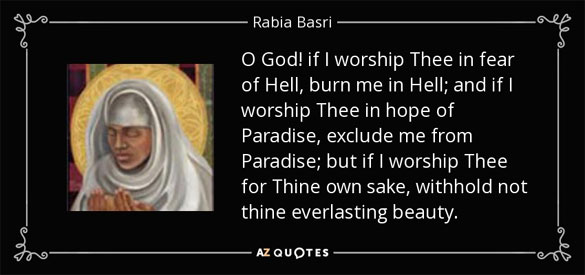
"Oh my
Lord, the stars are sparkling, and everyone is in their own solitary, their
eyes closed in deep sleep. Here I am, alone with you. Send me to Hell If I
worship You out of fear of the punishment of Hell. If I worship You in hope of
entering Paradise, remove me from Paradise. But, if I worship You simply for
Your sake, O Lord, don't disguise your eternal beauty.”
She would add,
“A person cannot repent until his Lord gives him the blessed chance [Tawfiq]
to repent and accepts him. You will turn to Him only if He turns to you."
“Ask
Allah for contentment, because this is a great blessing”, she used to say.
She added,
"Controlling one's heart and restraining forbidden desires is a symbol of
manliness"
This
outstanding lady who guided people toward righteousness and counselled them to
keep going in that direction was ill for a spell and was lying on the bed of
illness. Those in attendance were kind-hearted citizens of Basra who had come
to pay a visit. She abruptly addressed the crowd, asking them to make room for
angels. After everyone went, all that could be heard was a conversation for a
short period. When the sound stopped, everyone returned and discovered that
Hazrat Rabia had passed away.
Hazrat
Rabia Basri—the embodiment of upright, devout women—died and was buried in
Basra in the year 185 Hijri. Her life story, demeanour, and even personality
serve as a role model for women. Her devotion to Allah and her practice of
austerity and asceticism sends the message that everyone, male or female, has a
responsibility to fulfil their obligation to serve and love God.
One could
learn the following from her teachings: Worship the real God out of a yearning
for paradise and fear of hell. One should emulate the virtues of endurance,
patience, and contentment with one's destiny. One should live day and night in
the light of God so that his or her path through the hereafter will also be lighted.
The prophets have all been brought up in the arms of righteous women; she used
to say while addressing the virtues of women. The real knowledge, according to
her, is to recognize God Almighty through achieving Maarifa.
...
A
regular Columnist with NewAgeIslam.com, Ghulam Ghaus Siddiqi Dehlvi is a
Classical Islamic scholar with a Sufi background and English-Arabic-Urdu
Translator.
URL: https://newageislam.com/islamic-personalities/rabia-basri-righteous-allah-islamic-sufism/d/128856
New Age
Islam, Islam Online, Islamic Website, African Muslim News, Arab World News, South Asia News, Indian Muslim News, World Muslim News, Women in
Islam, Islamic Feminism, Arab Women, Women In
Arab, Islamophobia in America, Muslim Women
in West, Islam Women and Feminism