
Dr. Muhammad Hamidullah: A Reformer of Sirah and an Expert in International Law
By Dr. Zafar Darik Qasmi, New Age Islam
25 August 2025
Abstract:
Dr. Muhammad Hamidullah, a reformer of Sirah and authority in International Law, enriched Islamic scholarship with impartial research and timeless writings. His works on the Prophet’s life, humanism, pluralism, and the Constitution of Medina emphasize justice, tolerance, and coexistence—offering guiding principles for peace, harmony, and ethical global relations today.
Main Points:
1. Hamidullah highlighted unexplored aspects of the Prophet's life with impartiality.
2. He emphasized tolerance, unity, and reconciliation for peaceful societies.
3. His works connected scholarship with ethics, balance, and social relevance.
4. He contributed significantly to Islamic international law and global coexistence.
5. The Constitution of Medina demonstrated multi-religious harmony and inclusiveness.
6. His writings remain relevant for justice, dialogue, and global peace.
-----
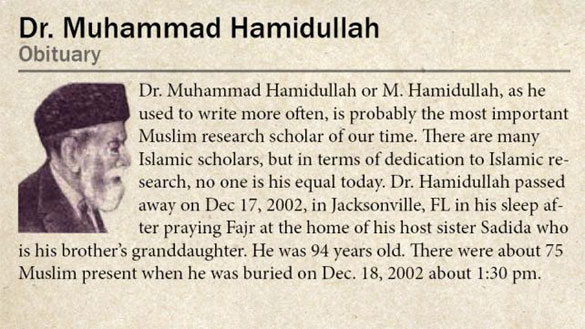
Dr. Muhammad Hamidullah (1908–2002) made remarkable contributions in the fields of knowledge, literature, and the study of the Prophet’s life (Sirah). He is well-known as a Mujaddid of Sirah ( مجدد سیرت) and as an authority in International Law. Besides Urdu, Arabic, and English, he had mastery over French, Turkish, and several other languages. His scholarly works, writings, and research are vast in number, and among them some notable books are:
عہد نبوی کے میدان جنگ ، عہد نبوی کا نظام حکمرانی ، محمد صلی اللہ علیہ کی سیاسی زندگی ، Introduction to Islam، اور پیغمبر اسلام.
These masterpieces provided new directions for the world of knowledge, research, and scholarship.
Dr. Hamidullah introduced scholars and intellectuals to those aspects of the Prophet’s life that had previously remained unexplored. His method of research, based on impartiality, honesty, and academic integrity, is still a dire need for our universities, institutions, and seminaries. True research must avoid prejudice and blind imitation. Unfortunately, in today’s academic climate, the trend of mere repetition without depth has become common. Dr. Hamidullah’s writings remind us that any work of scholarship must be presented with seriousness, intellectual weight, and thorough research—only then can it leave a lasting impact on society. A piece of writing that lacks depth, balance, and social relevance cannot produce enduring results.
Another unique feature of Dr. Hamidullah’s intellectual legacy is his emphasis on humanism, social diversity, and cultural harmony. His writings repeatedly highlight the importance of national reconciliation. He wished to see societies where knowledge and scholarship flourish alongside peace, tolerance, and unity, free from division and conflict. The message in his writings promotes moderation, balance, and inclusiveness. By spreading such thought, both academic and social stability can be achieved.
Dr. Hamidullah lived in the West for a long time and closely observed social pluralism, religious diversity, and intellectual variety. While there, he also carried out the mission of introducing Islam. His literary and practical efforts for intellectual balance and social harmony remain highly relevant today. He taught that knowledge should always serve human rights and social needs, but without compromising the core principles of religion and faith. Thus, he never supported intellectual trends that could cause social disruption.
Alongside his expertise in Qur’an and Sirah, Dr. Hamidullah made invaluable contributions in the field of International Law. After World War II, when the world recognized the importance of international relations and law, he translated the United Nations Charter into Urdu, making it accessible to a wider audience. (Hamidullah, Khutbat-e-Bahawalpur, p.115).
He also wrote a profound introduction to the critical edition of Ibn al-Qayyim’s Ahkam Ahl al-Dhimmah( احکام اہل الذمہ)(edited by Dr. Subhi al-Salih). In this, he shed light on Islamic laws regarding international relations, treaties with non-Muslim states, and the rights of ahl al-dhimmah.( اہل الذمہ)He also referred to the classical work of Imam al-Sarakhsi, Sharh al-Siyar al-Kabir, ( شرح السیر الکبیر)which explains issues of peace, war, trade, and relations with non-Muslims. Written during the Crusades, it is based on Imam Muhammad’s Kitab al-Siyar. ( کتاب السیر)This book, spread across several volumes, has been published many times in Hyderabad and Egypt.
Another monumental contribution of Dr. Hamidullah is his two-volume work Al-Watha’iq al-Siyasiyyah fi al-‘Ahd al-Nabawi wa al-Khilafah al-Rashidah, (الوثائق السیاسیۃ فی العہد النبوی و الخلافة الراشدہ) which collects the Prophet’s letters, treaties, proclamations, and other documents, as well as those from the era of the Rightly Guided Caliphs. In his book The Muslim Conduct of State, he presents an in-depth discussion on Islamic international law. His famous book The First Written Constitution in the World proves that the Constitution of Medina was the world’s earliest written constitution, establishing a multi-ethnic, multi-religious federation—a shining example of social harmony and tolerance.
The essence of Dr. Hamidullah’s writings is that healthy and just international relations are the foundation of peaceful societies. Cooperation on the basis of humanity cannot be denied. If ideas, nations, and societies clash, it only results in unrest and destruction. Corruption, injustice, and violence must be resisted so that humanity is protected. This is possible only when nations adopt peaceful traditions and establish sound principles of coexistence.
Dr. Hamidullah’s works show that despite material progress, modern societies have lost much of their ethical and spiritual values. When states put their own interests above human values, they destroy the bonds of mutual trust, leading to conflict and social disintegration. Whenever human relations have been harmed, history has witnessed disastrous consequences. On the other hand, good character, politeness, and kindness strengthen human ties, leaving behind an everlasting fragrance for future generations.
The contemporary relevance of Dr. Hamidullah’s writings lies in the fact that today’s world has become a global village. Dialogue, negotiation, and international cooperation are essential for sustaining peace. Conferences, seminars, and books are being produced across the globe to ensure that nations, despite differences of religion and ideology, do not fight one another but live in peace and mutual respect. Islam had already provided foundational principles for global peace and unity, which Dr. Hamidullah highlighted in his works.
Given the current climate of hostility, conflict, and alienation among nations, his writings shine as guiding lights. They offer principles of tolerance, moderation, and harmony that can help build societies rooted in respect, cooperation, and justice.
New Age Islam, Islam Online, Islamic Website, African Muslim News, Arab World News, South Asia News, Indian Muslim News, World Muslim News, Women in Islam, Islamic Feminism, Arab Women, Women In Arab, Islamophobia in America, Muslim Women in West, Islam Women and Feminism