
Mohammad Tahir Gani Kashmiri, Remains One of Kashmir's Most Brilliant Persian Poets

By Altamash Ali New Age Islam
19 February 2026
Mohammad Tahir Gani Kashmiri was a 17th-century Kashmiri master of Sabk-e-Hindi Persian poetry, known for simple yet deeply mystical verses on love, solitude, and life’s brevity. He rejected Mughal patronage, influenced Ghalib and Iqbal, and left a timeless Diwan reflecting profound Sufi wisdom and layered meaning.
Main points
· 1.Simple, deep Sufi shers on solitude, love-pain (virah), and life’s shortness – full of hidden meanings.
· 2.Born 1630 Srinagar, pious family; rejected Aurangzeb’s court call, called himself
· 3.Sabk-e-Hindi master; 100,000+ couplets; Diwan (~2,000 verses) collected later with ghazals & witty masnavis.
· 4.Sa’ib Tabrizi met him; completed kebab sher brilliantly; door open when away, locked when home (“I’m the treasure”).
· 5.Influenced Ghalib (translated 40+ shers), Mir, Iqbal (“Kashmir’s nightingale”); timeless heart-touching poetry lives on.
Ascetic, shelve your arrogance in the drinkers’ assembly.
Look! Drunk, how recklessly they spill the flask’s blood.
What makes his poetry special is its beautiful simplicity, deep love for solitude, rich Sufi wisdom, the intense fire of love and separation (virah), and wise reflections on how fleeting and temporary life truly is. His ghazals and individual couplets (shers) are packed with layers of meaning, one line can touch your heart on emotional, spiritual, and philosophical levels all at once.
My soul has burned to ashes from this fire.
If my breath makes the mirror shine bright, what's so strange?
(The soul's deep burning in love's pain heats the breath until it cleans the mirror, like a Sufi sign of how suffering purifies the spirit.)
In the drinkers' gathering, the prohibitor holds the highest place.
The moment he steps in, every glass is emptied in a flash.
(A clever jab at society's hypocrisy, people quickly hide their wine when the enforcer arrives.)
Crave true fame? Then chain yourself in solitude's trap.
Solitude turns into a phoenix soaring high.
(Celebrating simple, lonely living, real greatness blooms when you step away from worldly noise and show-off.)
While breath lingers in the body, the soul can't climb to the heavens.
A bird with a thread on its foot can never fly free.
(A thoughtful look at life's bonds, the soul needs to let go of the body to truly rise.)
Gani was born around 1630 CE (some sources say circa 1610) in Srinagar's historic old city, in the Rajouri Kadal area. He came from the respected Ashai family, originally from Bukhara in Central Asia. His family was known for deep religious knowledge, simple living, and keeping away from power and luxury, qualities that defined his entire life.
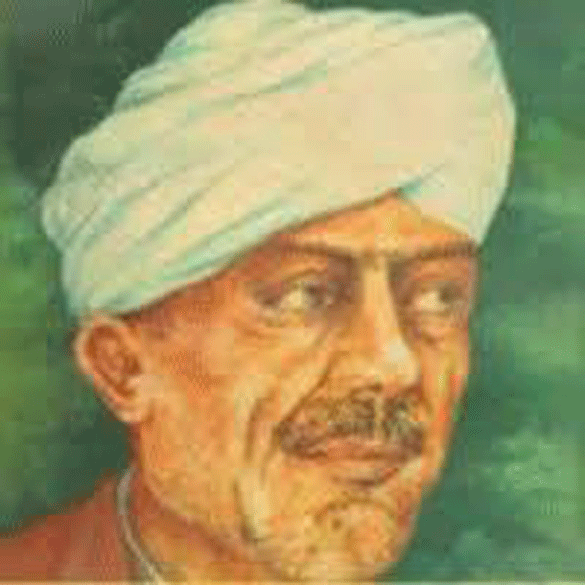
He studied under the great Kashmiri scholar and poet Mulla Mohsin Fani (or Mulla Hasan Fani), mastering Persian literature, philosophy, and even medicine, earning him the title "Mulla." He lived through the Mughal era of Shah Jahan and Aurangzeb but stayed far from courts, he never wrote praise poems (qasidas) for rulers or sought their favor.
Aurangzeb repeatedly invited him to the Delhi court. The emperor even wrote to Kashmir's governor, Saif Khan, to send Gani. When pressured, Gani boldly refused, saying, "Tell the emperor Gani is mad." When told a sane man can't be called mad, he tore his kurta, behaved like a lunatic, and walked away. Tragically, he passed away just three days later.
Gani was a master of the Indian style (sabk-e-Hindi) in Persian poetry, full of fresh ideas, clever symbols, innovative similes, and deep Sufi mysticism. He is said to have composed over 100,000 couplets, but he never compiled his own collection. After his death, his disciples, including Muhammad Ali Mahir (or Muslim Mujrim), gathered his work into the Diwan-e-Gani Kashmiri, which has about 2,000 verses, mostly ghazals, rubaiyat (quatrains), and two masnavis. One masnavi humorously describes Kashmir's biting winter, with witty takes on cold, snow, and daily struggles. The other satirizes a barber.
His verses explore love, separation, self-examination, the quest for God, life's brevity, and Kashmir's stunning yet melancholic beauty. He excelled at mani-afreeni, creating multiple meanings from a single word.
A well-known anecdote about Gani (praised by Iqbal in Persian), He kept his house doors locked when inside (guarding his only treasure, himself, as he owned nothing material), but left them open when out (since the empty house held no value). When asked why:
"There is nothing of any value in my house except myself. When I am in, the house is to be guarded like a treasure-house. When I am out, it is an empty place, which nobody would care to walk into."
His fame spread to Iran. The renowned poet Sa'ib Tabrizi, puzzled by the Kashmiri word "kraalpan" (potter's thread) in one sher, traveled to Kashmir to meet him. In a famous incident, Sa'ib left an unfinished couplet: the second line was "The smell of kebab wafts from your clothes." Gani instantly completed it: "Has a scorched heart brushed against your hem?", showing his sharp genius.
Another well-known story, praised by Allama Iqbal: Gani left his house door open when out, nothing worth stealing except his poetry papers and ink. But when home, he locked it, because he himself was the house's greatest treasure.
His influence touched Urdu and Kashmiri literature deeply. Mir Taqi Mir and Ghalib admired him greatly; Ghalib translated more than 40 of his shers into Urdu. Iqbal called him the "nightingale singing in Kashmir's paradise.
Gani Kashmiri stands as Kashmir's brightest literary gem. He never ran after fame, wealth, or power, poetry was his true wealth and purpose. His life of simplicity and solitude inspires even today. Whenever Kashmiri Persian literature is mentioned, his name rises first. His words remind us that genuine literature flows from the heart's depths, not from royal courts. He is a treasure not only for Kashmir but for the entire Persian-speaking world. His poetry feels fresh forever because it speaks directly to universal human emotions, love, heartache, longing, and the eternal search for the divine. His legacy endures eternally.
His death occurred around 1669 CE in Srinagar, at the young age of 38–39. His grave, near Rajouri Kadal in old Srinagar.
…
Altamash Ali is a Sufi writter and a student at IFTM University
New Age Islam, Islam Online, Islamic Website, African Muslim News, Arab World News, South Asia News, Indian Muslim News, World Muslim News, Women in Islam, Islamic Feminism, Arab Women, Women In Arab, Islamophobia in America, Muslim Women in West, Islam Women and Feminism