
Mir Ghulam Rasool Nazki: Voice of Inner Peace and Human Unity

By Altamash Ali, New Age Islam
22 April 2026
Mir Ghulam Rasool Nazki was a celebrated Kashmiri poet and broadcaster who promoted inner peace, simplicity, and human unity. Blending Sufi and Shaiv traditions, his timeless poetry urges self-reflection and compassion, making his message deeply relevant even today.
Main Points:
· Kashmiri poet, broadcaster, and humanist known for simplicity and depth
· Blended Sufism, Kashmir Shaivism, and universal humanism
· Pioneer voice of Radio Kashmir (since 1948)
· Sahitya Akademi Award (1987) for Awaz-e-Dost
· Emphasised self-reflection: “cave of the heart” philosophy
“Me kya karie yun gachhun sontuk ta harduk
Bahaar aasein harud aasein dapus guchh
Chillus chhus byoothmut pananiess dilluss munz
Panun aasein parud aasein dapus guchh”
Translation
Now what should I do? I only wish this
Whether spring comes or autumn comes, it makes no difference to me.
I am sitting inside the cave of my heart.
Whoever comes relative or stranger
I tell him, Stay away.
This rubai is by Mir Ghulam Rasool Nazki. It shows the depth of his introspection, moving away from the noise of the outer world. Nazki Sahab’s poetry repeatedly teaches us to turn inward, where true peace and knowledge are found.
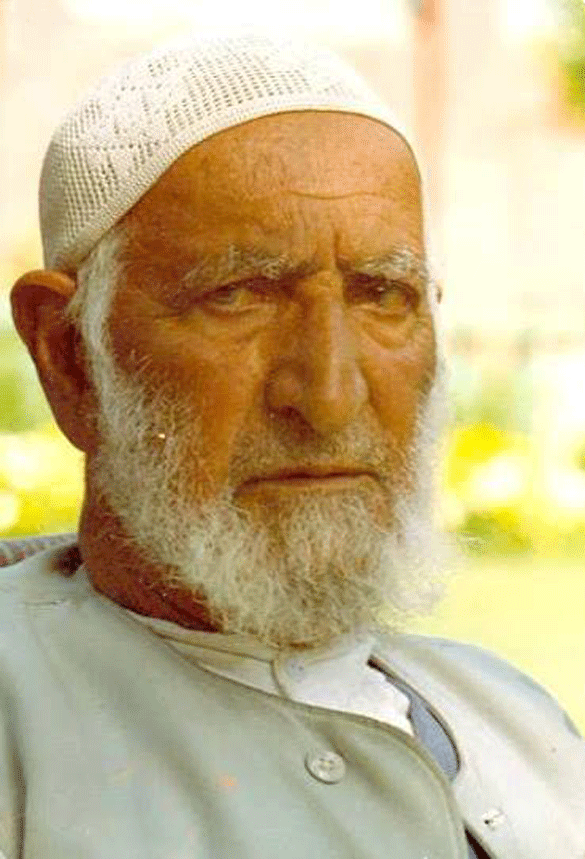
Nazki Sahab’s philosophy was a beautiful blend of humanism, Sufi mysticism and Kashmir Shaiv Darshan. He considered humanity as the greatest religion and stayed away from narrow-mindedness. Deeply influenced by Allama Muhammad Iqbal, he emphasised freedom, equality, compassion and humanity. He saw simplicity, hard work and self-reflection as the real essence of life. Connecting Sufi and Shaiv traditions, he believed that outer forms may differ, but truth is one. His main message was “Go into the cave of your heart” where peace and true knowledge can be found. He believed man has conquered the outer world but has lost control over himself. His poetry is satirical yet full of compassion. He showed society a mirror but always suggested the path of love and reform instead of violence.
Mir Ghulam Rasool Nazki was born on 16 March 1910 in Madar village near Bandipora, Kashmir, on the banks of Wular Lake. His father, Mir Ghulam Mustafa, was a learned man. He received education in Urdu, Persian and Arabic at home and later passed matriculation from Islamia College, Srinagar. At the young age of 16, he became a teacher in Kupwara. In 1948, he joined Radio Kashmir, Srinagar at the time of its establishment and gave the station’s inaugural broadcast. He worked with famous colleagues like Mahinder Kaul, Prem Nath Pardesi, Pran Kishore, Mohan Lal Aima and Bashir Butt. He retired from radio in 1966. He was fond of music, cricket and spiritual discussions. Swami Lakshman Joo, Ramakrishna Paramhansa and Lal Ded were his ideals.
In 1950, when President Dr Rajendra Prasad visited Kashmir, a grand boat procession was organised on the Jhelum River. Mir Ghulam Rasool Nazki was given the honour of doing the live commentary of this historic event. He gave such lively, emotional and literary commentary in Kashmiri that people gathered around radios all over Kashmir. Those standing on the riverbank and listeners at home were spellbound. This broadcast made him the most popular voice of Radio Kashmir and took his reputation as a broadcaster to new heights.
Nazki Sahab wrote in Urdu, Kashmiri, Persian and Arabic. He was the first Kashmiri writer whose work was published in independent India. He revived the rubai form in Kashmiri literature, which is connected to the tradition of Lal Ded and Nund Reshi.
Urdu Works:
Deeda-e-Tar (1948), The first Urdu poetry book from Kashmir in independent India, containing deep poems on social and spiritual subjects. Chirag-e-Raah, A collection full of moral and Sufi thoughts. Mata-e-Faqeer (1996), His last major Urdu work with a faqir-like and humanistic approach.
Kashmiri Works
Nimrudnama (1964), A beautiful collection of rubais. Awaz-e-Dost, Awarded the Sahitya Akademi Award in 1987. Kaweyenewol, Based on folk life and spirituality.
His Persian poem was published in a magazine in Moscow, Soviet Union. He wrote hundreds of programmes for Radio Kashmir, including literature, culture, folk tales and spiritual discussions. Great poets like Gulzar, Josh Malihabadi and Tajwar Najibabadi praised his Urdu poetry.
Nazki Sahab’s legacy lives on through his seven sons:
Farooq Nazki is an eminent poet and broadcaster, while Ayaz Rasool Nazki is a noted poet, author, scientist, and the founder of the Nazki Foundation. Justice Bilal Nazki served as the Chief Justice of the Odisha High Court. Prof. Iqbal Nazki is a Sahitya Akademi Award-winning writer, and Viqar Nazki has served as the Vice President of J&K Bank. Late Riyaz-ul-Islam Nazki worked as Joint Director in the Agriculture Department, while Late Dr Tariq Nazki was a physician based in the United Kingdom.
Ayaz Rasool Nazki translated his father’s rubais into English in the book “Echo” and, with the help of the entire family, kept his memory alive. The Nazki family together preserved their father’s legacy. On 16 April 1998, at the age of 88, he passed away. He was suffering from colorectal cancer but refused treatment. He said he wanted to feel the full “thrill” of death and did not want to die in sleep. This shows his strong willpower and deep understanding of life.
A Poem, Days of Poverty
“Ah! Those days of Poverty.
How good they were!
How light was this heavy frame!
How good that was for us!
A family, A big dish pot and a hearth in the kitchen;
How good all that was!
We, hard workers, A labourer, a carpenter;
How good we were!”
(Meaning)
Ah! Those days of poverty were so good!
The body felt so light!
One family, one big cooking pot, a hearth in the kitchen, everything was so beautiful!
We hardworking people, how good we were
Mir Ghulam Rasool Nazki was a poet, broadcaster, teacher and thinker. His works are still relevant today because they remind us of simplicity, compassion and self-reflection. “I am sitting in the cave of my heart… tell everyone to stay away.” This line is the essence of his entire journey. His place in Kashmir’s literary heritage will always remain immortal
New Age Islam, Islam Online, Islamic Website, African Muslim News, Arab World News, South Asia News, Indian Muslim News, World Muslim News, Women in Islam, Islamic Feminism, Arab Women, Women In Arab, Islamophobia in America, Muslim Women in West, Islam Women and Feminism