
Hazrat Syed Janbaz Wali: Sufi Saint of Love and Service in Kashmir

By Altamash Ali New Age Islam
14 February 2026
Hazrat Syed Janbaz Wali, a 14th-century saint from Isfahan, settled in Baramulla during Sultan Zain-ul-Abidin’s reign. Founder of Khanpora’s langar, he preached love, equality, and devotion. Revered for miracles and tolerance, his shrine remains a major spiritual centre in Kashmir.
Main points:
· Born 1329 AD in Isfahan, Iran.
· Descendant of Hazrat Prophet Muhammad through Hazrat Imam Hassan.
· Called “Janbaz” for fearless devotion.
· Linked to Rifai/Qadri Sufi order.
· Came 1420 AD in Sultan Zain-ul-Abidin’s time.
· Founded Khanpora village.
· Started langar open to all, Hindus named him “Annapurna”.
· Deg never emptied; created Zain Lank Island by Duaa.
…
"Muskhil Kusha Hajat Rawa ya Shahi Janbaz Wali"
(The remover of difficulties, fulfiller of needs, O Shahi Janbaz Wali)"Ya Janbaz Wali... Sani... Ya Rifai..."
(O Janbaz Wali... Sani... O Rifai...)"Ya Peer-e-Kamil Rahmatullahi Ala"
(O perfect guide, may Allah's mercy be upon him)
These are some heartfelt lines from manqabats sung in praise of Hazrat Syed Janbaz Wali . They reflect his complete philosophy, difficulties are solved through Allah's mercy and the saint's prayers, needs are fulfilled by his miracles, and true richness comes not from worldly efforts but from Allah's grace. The core of his teachings was complete love for Allah, service to humanity, simplicity, asceticism (zuhd) winning hearts with love, helping with compassion, and spreading equality. He believed the Sufi path is not just book knowledge but living it in daily life, a perfect balance of inner (batini) and outer (zahiri) knowledge, teaching morality in the light of Quran and Hadith.
His philosophy emphasized religious tolerance, peace, and humanity, his langar (community kitchen) was open to Muslims and non-Muslims alike, food never ran short, so Hindus called him "Annapurna," meaning the one who provides food. He fought injustice and oppression not with violence but with love and service. His miracles (karamat) are countless, living proofs of Allah's power and his spiritual elevation. These are described in Sufi traditions, oral histories, and books like "Muarif Janbaz," and people still talk about them today
Hazrat Syed Muhammad Janbaz Wali Rifai was born in 735 Hijri (1329 AD) in Isfahan city, Iran, which was the capital at that time. His real name was Syed Muhammad Rifai. He belonged to Ahl-e-Bait—23rd generation descendant of Prophet Muhammad through Hazrat Imam Hassan and Hazrat Imam Hussain. His ancestors included Syed Ahmad Rifai, nephew of the famous saint Sheikh Abdul Qadir Gilani, known as Dastagir Sahib. This is why he is linked to the Rifai or Qadri Sufi order. Details about his parents' names are not available in detail, but he came from a noble, religious family of Prophet's lineage. From childhood, he grew up in a pious environment focused on worship and morality.
In his early years, education was given by the famous Arab scholar Syed Muhammad Arabi, who taught him basics of Quran, Hadith, and Islamic principles. Later, his spiritual guide (murshid) was Mir Syed Jalaluddin Bukhari (Makhdoom-e-Jahaniyan), or in some sources Mir Syed Muhammad Hamdani, who taught him the depths of the Sufi path, both inner and outer knowledge. Due to his intense spiritual exercises, asceticism, and worship, he earned the title "Janbaz" (one who stakes his life), meaning he fearlessly served and preached in Allah's way without caring for his own life.
In 827 Hijri (1420 AD), during the reign of Sultan Zain-ul-Abidin (Badshah), he arrived in Kashmir with 120 (or in some sources 150) saints and scholars. He entered via Shopian and reached Srinagar. The Sultan welcomed him with great respect, going outside the city to meet him, arranging grand stay, and visiting twice a week for spiritual guidance. The Sultan himself became his devoted disciple (murid). After two years in Srinagar, he moved to Baramulla for solitude, deeper meditation, and more preaching. The Sultan arranged the journey and accompanied him by boat on the Jhelum River. In Baramulla, he founded Janbazpora, then settled in Khanpora (Khawanpora) village, meaning "place of food" in Persian. Here he started a langar-khana that always stayed warm
His large copper vessel (deg) never emptied. No matter how much food was cooked, hundreds or thousands ate from the langar, but the deg remained full. This miracle became so renowned that keepers of Shah-e-Hamdan (Amir Kabir) shrine claimed the deg belonged to them. A dispute arose, and it was decided to send the deg to Srinagar for repair. After repair, when it was taken to the Jhelum River for washing, by Allah's power it sank and completely disappeared, considered Allah's judgment, and the deg never returned
Storms in Wular Lake caused many deaths. The king expressed a wish to build an artificial island in the lake for the safety of people. Hazrat raised his hands in dua, and by Allah's grace, the island appeared, known today as Zain Lank. The king's success in this is seen as the result of his dua.
Among his disciples, Sultan Zain-ul-Abidin was the most prominent. Thousands of followers, Muslims and non-Muslims—were influenced by his teachings and came to Islam, adopting moral lives. He taught Quran-Hadith and the Sufi path.
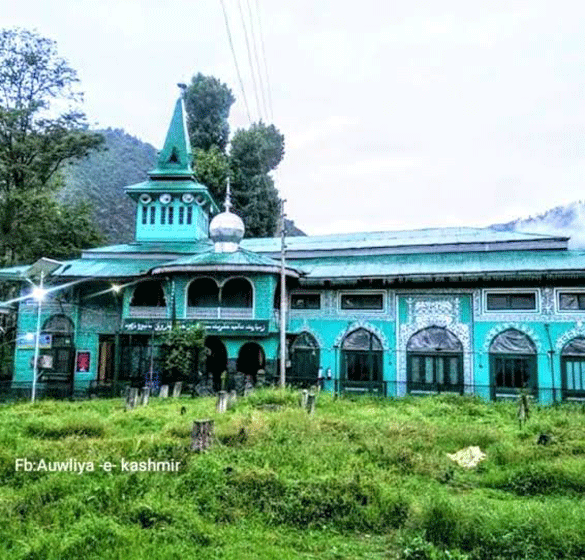
He passed away on 24 Rabi-ul-Awwal 840 Hijri (1433 AD) at the age of 105. His shrine is in Khanpora, Baramulla, on the banks of the Jhelum River along the Baramulla-Uri Road, one of Kashmir's oldest and most important shrines. The annual Urs is observed in Rabi-ul-Awwal, especially on the Friday after 24 Rabi-ul-Awwal. Thousands visit for ziyarat, with displays of holy relics (tabarrukat like kula/turban and kangi/comb) after every prayer from Fajr to Isha
Altamash Ali is a Sufi writter and a student at IFTM University.
New Age Islam, Islam Online, Islamic Website, African Muslim News, Arab World News, South Asia News, Indian Muslim News, World Muslim News, Women in Islam, Islamic Feminism, Arab Women, Women In Arab, Islamophobia in America, Muslim Women in West, Islam Women and Feminism