
Hazrat Shah Asrar-Ud-Din: The Shrine of Darbar-E-Asrariya And Symbol Of Communal Harmony In Kishtwar

By Altamash Ali, New Age Islam
15 December 2025
In Kishtwar's Chenab Valley, the shrine of 17th-century Sufi saint Hazrat Shah Asrar-ud-Din unites Hindus and Muslims despite past tensions. Known for miracles and teachings on love, his legacy promotes peace and devotion.
Main points:
1. The Darbar-e-Asrariya shrine in Kishtwar serves as a powerful symbol of Hindu-Muslim harmony in a region with a history of communal tensions.
2. Born around 1667 in Bhandarkote to Hazrat Shah Farid ud Din Baghdadi, he followed the Qadiri Sufi tradition and assisted in spreading Islam peacefully.
3. He lived only 18 years but gained immense popularity through spiritual teachings on love and devotion.
4. Legend says his father prepared sugar syrup to fulfil divine will, leading to his passing on the 25th of Kartik.
5. Thousands gather every year on the 25th of Kartik for the Urs, seeking blessings in a grand display of faith and unity.
Hazrat Shah Asrar-ud-din was a Sufi saint who played a big role in spreading Islam across the Indian subcontinent. He was famous for his deep spiritual understanding and teachings that focused on love, devotion, and mysticism to help people get closer to God. Sufi saints like Hazrat Shah Asrar-ud-din have left a strong mark on the culture and spirituality of this region.
He was born in Bhandarkote, Kishtwar, around 1667 AD. His father was Hazrat Shah Farid- ud- Din.
He came from Delhi and reached Kishtwar via Deeng-Batal. The landlord’s daughter in Deeng-Batal was so impressed by the saint’s piety that she married him and took the name Roshan-Dil. He stayed there for seven days. Later, he married the daughter of Shah Noor Ali, the lumberdar of Nagori village in Doda, and named her Malahat Beg.
From there, he travelled through Bhandarkote to Kishtwar. Raja Jai Singh was very impressed by his character and pious life, so he built a house for him near the palace.
Hazrat Farid-ud-Din, the father of Hazrat Asrar-ud-din, is credited with spreading Islam in the Chenab Valley. His mausoleum is in another part of the town. He arrived in Kishtwar in 1664 when the area was ruled by the Hindu Rajput king Kirat Singh. Under the influence of Hazrat Farid-ud-Din, the Raja accepted Islam.
Hazrat Shah Asrar-ud-din life was meant for a deep spiritual path from the very beginning. He followed the footsteps of Peeran-e-Peer Hazrat Syedna Sheikh Abdul Qadir Jeelani. The teachings of Jeelani—based on love, kindness, and devotion to God—touched the young saint deeply.
He set out on a journey of self-discovery and enlightenment. Following these principles became his guiding strength.
Even as a child, signs of his spiritual greatness were clear. He was drawn towards religious activities and had a strong connection with Islamic teachings. It is said that during prayer and meditation he felt a deep bond with God.
As he grew up, he fully devoted himself to Islamic studies. His eagerness to learn and natural spiritual sensitivity made him stand out from others.
His contribution to spreading Islam was huge. He helped his father and taught Islamic principles to the community, showing great responsibility and dedication.
His unique way of preaching made him special and influential. Writers of that time carefully recorded his daily routine. Through these efforts, many people were attracted to Islam and a strong community based on faith was formed.
He is linked to many miracles. Devotees tell stories of healing, foresight, and divine help. He is believed to have cured the sick with prayers, and there are tales of people recovering from illnesses that doctors thought were incurable.
There are stories of his supernatural knowledge—seeing the future or giving guidance beyond normal understanding. Devotees say his advice helped them overcome difficulties and make important life decisions.
Legends also say nature obeyed him, like sudden changes in weather. These stories, passed down through generations, add to his mystical image. All these are based entirely on faith and belief. Among the miracles told by word of mouth are: bringing back to life the only son of a Hindu who had died, giving sight to those blind from birth, making a wall move, and curing people of deadly diseases.
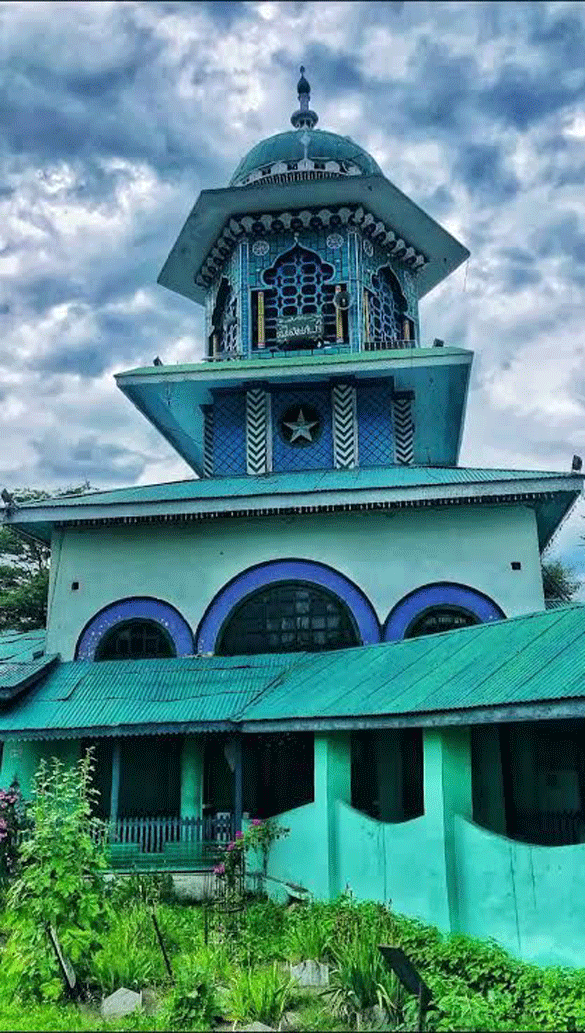
The shrine of Hazrat Shah Asrar-ud-din (known as Darbar-e-Asrariya or Astan-e-Payeen) is located in the south-east of Chowgan in Kishtwar. It is dedicated to Hazrat Shah Asrar-ud-din, son of Hazrat Shah Farid-ud-Din,and is famous for the miracles associated with him. Even though he lived only 18 years, he became very popular. Legend says God called him back.
His father recognised his son extraordinary abilities early. To fulfil God will, he prepared sugar syrup while reciting Quranic verses. On the 25th day of Kartik, he asked Hazrat Shah Asrar-ud-din to drink it. After drinking, he passed away and returned to God. His grave in Chowgan is now called Darbar-e-Asrariya.
Every year on the 25th of Kartik, the Urs is celebrated. Thousands of devotees come to seek blessings and fulfil their wishes. It is one of the biggest events in Kishtwar. The shrine also keeps dozens of precious 17th-century manuscripts written in Persian, Arabic, and Kurdish. These describe Baghdadi’s travels, his poetry, and the family tree of Sufi saints who are direct descendants of Prophet Muhammad (SAW).
…
Altamash Ali is a Sufi writer and a student at IFTM University.
URL: https://www.newageislam.com/islamic-personalities/shah-asraruddin-shrine-darbar-harmony/d/138003
New Age Islam, Islam Online, Islamic Website, African Muslim News, Arab World News, South Asia News, Indian Muslim News, World Muslim News, Women in Islam, Islamic Feminism, Arab Women, Women In Arab, Islamophobia in America, Muslim Women in West, Islam Women and Feminism