
Hakeem Manzoor- Voice of Kashmir’s Soul

By Altamash Ali New Age Islam
02 May 2026
Hakeem Manzoor was a prominent Kashmiri Urdu poet whose work reflected life’s incompleteness, human emotions, and Kashmir’s soul. Blending philosophy, Sufi thought, and social reality, his poetry continues to inspire and preserve the cultural and emotional essence of Kashmir.
Main Points:
· Renowned Kashmiri Urdu poet known for themes of incompleteness and inner struggle.
· His poetry blends love, pain, self-reflection, and Kashmiriyat.
· Authored notable works like Na Tamaam and Lahu Lams Chinar.
· Served as a senior Jammu & Kashmir government officer.
· Remembered for expressing Kashmir’s beauty and suffering with depth.
Hakeem Manzoor’s poetry is filled with deep sensitivity. It beautifully captures the incomplete picture of life, the hidden fire beneath the cold winds of Kashmir, the fragility of human relationships, and the sincere attempt to see oneself in the mirror of society. His thoughts mainly revolve around the incompleteness of life (natamami), the breaking of dreams, the shadows of memories, and the complexities of human existence.
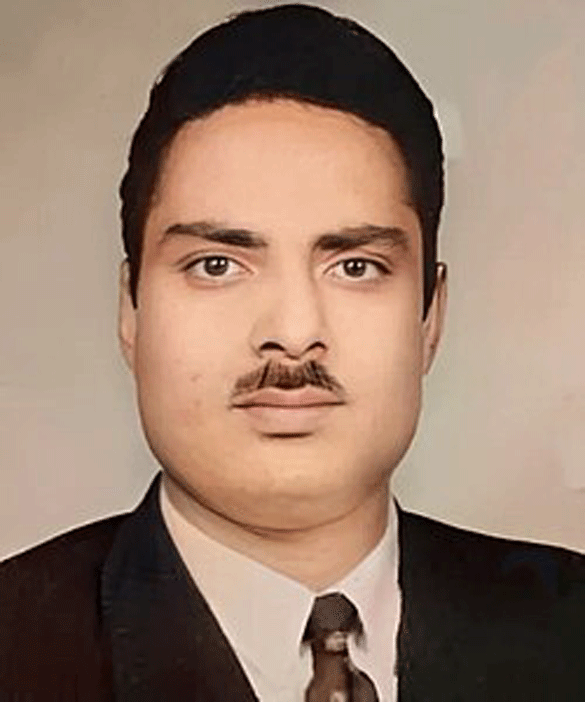
Here are some of his selected couplets and quotes:
“In the mirror of the city, this too shall be written
Just to stay alive.”
This sher powerfully expresses the harsh reality of life that merely surviving has become a big achievement.
“Life left behind, giving each eye some broken dreams
What a torment it gave to this existence.”
Here, he portrays life as a guest who departs after leaving unfinished dreams in everyone’s eyes.
“Whether I understood it or not, I have thought about her
After leaving me, I wonder if she ever thought of me again”
He has expressed the complex emotions of love and separation with great delicacy and refinement.
Hakeem Manzoor’s poetry carries the sweet fragrance of Kashmiriyat. The fire hidden under the sheet of snow, the touch of blood on the leaves of the chinar tree, and the new name of fragrance, all these reflect his philosophical outlook. He believed that poetry is not just a play of words, but a medium to complete the incomplete story of human life. His philosophy was to accept incompleteness and yet find beauty in it. He used to say that man always remains incomplete, but it is this incompleteness that pushes him forward.
His poetry beautifully blends society, history, and personal experiences. He was deeply influenced by thinkers like Allama Iqbal, which is evident from his book Iqbal: Ek Tazkira. In his philosophy, self-awareness, honest expression of human weaknesses, and the portrayal of Kashmir’s natural beauty along with its pain are the most prominent elements.
Hakeem Manzoor was born on 17 January 1937 in the historic locality of Akhoon Sahib, Gojwara, Srinagar, Jammu and Kashmir. His childhood was spent in heavy snowfall, which later repeatedly returned in his poetry as metaphors of snow, cold, and inner warmth. He received his early education from Islamia High School, Rajouri Kadal, Srinagar. Later, he completed his M.A. from S.P. College, Srinagar, and Aligarh Muslim University. Although his family wanted him to study science, his heart was drawn to the world of words and literature. He chose literature and enriched Urdu poetry throughout his life.
He served as an officer in the Jammu and Kashmir Administrative Service. He held several important positions, including Custodian of Evacuee Property, Secretary of Jammu Development Authority, Director of School Education, and Deputy Commissioner of Baramulla. Despite his busy government job, he never gave up poetry and writing. He had a deep connection with Kashmir. He was a true chronicler of Kashmir’s culture, language, traditions, and the pain of its people. The echoes of Kashmir’s valleys, chinar trees, lakes, and the emotions of its people can be clearly heard in his poetry. He was like an ambassador of Kashmiriyat who carried Kashmiri sensibilities to the country and the world through the medium of Urdu.
In 1987, Hakeem Manzoor’s presence at a mushaira in Delhi became memorable. In those famous poetry gatherings, he mesmerised the audience with his ghazals. On a big stage like Delhi, he presented the voice of Kashmir with great dignity and elegance. This event was an important turning point in his career, where his poetry received wide acclaim and established him as a major Kashmiri voice in Urdu literature.
Hakeem Manzoor wrote not only Urdu poetry but also prose. His poetry is mainly based on the ghazal and nazm forms. While maintaining the traditional Urdu style, he incorporated modern sensibilities and the reality of Kashmiri life. His style was thoughtful, introspective, and symbolic.His major books include:
Na Tamaam (1977), His first major collection, in which the theme of incompleteness is prominent. Lahu Lams Chinar (1982), A beautiful blend of Kashmiri nature and human emotions. Khushboo Ka Naam Naya (1991), Sher Aasman (1994). Sukhan Barf Zar (2003). Iqbal: Ek Tazkira (2000), A prose work on Allama Iqbal, Chahar Zarb (2009)
He also wrote two books in the Kashmiri language Mea Chu Vartan Tai and Dopmai Balle Yaras (1998).
His studies were based on Urdu literature, Kashmiri culture, history, and philosophy. He remained active in mushairas and encouraged young poets. His poetry has a beautiful mix of Sufi colours, philosophical depth, and social awareness. He believed that a poet’s pen should be the mirror of society, reflecting both its flaws and virtues.
Here is another excerpt from one of his ghazals:
“On you will be revealed many of my own secrets too
I have also seen tears in your eyes”
His complete Ghazals beautifully portray every shade of life, joy, sorrow, love, separation, hope, and despair.
Hakeem Manzoor had been suffering from serious kidney disease for a long time. In his final days, he was admitted to the All India Institute of Medical Sciences (AIIMS) in New Delhi for treatment. He passed away on 21 December 2006 at the age of 69. The next day, his body was brought to Srinagar and buried in the ancestral graveyard in the Bahud-Din Sahib area of Gojwara
His death was a great loss to Kashmiri Urdu literature. He is survived by his wife and a son. Even today, his books, ghazals, and thoughts continue to inspire the younger generation.
Hakeem Manzoor was not just a poet, but a true documenter of Kashmir’s soul. In his poetry, the coolness of snow and the fire of the heart walk side by side. He enriched Urdu literature with Kashmiri sensibilities and showed how literature can make the incompleteness of life beautiful as well.
…
Altamash Ali is a sufi writer and a student at IFTM University.
URL: https://newageislam.com/islamic-personalities/hakeem-manzoor-voice-of-kashmir-soul-/d/139869
New Age Islam, Islam Online, Islamic Website, African Muslim News, Arab World News, South Asia News, Indian Muslim News, World Muslim News, Women in Islam, Islamic Feminism, Arab Women, Women In Arab, Islamophobia in America, Muslim Women in West, Islam Women and Feminism