
Wajida Tabassum And Feudal Hyderabad
By Afroz Khan, New Age Islam
4 February 2026
Wajida Tabassum was a fearless Urdu writer who exposed feudal Hyderabad’s hypocrisy, nawabi arrogance, and brutal exploitation of women. Through bold stories like Utran and Tehkhana, she challenged patriarchy, faced backlash, yet created powerful female characters who spoke truth without compromise and inspired lasting resistance.
Points:
· Wajida Tabassum wrote boldly against feudal and nawabi hypocrisy.
· Her stories exposed the exploitation and oppression of women.
· Utran, Nath Utarai, and Tehkhana challenged patriarchy and taboos.
· She faced threats and backlash but never compromised the truth.
· Her female characters were strong, fearless, and defiant.
…
"ham ko to apanee be-baakee kee saza milanee hee thee,
tum kyoon khafa ho gae ham to sach
bole the.”
(“I was bound to receive punishment for my outspokenness;
why did you take offence, when I only spoke the truth?”)
— Wajida Tabassum
From 1940 to 1970, Hyderabad witnessed a period of intense upheaval and a deeply entrenched feudal system. This was an era when false nawabi pride and hollow grandeur were at their peak. Alongside this nawabi order, the exploitation of women also reached its extreme. It was this very feudal structure that Wajida Tabassum targeted through her stories. Through her narratives, she exposed the violence, oppression, and moral degeneration inflicted upon women.
Wajida Tabassum was born on 16 March 1935 in Amravati, Maharashtra. She belonged to a highly elite and affluent family. Her mother hailed from a royal lineage, a fact that Wajida herself mentioned in her autobiographical essay Meri Kahani.
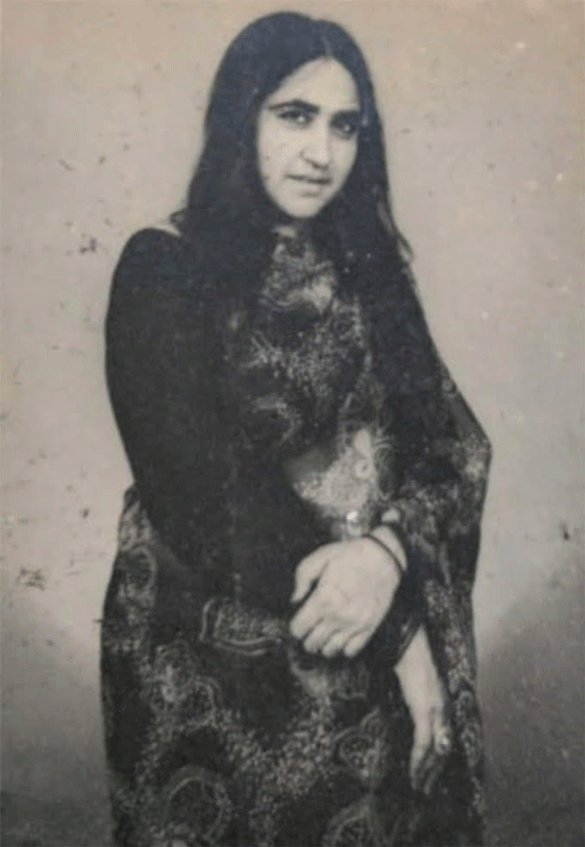
A major turning point in Wajida’s life came when her parents lost all their wealth. Her parents passed away when she was still very young, and she was orphaned at the age of just three.
In 1960, Wajida Tabassum married her cousin Ashfaq Ahmed. Her husband worked with the Indian Railways and was a strong supporter of her writing. After his retirement from the Railways, it was he who took on the responsibility of publishing all of Wajida Tabassum’s books.
Wajida Tabassum began writing at a very young age, but the formal beginning of her literary journey took place in the 1950s. Her first short story, Shola, was published in the renowned literary magazine Beesvi Sadi of that time.
Over the course of her literary career, Wajida Tabassum wrote a total of 27 books. Most of her works were collections of short stories (afsanas), which included well-known titles such as Shehar-e-Mamnū, Tehkhana, Utran, and Chutney.
Her most famous and controversial story, Utran, published in 1975, openly attacked the arrogance and swagger of the nawabs and their behaviour towards their servants. Through the character of Chamki, Wajida Tabassum presented a powerful and fearless image of a woman—one who takes revenge, in a bold manner, against the repeated assaults on her self-respect. This story directly struck at the ego of the nawabs, who believed that the poor survived merely on their “cast-off clothes” (utran).
The uproar surrounding this story was so intense that Wajida Tabassum received threats, and conservative sections of society attempted to socially boycott her.
In response, Wajida Tabassum said:
“A woman is not an ‘utran’—something that anyone can wear and discard. She has her own soul, her own choice, and her own revenge.”
In 1977, her story Nath Utarai, often referred to as Nath ka Bojh, was published. This story was based on a cruel practice prevalent in the feudal society of Hyderabad, where the virginity of young girls was traded and sold. Wajida portrayed this repulsive reality with such courage and frankness that conservative sections termed it the “peak of obscenity.” Because of this story, fatwas were issued against her, and demands were raised to ban her writings.
Responding to this controversy, Wajida Tabassum stated:
“I wrote only what happened behind closed doors and within the high walls of palaces. If society finds my writing obscene, then society must first examine its own actions.”
She further said:
“The nawabs’ so-called culture and refinement were limited only to their clothes and conversation; within them lay a darkness where humanity suffocated and died.”
In her stories, Wajida Tabassum used the Dakkani Urdu spoken in Hyderabad along with local idioms, which made her characters come alive. The women in her stories were not merely victims; they were heroines who used their sexuality and intelligence as weapons to challenge the system.
Like Saadat Hasan Manto, she adopted stark and naked realism to remove the mask from the face of so-called “respectable” society. She never attempted to conceal bitter truths in beautiful language. Because of this fearlessness, Wajida Tabassum was often referred to in literary circles as the “female Manto.”
On this, she said:
“People call me the ‘female Manto’. I do not object to it, because like Manto, I too removed the bandages from the wounds of society—wounds that people preferred to look away from.”
The darkness and exploitation hidden behind the “veil” of feudal and nawabi society were presented by Wajida Tabassum in an extremely terrifying and forceful manner in her famous story Tehkhana. This story exposes the horrifying saga of the exploitation of maidservants and female attendants within the palaces of the nawabs.
On this, she said:
“Hyderabad is not just a name for biryani and buildings; it is also a city of suppressed screams that never crossed the high walls of palaces.”
Wajida Tabassum was one of the most outspoken and bold women writers of her time. She tore away the masks of decency worn by nawabs and feudal lords and placed reality before the world. Although her fearlessness prevented her from receiving major literary awards, she never stopped writing the truth for the sake of recognition.
She expressed her views on women openly and in her own distinctive voice. She challenged orthodox traditions and presented society’s bitter realities to the world without any embellishment. Wajida Tabassum became a mirror to society’s darkest corners and showed it its own grotesque reflection.
Wajida Tabassum died on 7 December 2011 in Mumbai. With her death came the end of a towering figure in Urdu literature. one who challenged patriarchal society, gave voice to oppressed women, and created heroines who were capable of avenging their own humiliation.
…
Afroz Khan is a teacher by profession who writes on women, politics, communal harmony, and Islam. She holds a master’s degree in Education.
URL: https://newageislam.com/islamic-personalities/wajida-tabassum-feudal-hyderabad/d/138715
New Age Islam, Islam Online, Islamic Website, African Muslim News, Arab World News, South Asia News, Indian Muslim News, World Muslim News, Women in Islam, Islamic Feminism, Arab Women, Women In Arab, Islamophobia in America, Muslim Women in West, Islam Women and Feminism