
Tayeba Begum, The First Muslim Woman Graduate of India from Hyderabad
By Afroz Khan, New Age Islam
04 June 2026
Tayeba Begum Khedive Jung was India's first Muslim woman graduate and a pioneering advocate of girls' education in Hyderabad. Through her writings, schools, and social work, she challenged conservative norms, promoted women's empowerment, and inspired future generations to pursue education and social reform.
Main Points:
· India's first Muslim woman graduate.
· Pioneer of girls' education in Hyderabad.
· Co-founder of Mahbubia Girls' School.
· Author of Anwari Begum and social reformer.
· Inspired generations of women through education and public service.
“In the present age, it is not appropriate for any ruler to discriminate against people on religious grounds. In fact, every effort should be made to maintain equality at all costs. That is why my aim is to educate both Muslim and Hindu girls.”
Tayeba Begum Khedive Jung
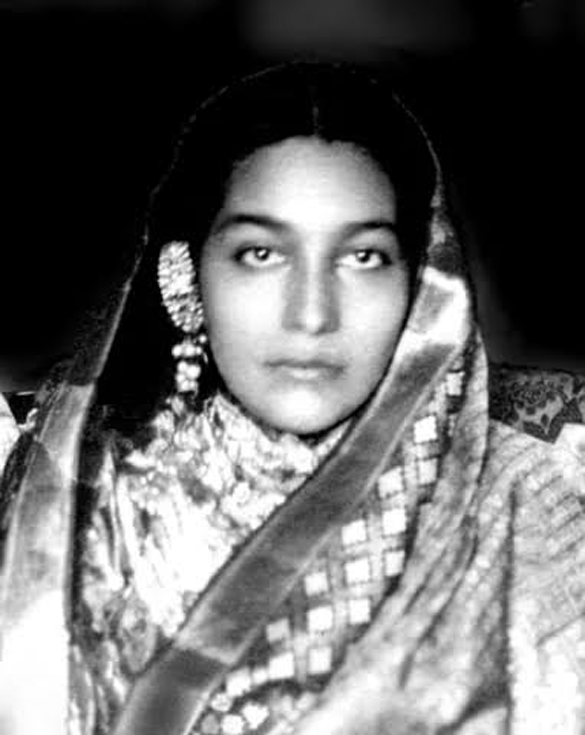
In nineteenth-century India, only a handful of families were considered progressive with regard to women's education and social reform. Their greatest contribution to society was that they encouraged the women in their own households to pursue education and participate in social work, inspiring middle-class and poor families to educate their daughters and involve them in public life.
One such distinguished family was the Bilgrami family of Hyderabad. It was in this family that Tayeba Begum was born in 1873. Her mother was Abbasi Begum Bilgrami, and her father was Imad-ul-Mulk Syed Hussain Bilgrami, a renowned scholar, educationist, and a close official of the Nizam of Hyderabad. He fostered an environment in which girls' education was considered essential. As a result, Tayeba Begum learned Urdu, Persian, Arabic, and English at an early age.
Tayeba Begum was the first Muslim woman in India to obtain a university degree, but her journey was far from easy. She had to overcome numerous challenges and social barriers. In those days, women of elite families were expected to observe strict purdah, making it extremely difficult for them to attend college and participate in classes. Consequently, she continued her studies from home as a private candidate.
Even this was not easy. At that time, there were no facilities for distance learning or private tutoring on the scale available today, and completing the demanding curriculum of the University of Madras without the assistance of teachers was a remarkable challenge. Through determination, self-confidence, and perseverance, Tayeba Begum successfully completed her studies and made history as the first Muslim woman in India to earn a bachelor's degree.
Despite the many social restrictions she faced, her achievement did not go in vain. Her success inspired countless Muslim women in Hyderabad and across India, especially those living behind the veil, to believe that they too could pursue education.
Just two years after completing her degree, she married Dr. Mirza Karim Khan, and her formal education came to an end. However, this was merely the end of her academic journey and the beginning of her social activism.
Tayeba Begum began her literary career around 1900. In 1905, she wrote her famous novel Anwari Begum, through which she exposed the confined lives of women in Hyderabad's aristocratic households and highlighted the rigidities of the purdah system, hoping to encourage social reform.
Tayeba Begum believed that:
“The purpose of women's education is not merely to participate in a blind race for gender parity. Its broader goal is to equip women with the skills and knowledge necessary to raise children, manage households, and care more effectively for the poor and disadvantaged members of society.”
In 1907, Tayeba Begum, along with Lady Amina Hydari and Sarojini Naidu, persuaded the Nizam of Hyderabad to establish the Mahbubia Girls' School. This marked the beginning of her organized social work. Subsequently, she established eight schools in different parts of Hyderabad for underprivileged girls.
Tayeba Begum never confined education or social work within religious boundaries. She established separate primary schools for Hindu and Muslim girls. Explaining her decision, she stated:
“Had I not been bound by certain religious beliefs and social constraints, I would never have established separate schools for them. Although girls from both communities are educated along the same lines, they could not be taught together because, in the early stages of life, they required more extensive religious instruction.”
Recognizing her dedication and commitment to girls' education, Sarojini Naidu remarked:
“Tayeba Begum is a rare and beautiful synthesis of modern and traditional values. She is a visionary woman who broke the chains of orthodoxy and lit a new torch of women's education within Muslim society.”
In 1908, when the Musi River in Hyderabad witnessed a devastating flood, both Lady Amina Hydari and Tayeba Begum were pregnant. Nevertheless, they actively participated in relief and rescue operations. They established relief camps along the riverbanks and directly assisted displaced and suffering families. Speaking about Tayeba Begum's spirit of service, Lady Amina Hydari said:
“Tayeba is not a woman who merely sits in palaces making policies. When society faces a crisis, she has the courage to set aside her personal difficulties and work directly on the ground.”
Tayeba Begum also introduced informal educational centres and innovative school models aimed at providing girls with practical skills suited to their abilities. In addition to academic subjects, girls were trained in sewing, embroidery, and other domestic arts, enabling them to become economically self-reliant.
Modern historians and cultural researchers of Hyderabad have described Tayeba Begum as an “extraordinary” figure for her time.
As some historians have observed:
“We must carefully consider the era in which she lived. It was a time when it was almost unimaginable for a woman of noble birth to step beyond the confines of purdah. In such circumstances, challenging conservative social structures and gender roles, and choosing to lead society on her own terms, was truly remarkable.”
It is unfortunate that such a dedicated reformer and agent of social change passed away prematurely at the age of forty-eight. Yet her work did not end with her death. Her daughter Masuma Begum, along with other women reformers such as Sughra Humayun Mirza, carried forward her mission of promoting girls' education and strengthening the foundations she had laid for future generations.
…
Afroz Khan is a teacher by profession who writes on women, politics, communal harmony, and Islam. She holds a master’s degree in Education.
New Age Islam, Islam Online, Islamic Website, African Muslim News, Arab World News, South Asia News, Indian Muslim News, World Muslim News, Women in Islam, Islamic Feminism, Arab Women, Women In Arab, Islamophobia in America, Muslim Women in West, Islam Women and Feminism