
Takdira Begum, The Master Artist From West Bengal Who Revived The Traditional Nakshi Kantha Embroidery

By Afroz Khan, New Age Islam
7 November 2025
Takdira Begum, a master artist from West Bengal, has revived the traditional Nakshi Kantha embroidery while empowering rural and minority women through her art. Recipient of the Padma Shri, Shilp Guru, and National Merit Awards, her journey reflects dedication, resilience, and cultural pride.
Main Points:
1. Takdira Begum, born in 1953 in West Bengal, mastered the ancient Nakshi Kantha embroidery.
2. Inspired by her mother, she began stitching at the age of 12 and turned her passion into profession.
3. She empowers rural women by training them to earn through Kantha embroidery.
4. Honoured with the Padma Shri (2024), Shilp Guru (2009), and National Merit Award (1995).
5. Her work preserves Bengal’s cultural legacy and promotes women’s financial independence.
-----
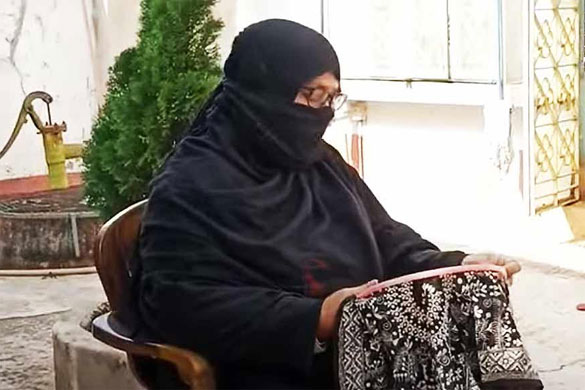
Takdira Begum, image courtesy: GetBengal.Com
-----
The state of Bengal is famous for its traditional and exquisite “Kantha embroidery”, which is done in various styles such as Nakshi Kantha, Lep Kantha, Sujani Kantha, Bayton Kantha, Oor Kantha, Archilata Kantha, Durjoni/Thalia Kantha, and Rumal Kantha. This art form is a part of India’s ancient heritage and serves as a distinctive cultural identity of Bengal.
In Nakshi Kantha, old saris and fabrics are layered together and intricately embroidered with colorful threads. It is mainly popular in Bangladesh and the Indian states of West Bengal, Tripura, and Assam. The art involves creating beautiful “naksha” (artistic patterns) using running stitches or Kantha stitches, and is often used for quilts, bedspreads, curtains, and other household items.
Takdira Begum is a master artist of this Nakshi Kantha embroidery. She was born on 13 November 1953 in Srikrishnapur, 24 Parganas, West Bengal. Her mother used to practice Bengal’s traditional Nakshi Kantha embroidery at home. Watching her mother work inspired Takdira’s natural love for this art form.
As a child, Takdira would often join her mother after school to do Kantha embroidery, creating traditional designs with colorful threads. By the age of 12 or 13, she had already entered the creative world of Kantha embroidery.
Takdira Begum’s father originally belonged to Shrikrishnapur, but later moved to Jaykrishnapur. She studied up to the 10th grade at Bhedia Girls’ School in Ausgram. Her interest in stitching and embroidery began as early as the fifth grade. Inspired by her mother’s work in Kantha embroidery, she was drawn beyond traditional academics to the intricate art of needlework.
Over the past 30 years, Takdira has dedicated her life to perfecting the art of Kantha embroidery. What began as a childhood hobby gradually became both her passion and profession. The stitching skills she acquired during her school days laid the foundation for a lifelong journey in this craft.
After receiving the Padma Shri Award in 2024, Takdira emphasized the importance of empowering marginalized communities and encouraging minority women to work towards improving their socio-economic conditions. She believes that financial independence through traditional arts can transform women’s lives and help preserve cultural heritage at the same time.
According to Anandabazar.com, Takdira says, “I can’t sit idle; I love to work. It is a matter of great happiness for me that the Central Government found me deserving of this honour.”
She further explains that she first learned stitching during a sewing class in school when she was in the fifth grade. Later, she learned the art of Kantha stitch embroidery from the women in her family. What began as a hobby eventually became her profession.
Currently, Takdira continues her work from home in Bolpur, West Bengal. Her daughter and son-in-law, who live in Delhi, manage the sales and marketing of her handcrafted Kantha products.
Takdira was married at the age of 19 and became a mother to three daughters soon after. Despite facing the limitations of a patriarchal society, she persevered and turned her skill into strength.
In an interview with GetBengal.com, Takdira recalled:
“My mother could never even imagine selling her work and earning from it, it was never allowed in our family back then. But she was a master stitcher and taught me many rare and intricate designs. I wanted to take this embroidery to a bigger stage. I had dreams.”
She further shared:
“Even though many girls were eager to work and become financially independent, their husbands refused to let them come out of their homes. However, my husband supported me immensely and encouraged his friends to do the same, to let their wives work and gain independence.”
Takdira has not only been honoured with the Padma Shri, but also received the National Merit Award in 1995 and the Shilp Guru Award in 2009. These prestigious honours stand as a testament to her exceptional skill, dedication, and artistic excellence.
Through her dedication, Takdira Begum has become an inspiration for countless women across India, proving that with determination and skill, traditional art can not only survive but also empower generations. Her journey of over three decades in empowering rural women was filled with challenges, yet it has borne remarkable results. Takdira stands today as a shining example of how even women from marginalised and minority communities in India can create an artistic legacy that sustains both culture and livelihood.
----
Afroz Khan is a teacher by profession, focusing on writings about women and Islam. She holds a Bachelor’s degree in Education.
New Age Islam, Islam Online, Islamic Website, African Muslim News, Arab World News, South Asia News, Indian Muslim News, World Muslim News, Women in Islam, Islamic Feminism, Arab Women, Women In Arab, Islamophobia in America, Muslim Women in West, Islam Women and Feminism