
Sughra Mehdi, A Writer and Grassroots Social Worker Associated with Jamia Millia Islamia

By Afroz Khan, New Age Islam
12 May 2026
Sughra Mehdi was an Urdu scholar, writer, teacher, and social activist associated with Jamia Millia Islamia. Through her novels, stories, and activism, she highlighted women’s struggles, social inequality, Partition trauma, and the importance of education, legal rights, and women’s economic independence.
Key Point:
· Sughra Mehdi was a noted Urdu writer and scholar.
· She taught at Jamia Millia Islamia for nearly two decades.
· Her writings focused on women’s struggles and social issues.
· She actively worked for Muslim women’s rights and education.
· Her novels addressed Partition trauma, domestic violence, and gender inequality.
“It is a tragedy that a religion which declared men and women equal in every respect is today increasingly seen as a symbol of women’s oppression.”
Sughra Mehdi
Dr. Sughra Mehdi was born on 8 August 1937 in Bhopal. Her real name was Amanat Fatima. Her father’s name was Syed Mohammad Mehdi and her mother’s name was Kaneez Fatima. She belonged to a respected and cultured family of Bhopal. Her childhood was spent amidst the traditional and literary culture of Bhopal, and she also received her early education there.
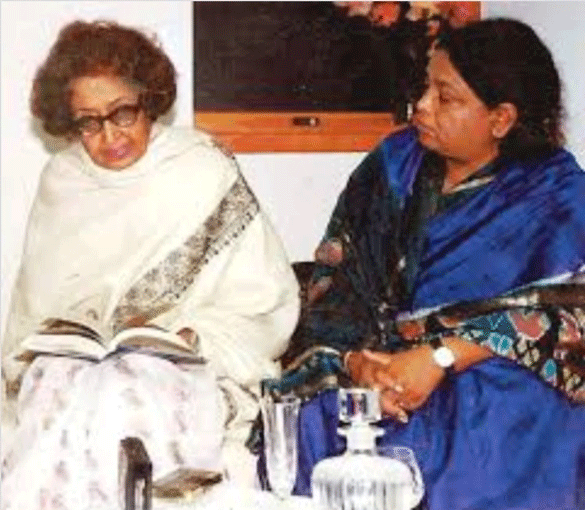
At a very young age, Sughra Mehdi moved to Delhi to live with her uncle and aunt. The environment of Delhi was completely different from that of Bhopal. Her uncle, Abid Husain, was a renowned Gandhian scholar and one of the founders of Jamia Millia Islamia, while his wife, Saliha Abid Husain, was a well-known writer.
Dr. Sughra received her higher education from Jamia Millia Islamia. She was among the earliest students of Jamia’s “Rural Institute.” She completed her Ph.D. research on the life and literary works of the famous Urdu poet Akbar Allahabadi. Her research work is considered an important reference text in Urdu literature.
Dr. Sughra Mehdi began teaching in the Urdu Department of Jamia Millia Islamia in 1977 and served there for nearly twenty years.
Writing Work
Dr. Sughra Mehdi displayed her literary talent from an early age. While studying in Class 8, she wrote her first story, which was published in the children’s magazine Khilone. However, she did not consider it her first formal literary work; instead, she regarded Atish-e-Khamosh as the true beginning of her writing career.
Atish-e-Khamosh was written for a competition organised by a girls’ literary circle in Delhi, where it won the first prize. After this success, her writings began appearing regularly in major literary magazines such as Beesvi Sadi and Aajkal.
Through her writings, Dr. Sughra Mehdi boldly raised issues concerning women and their struggles with remarkable clarity and sensitivity.
In her work Purwai, she portrayed the condition of women in middle-class Muslim families, highlighting the conflict between their dreams and the restrictions imposed by society.
In her memoir Hamari Jamia, she documented the stories of women who either lived behind the veil or broke social barriers to help build Jamia Millia Islamia. She demonstrated how deep and difficult the struggle of women in the field of education had been.
Sughra Mehdi often used to say:
“The soul of Jamia comes from all those strong and resilient women who collectively built Jamia and the Muslim women’s movement over decades.”
Syeda Hameed described “Hamari Jamia” as an “amazing book” and praised it, and said
“Stories of the women of Jamia survive in one amazing book, Hamari Jamia, which deserves to be translated into many languages and made available worldwide... The author, Prof. Sughra Mehdi, wrote it with immense willpower just before she passed away. If not for her, these stories would have been lost forever.”
In her short story collection Kaanch Ke Ghar, Sughra Mehdi especially wove together the stories of women who suppress their emotions in an attempt to maintain a “perfect” household. The collection powerfully portrays domestic violence, both psychological and physical, along with the complexities of married life.
Through these stories, she attacked the bitterness, silence, and culture of pretension hidden within middle-class families. She showed how homes that appear beautiful from the outside can internally be hollow and full of tension.
Dr. Sughra Mehdi wrote several important literary works, including Talash-e-Noor, Dhoop Ki Jhankar, Pa-ba-Jolan, and Raat Ki Rani.
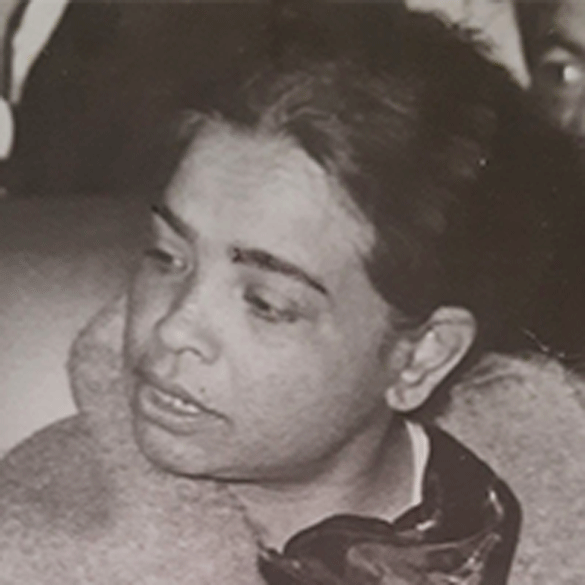
Another important novel by Dr. Sughra Mehdi is Jo Bach Gaye The. This novel mainly revisits the wounds caused by the Partition of India in 1947 and the communal riots that followed. The title Jo Bach Gaye The refers to those people who physically survived the violence of Partition but were left emotionally and mentally shattered.
In this novel too, Sughra Mehdi gave special importance to the perspective of women. The physical and emotional suffering endured by women during Partition can be deeply felt throughout the layers of the narrative.
Dr. Sughra Mehdi travelled to the United Kingdom, the United States, Japan, and Pakistan. During these travels, she not only visited friends and family members but also explored tourist sites and academic institutions.
Her travels were not limited to sightseeing alone; she carefully observed the educational systems and the condition of women in those societies, the influence of which can clearly be seen in her writings.
Social Work
Dr. Sughra Mehdi retired from Jamia Millia Islamia in 1997, and after retirement she became even more active in social work. She particularly worked at the grassroots level for the education and rights of Muslim women through the “Muslim Women Forum.”
Along with Syed Hamid, she fought legal battles in courts for women’s rights, addressed rallies, and wrote booklets on legal awareness and rights. Her main argument was that women are entitled to equal rights under both the Indian Constitution and Muslim law.
She strongly believed that:
“There exists a huge gap between laws made for gender equality and social reality.”
In her own way, she worked sincerely to bridge this gap. She also believed that the true strength of women lies in their economic independence. For this reason, she made several grassroots efforts for girls’ education and the development of professional skills.
Dr. Sughra Mehdi was a strong advocate of women’s self-reliance. She believed that:
“Girls and women must become economically independent so that they can stand on their own feet.”
Dr. Sughra Mehdi was not merely an academic scholar, but also a committed social activist who stepped beyond middle-class intellectual circles to understand the struggles of ordinary women and work towards meaningful solutions for them.
…
Afroz Khan is a teacher by profession who writes on women, politics, communal harmony, and Islam. She holds a master’s degree in Education.
New Age Islam, Islam Online, Islamic Website, African Muslim News, Arab World News, South Asia News, Indian Muslim News, World Muslim News, Women in Islam, Islamic Feminism, Arab Women, Women In Arab, Islamophobia in America, Muslim Women in West, Islam Women and Feminism