
Malalai of Maiwand: Afghanistan’s Fearless Daughter

By Afroz Khan, New Age Islam
4 December 2025
In 1880 at Maiwand, 19-year-old Malalai rallied retreating Afghan troops with bold verses and her veil as a flag. Shot dead while leading the charge, her sacrifice inspired victory against the British, making her Afghanistan’s eternal symbol of courage and honour.
Main Points:
1. 19-year-old Malalai went to Maiwand battlefield to help wounded Afghan soldiers.
2. When Afghans were losing and retreating, she shouted brave poetry to inspire them.
3. She raised her veil as a flag and led the charge herself.
4. She was killed by a British bullet but her death sparked a massive Afghan counter-attack.
5. Her sacrifice turned defeat into victory; she became Afghanistan’s greatest heroine.
----
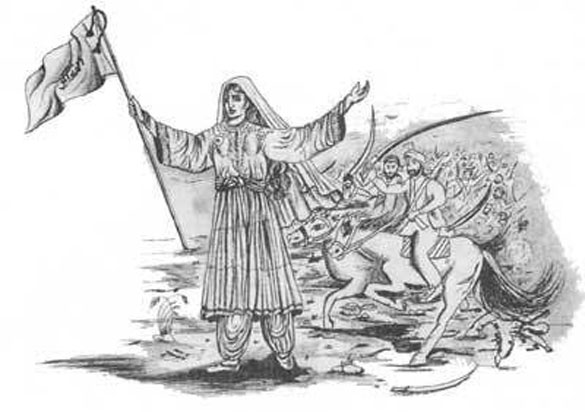
"Malalai of Maiwand was a shining example of bravery and selflessness." - (Khaled Hosseini, renowned novelist)
Malalai was born into the Noorzai tribe in 1861 in the village of Khig, about 3 miles southwest of the then village of Maiwand in Afghanistan's southern Kandahar Province. Malalai's father was a shepherd. When she turned 19, her father arranged her marriage to a man who was a soldier in the Afghan army.
This was the period of the 1880s, when two major powers, Britain and Russia, were competing for control of Central Asia, resulting in Central Asia becoming a frequent battlefield.
The local administration and people were distressed by these imposed wars but were always ready to defend their homeland. They rejected the dominance of any foreign power on their soil.
In 1878, Russia sent a diplomatic mission to the court of Sher Ali Khan, the Amir of Afghanistan. Sher Ali Khan, wishing to remain neutral, rejected the mission.Then, Lord Lytton, the then Viceroy of British India, attempted to appoint a British Resident in Afghanistan, ending the policy of "Masterly Inactivity." Sher Ali Khan also refused to accept the British diplomatic mission.
Sher Ali Khan's refusal led to the British invasion of 21 November 1878, which marked the beginning of the Second Anglo-Afghan War.
The British main garrison was located in Kandahar, the nearest city to Maiwand. The Afghan army was led by Commander Ayub Khan, son of the Afghan Emir Sher Ali Khan, and the British-Indian Army was led by Brigadier General George Burrows.
The British troops, numbering approximately 2,500, were better trained and equipped with military weapons. The Afghan troops were facing defeat at the hands of these modern weapons and skilled soldiers, and despair was brewing in them.
The citizens of Maiwand were constantly ready to care for the wounded soldiers and bandage their wounds. Malalai was also present there to care for these soldiers.
Malalai Was A Brave Young Woman
When she realised that the Afghan soldiers were becoming deeply disappointed and were retreating from the battlefield, her actions were recorded in the pages of history as her bravery.
On the battlefield, Malalai spoke these words to inspire the troops and remind the Afghan soldiers of their duty:
"Young love, if you do not fall in the battle of Maiwand,
I swear by God, someone is saving you as a mark of shame."
She also recited a Pashto poem:
"With a drop of my beloved's blood,
shed in defence of the motherland,
will I put a dot of beauty on my forehead,
such that even the roses of the garden will be ashamed.”
When the Afghan soldiers heard this inspiring poem and were deeply moved by Malalai's rousing voice, her powerful words shook the retreating soldiers and inspired them to attack anew.
Waving her veil as a battle flag, Malalai led the attack and, carrying the flag, was struck by a British bullet and fell, martyring her life. With Malalai's martyrdom, the Afghan soldiers were filled with anger and retaliated against the British forces with full force.
Malalai's bravery and sacrifice played a crucial role in the Afghan victory, which was one of the worst defeats for the British Empire in Afghanistan.
Regarding Malalai's sacrifice and zeal, the famous poet and philosopher Rumi said:
"Malala's story is a reminder that even a small voice can spark a revolution and change the course of history.”
Malalai's bravery immortalised her. At such a young age, she paved the way for the Afghan fighters to victory.
She is an example of bravery in Afghanistan, and several schools and hospitals have been established in her name.
In Afghanistan, daughters are named after her with the hope that they too will become brave and fearless women like Malalai. Nobel Prize winner Malala Yousafzai is also named after her.
Malala Yousafzai herself mentioned this, saying, "I was named after Malalai of Maiwand, Afghanistan's greatest heroine."
She continued,
"Oh Malalai of Maiwand, rise again to teach the Pashtuns a song of honour. Your poetic words change the world. I beg you, rise again.”
Malalai's story tells us that bravery is not measured by physical strength; bravery means standing firm against the enemy till the last breath, fighting for one's motherland and honour, and not accepting defeat under any circumstances.
-----
Afroz Khan is a teacher by profession who writes on women, politics, communal harmony, and Islam. She holds a master’s degree in Education.
URL: https://www.newageislam.com/islamic-personalities/malalai-afghanistan-fearless-daughter/d/137884
New Age Islam, Islam Online, Islamic Website, African Muslim News, Arab World News, South Asia News, Indian Muslim News, World Muslim News, Women in Islam, Islamic Feminism, Arab Women, Women In Arab, Islamophobia in America, Muslim Women in West, Islam Women and Feminism