
Iqbalunnisa Husain Who Dedicated Both Her Pen and Her Life to the Cause of Women’s Rights
By Afroz Khan, New Age Islam
30 May 2026
Iqbalunnisa Husain was an Indian writer, educator, and social reformer who advocated women’s education and rights. Through her groundbreaking novel Purdah and Polygamy: Life in an Indian Muslim Household and social initiatives, she challenged patriarchy, purdah, polygamy, and gender inequality in early twentieth century India.
Main Points
· Iqbalunnisa Husain was among the earliest Muslim feminist voices in India.
· She wrote Purdah and Polygamy: Life in an Indian Muslim Household, the first English novel by an Indian Muslim woman.
· She strongly advocated women’s education and rights.
· She founded schools and organisations for Muslim women’s empowerment.
· She challenged purdah, polygamy, and patriarchal social practices.
…
“Discrimination against women is neither a new nor a recently developed practice. It is deeply embedded in a history that grants men a ‘superior’ status while viewing women as easily replaceable ‘subordinates”
Iqbalunnisa Husain
Iqbalunnisa Husain was born on 21 January 1897 in Chikkaballapur, near Bangalore in Karnataka, into a traditional Sunni Muslim family. Her father’s name was Ghulam Moinuddin Khan and her mother was Zaibunnisa. Her mother was a direct descendant of the ruler of Mysore, Tipu Sultan.
During that period, child marriage was extremely common in India, and Iqbalunnisa too became a victim of this social evil. She was married at the age of just fifteen to Syed Ahmed Husain. However, her husband respected her desire to continue her education and, in 1930, sent her to Maharani’s College in Bangalore, where she completed her graduation and received a gold medal for her academic excellence.
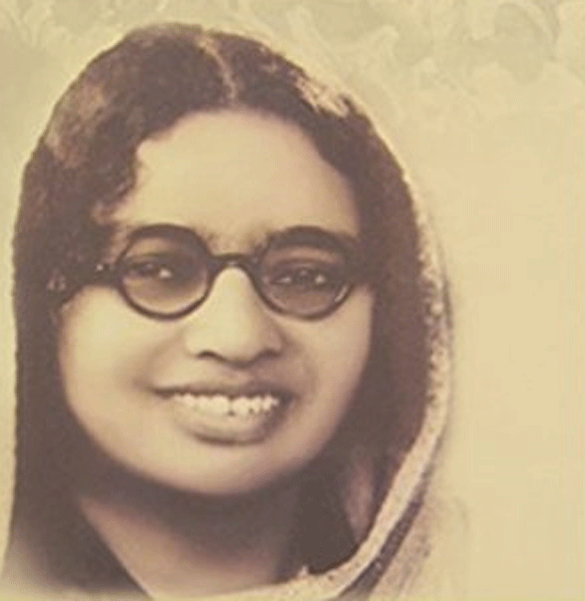
In 1933, she went to the United Kingdom for higher studies. There, she obtained a master’s degree in Education from University of Leeds.
After completing her education in the UK and returning to India, she began writing about the plight of women. She started writing mainly around the 1930s and contributed numerous articles to newspapers and magazines on the status of women in society, particularly focusing on the education and rights of Muslim women. In 1940, she compiled these revolutionary writings into her first book, Changing India: A Muslim Woman Speaks.
In 1944, she published her most famous novel, Purdah and Polygamy: Life in an Indian Muslim Household. It is regarded as the first full-length novel in English written by an Indian Muslim woman.
Through this novel, she highlighted several social evils prevalent in Muslim society at the time, while also raising important issues concerning women. She exposed how the practice of purdah was used to deprive women of education and their rights. The novel also addressed the practice of polygamy and its psychological impact on women.
Iqbalunnisa personally believed that:
“Women must challenge all those chains and limitations that confine them only to subservient roles. They must fight for their own identity and freedom.”
Praising her novel, Sir C. R. Reddy wrote:
“The minuteness and truth with which Mrs. Husain portrays the inner life of Indian Muslim families make her the Jane Austen of India.”
He further remarked about the novel:
“Perhaps no other novel published in India has a stronger claim to recognition than Mrs. Iqbalunnisa Husain’s Purdah and Polygamy.”
Professor Jessica Berman of the University of Maryland stated:
“Iqbalunnisa Husain’s writing is among the most powerful, courageous, and striking feminist narratives of its time.”
Although Iqbalunnisa Husain wrote only one novel and one major book, she undertook remarkable work for the welfare of women and girls in both her professional and personal life.
She began her career as the headmistress of a primary school. Despite social opposition, she transformed that institution into an Urdu Girls’ Middle School so that girls from the Muslim community could attend school without hesitation.
She also established the “School of Home Industries” for Muslim women in Bangalore. The institution provided practical training in carpet weaving, rug making, embroidery, and tailoring so that women could become financially independent.
She firmly believed that:
“Until women become economically independent, they cannot be completely free from the bonds of patriarchy.”
Iqbalunnisa Husain also founded the “Association of Muslim Women Educators” in Bangalore. Through this organisation, she encouraged women who wished to enter the teaching profession, helping address the severe shortage of female teachers within the Muslim community.
In September 1935, she represented Indian women at the 12th International Women's Congress held in Istanbul and voiced her ideas on an international platform.
Bringing social change in early twentieth century India was never easy. Due to her revolutionary reforms, she faced severe criticism, threats, and social boycott from orthodox sections of her own community. Nevertheless, she never abandoned her mission to improve the social and educational condition of Muslim women.
On 22 October 1954, she passed away. Even during the final years of her life, she remained actively engaged in women’s education and social reform. With her death, India lost one of the earliest and most powerful feminist voices to emerge from within the Muslim community in the early twentieth century.
…
Afroz Khan is a teacher by profession who writes on women, politics, communal harmony, and Islam. She holds a master’s degree in Education.
New Age Islam, Islam Online, Islamic Website, African Muslim News, Arab World News, South Asia News, Indian Muslim News, World Muslim News, Women in Islam, Islamic Feminism, Arab Women, Women In Arab, Islamophobia in America, Muslim Women in West, Islam Women and Feminism