
How Thashlima Nashrin Became a Symbol of Communal Harmony Through Education

By Afroz Khan, New Age Islam
12 March 2026
A. Thashlima Nashrin, a woman with a disability from Madurai, volunteers under Tamil Nadu’s Illam Thedi Kalvi scheme to teach village children. Conducting classes in a Murugan temple, she has become a symbol of social harmony, proving that education and humanity rise above religious differences.
Points:
· 1.Thashlima Nashrin is a differently-abled volunteer from Madurai.
· 2.She teaches children under the Illam Thedi Kalvi scheme.
· 3.Her classes are held in a Murugan temple in Vellaripatti.
· 4.The initiative reflects strong communal harmony.
· 5.Her work encourages rural children, especially girls, to continue education.
…
“Illam Thedi Kalvi scheme has given me an opportunity to give something back to society. Seeing the sparkle of learning in the eyes of children is my real reward.”
A. Thashlima Nashrin
A. Thashlima Nashrin, a resident of Munnamalaipatti village in Madurai district of Tamil Nadu, may be described as a woman with a disability, but she has set such a remarkable example of social harmony that the entire village considers her their own daughter.
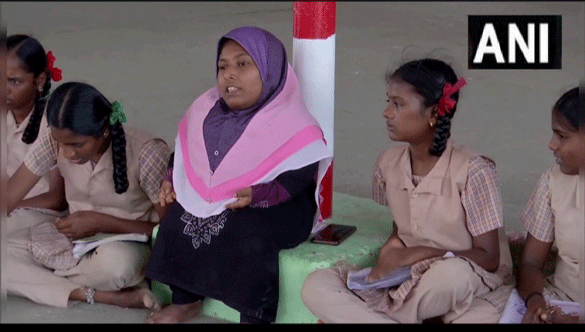
Thashlima belongs to a simple Muslim family. Her family has always been deeply committed to her education, and because of this support, despite her physical challenges, she successfully completed her Bachelor’s degree in History.
Illam Thedi Kalvi Scheme
During the COVID-19 pandemic, when schools were closed, students from Classes 1 to 8 suffered a significant loss in their learning. This gap in learning is commonly referred to as the “learning gap”. To bridge this gap, the Government of Tamil Nadu launched the “Illam Thedi Kalvi” (“Education at Your Doorstep”) scheme so that children could relearn the basic skills suitable for their age.
Under this scheme, instead of appointing regular teachers, the government involved local volunteers so that children could easily connect with them and continue their learning. The classes are not conducted in school buildings; rather, they are organised near the children’s homes at public places such as temples, community centres, or open grounds.
When the Tamil Nadu government launched this scheme, Thashlima applied as a volunteer under the programme and took the responsibility of teaching the local children in her village.
However, when Thashlima faced difficulty in finding a place to conduct the classes, local residents suggested that she hold the classes in the premises of the Murugan Temple located in Vellaripatti village. She gladly accepted the suggestion.
Although she is a Muslim woman, the local people readily provided her space in the temple to teach children. On this, Thashlima says:
“When the villagers suggested that I should teach in the temple, I felt very happy. It shows that in our society people place education and the future of children above religion.”
Despite her physical disability, Thashlima travels every evening from her village to the temple to teach children in the calm and peaceful environment of the Murugan Temple. Speaking about teaching in the temple, she says:
“Knowledge has neither boundaries nor religion, and a temple is a calm and sacred place where children can learn without any discrimination.”
Together, Thashlima and the people of Vellaripatti village present not only an inspiring example of social harmony, but also the story of a determined woman who refuses to allow her physical condition to become an obstacle in achieving her goal. Speaking about her physical condition, she says:
“My physical condition (disability) has never become a barrier to my work. I want rural children, especially girls, not to lag behind in education. If I can help them by teaching near their homes or in the nearby temple, it is a matter of pride for me.”
The villagers and the priest of the temple where Thashlima teaches hold great respect for her. This stands as a living example of Tamil Nadu’s “Dravidian model” and the spirit of communal harmony, where the walls of religion are set aside for the sake of education.
Her classes in the temple are not seen merely as an educational activity, but as a form of social transformation. The elders of the village and the temple administration treat her with great respect, which clearly shows that at the grassroots level the importance of education is greater than the barriers of religion.
In today’s times, when incidents of religious intolerance and hatred are increasingly reported in India, Thashlima Nashrin has emerged as an extraordinary symbol of communal harmony. That is why her story is both inspiring and highly noteworthy.
…
Afroz Khan is a teacher by profession who writes on women, politics, communal harmony, and Islam. She holds a master’s degree in Education.
New Age Islam, Islam Online, Islamic Website, African Muslim News, Arab World News, South Asia News, Indian Muslim News, World Muslim News, Women in Islam, Islamic Feminism, Arab Women, Women In Arab, Islamophobia in America, Muslim Women in West, Islam Women and Feminism