
Dr. Khadija Mumtaz, Kerala's Bold Literary Voice
By Afroz Khan, New Age Islam
25 February 2026
Dr. Khadija Mumtaz, a gynaecologist from Kerala, transformed into a writer and activist after her experiences in Saudi Arabia. Her novel Barsa challenged restrictions on Muslim women and sparked controversy. Awarded by the Kerala Sahitya Akademi, she continues advocating for women’s health, rights, and social empowerment.
Points:
· Dr. Khadija Mumtaz is a gynaecologist from Kerala who later became a writer and activist.
· Her stay in Saudi Arabia deeply influenced her thoughts on women’s rights.
· Her novel Barsa questioned restrictions on Muslim women and sparked controversy.
· She received the Kerala Sahitya Akademi Award for her work.
· She actively advocates for women’s health, legal rights, and social empowerment.
“Dr. Khadija’s writing is like her medical profession, precise, profound, and healing. She uses her pen against those social evils that are often ignored.”
M. N. Karassery (renowned critic and scholar)
Dr. Khadija Mumtaz began her professional journey as a doctor. However, certain experiences connected to this very profession transformed her into a writer. Later, the controversy that arose from her novel inspired her to become a social activist. The journey of Dr. Khadija Mumtaz itself appears like an engaging novel.
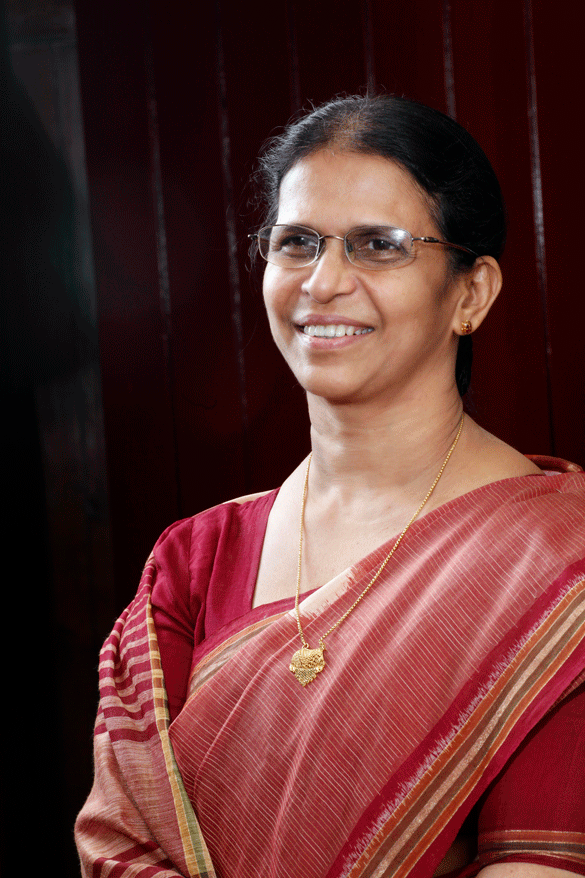
Dr. Khadija Mumtaz was born in 1955 in Kattur in Thrissur district of Kerala. She completed her early education at St. Joseph’s College, Irinjalakuda and later obtained her MBBS degree from Government Medical College, Kozhikode. In 1970, she began her medical career and initially started working in Kerala itself as a gynaecologist.
A revolutionary change came in her life in 1983 when she moved to Saudi Arabia with her husband. There, she began working as a gynaecologist. There was a vast difference between the social fabric of Saudi Arabia and Kerala, and this contrast shook her deeply.
Speaking about her stay in Saudi Arabia, she says:
“As a woman doctor, I was able to become part of a world of women where men had no entry. I saw how even inside the hospital, women remained extremely cautious about their identity and faces. The suffocation behind this ‘veil’ and their silent screams shook me to the core.”
Her stay was in Mecca. On one hand, she had deep religious faith associated with Mecca, and on the other hand, there were strict social laws. She realised that in the name of religion, restrictions imposed on women were often placed above human sensitivity. She witnessed with her own eyes how, even during serious medical treatment, doctors had to wait for male consent.
During her stay in Saudi Arabia, she was deeply affected by one such incident. She could not stop herself from weaving that experience into words, and from that incident emerged the seed of her famous novel “Barsa.”
While Dr. Mumtaz was working as a gynaecologist in a hospital in Saudi Arabia, a pregnant woman came to her. The woman was in unbearable pain, yet she hesitated to speak openly to her doctor or express her suffering because, due to strict social norms, women were accustomed to suppressing their pain. The “silent eyes” of that woman shook Dr. Mumtaz so deeply that she decided to bring such untold stories before the world.
‘Barsa’ is an Arabic word which means “a woman who does not wear a veil.” Dr. Mumtaz explained that she chose this title because in a country like Saudi Arabia, where the veil was mandatory, imagining a heroine who questions without wearing a veil was itself a bold act of rebellion.
Dr. Khadija Mumtaz’s novel “Barsa” was published in 2007. The novel raises serious questions about the condition of women in Muslim society, their rights, and the restrictions imposed upon them. For this novel, Dr. Mumtaz received the Kerala Sahitya Akademi Award in 2010.
The jury of the Akademi remarked about her novel:
“Mumtaz’s novel ‘Barsa’ is a milestone in Malayalam literature because it presents, with great honesty and without hesitation, the complex relationship between religion, culture, and female identity.”
Renowned Malayalam writer M. Mukundan said about her novel:
“Khadija Mumtaz has opened the closed doors of a world about which outsiders knew very little. Her writing is not merely a story, but a courageous struggle of a woman for her identity.”
Regarding Khadija Mumtaz’s novel, some critics and certain religious organisations believed that the novel misrepresented Islamic traditions, especially the restrictions imposed on women. Some fundamentalist groups even demanded that she apologise or return her award.
Dr. Mumtaz responded in a calm yet firm tone: “What I have written is the truth, and one does not apologise for the truth.” Her fearlessness made her an icon among women in Kerala.
Despite all these controversies, Dr. Mumtaz remained steadfast in her stand. She clarified that her intention was not to insult religion, but to expose women’s subordination and the misinterpretations of religious texts.
Due to the sharp criticism and controversy arising from her novel, she began speaking against fundamentalism. She not only spoke out but also firmly raised her voice in support of Muslim women’s rights.
After retiring from medical college in 2013, she devoted her full time to social issues. During this period, through organisations like Forgon, she began a grassroots struggle for the legal rights of Muslim women.
Dr. Khadija Mumtaz believes:
“Muslim women do not need permission from others to speak about their own problems.”
As a doctor (gynaecologist), she has conducted several campaigns in rural areas of Kerala to spread awareness about women’s health and reproductive rights. Dr. Khadija Mumtaz believes that women’s empowerment begins with awareness of their own health. She has particularly worked to remove social taboos associated with pregnancy, childbirth, and menopause.
She has also made several efforts at the administrative level to improve facilities in government hospitals and to ensure better treatment for poor patients.
Dr. Khadija Mumtaz has also served as the Vice President of the Akademi, where she has promoted literary activities that provide a platform to marginalised communities and women’s voices.
Dr. Khadija Mumtaz is associated with several forums that work to eliminate discrimination between men and women. She often says:
“Until women are made economically and legally independent, the development of society will remain incomplete.”
Dr. Khadija Mumtaz is a powerful voice for marginalised Muslim women in Kerala. She is a woman who continuously strives to improve the health and social lives of other women.
…
Afroz Khan is a teacher by profession who writes on women, politics, communal harmony, and Islam. She holds a master’s degree in Education.
URL: https://newageislam.com/islamic-personalities/dr-khadija-mumtaz-kerala-bold-literary-voice/d/139011
New Age Islam, Islam Online, Islamic Website, African Muslim News, Arab World News, South Asia News, Indian Muslim News, World Muslim News, Women in Islam, Islamic Feminism, Arab Women, Women In Arab, Islamophobia in America, Muslim Women in West, Islam Women and Feminism