
The Celestial Poet-Saint: Hazrat Khwaja Jamaaluddin Jumman Shah Chishti of Ahmedabad, Gujarat

By Adnan Faizi, New Age Islam
24 April 2026
Hazrat Khwaja Syed Jamaaluddin Jumman Shah Chishti, the unparalleled poet and Chishti Nasiri Shaykh, graced Ahmedabad with divine poetry and spiritual miracles. His life exemplifies how the Sufi discipline transforms heart and mind into vessels of divine love.
Main Points:
· Hazrat Khwaja Syed Jamaaluddin born in Ahmedabad, Gujarat 940 Hijri.
· He became Hafiz-e-Qur’an aged nine, offering thousand daily nafl rak’ats regularly.
· He was a Chishti Nasiri khalifa, famed poet with takhallus Jumman.
· His wisaal occurred on 20 Zil Hijja 940 Hijri, and his mazaar stands in Navrangpura, Ahmedabad.
· His life helps devotees find faith, patience, guidance, and inner peace.
Introduction
Hazrat Khwaja Syed Jamaaluddin Jumman Shah Chishti stands among the luminous Chishti Sufi masters of Gujarat, whose life is beautifully united poetry, scholarship, worship, and miracles. Born in Ahmedabad into the noble Husaini Sadaat lineage, he represented the spiritual values of the Chishti Nasiri silsila, centred on divine love, humility, and service. His father, Hazrat Khwaja Syed Mahmood Rajan Chishti bin Hazrat Khwaja Syed Muhammad Ilmuddin, personally trained him in both outward and inward knowledge, and by the age of nine he had become a Hafiz-e-Qur’an. Hazrat Khwaja Syed Jamaaluddin was also a gifted poet who used the takhallus “Jumman.” Through his verses, he expressed the deeper truths of Sufism, especially the love of Allah and spiritual self-purification. He was learned in Arabic and Persian, taught students in the madrasa of his khanqah, and maintained a life of intense worship, offering one thousand nafl rak‘ats daily. As the foremost mureed and khalifa of his father, he guided seekers towards purification of the heart and closeness to Allah.
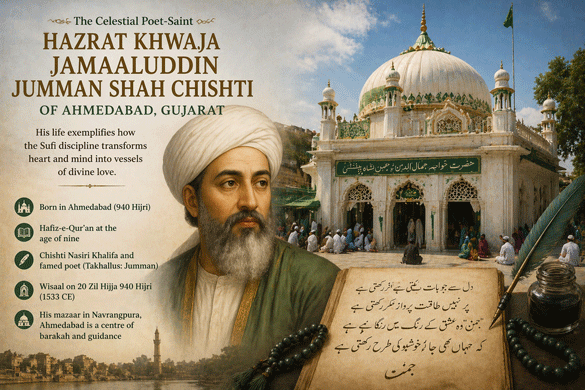
Hazrat Khwaja Syed Jamaaluddin Jumman Shah Chishti passed away on 20 Zil Hijja 940 Hijri (1533 CE). His blessed mazaar in Navrangpura, Ahmedabad, continues to attract devotees. His life remains a timeless example that true spiritual knowledge is achieved when disciplined learning is joined with sincere love of Allah.
Early Life and Noble Lineage
Hazrat Khwaja Syed Jamaaluddin Jumman Shah Chishti was born in Ahmedabad, Gujarat, into the respected Husaini Sadaat family, a lineage connected to Hazrat Imam Husain, and honoured for carrying Prophetic barakah. His birth came during a period when the Chishti silsila was flourishing in Gujarat, where khanqahs served as centres of both Shariat and Tariqat. From an early age, signs of divine favour were evident, and his noble lineage prepared him for a life of spiritual leadership. His father, Hazrat Khwaja Syed Mahmood Rajan Chishti bin Hazrat Khwaja Syed Muhammad ilmuddin, became his first teacher and murshid, training him in Qur’anic recitation, knowledge, and spiritual adab. Under his guidance, Hazrat Khwaja Syed Jamaaluddin memorised the entire Qur’an by the age of nine, becoming a Hafiz-e-Qur’an. This remarkable achievement reflected both sharp intellect and divine blessing. It also laid the foundation for his later mastery of Arabic and Persian, the languages through which he expressed learning and spiritual poetry.
His life was deeply connected to the discipline of the khanqah. No reliable records mention a spouse or children, indicating that his focus remained centred on worship, teaching, and sulook. He taught students in the madrasa of the khanqah, offering not only formal knowledge but guidance that awakened hearts. Alongside this, he performed one thousand nafl rak‘ats daily, reflecting the Chishti belief that constant worship purifies the soul. Hazrat Khwaja Syed Jamaaluddin also gained great respect as an unmatched poet. Writing under the takhallus “Jumman,” his verses carried spiritual light and touched hearts across Gujarat. His early life beautifully showed that true faith joins knowledge, worship, discipline, and love, turning religion into a living spiritual experience rather than dry learning alone.
Spiritual Training and Bay‘ah
Hazrat Khwaja Syed Jamaaluddin Jumman Shah Chishti received bay‘ah from his father, Hazrat Khwaja Syed Mahmood Raajan Chishti, establishing a deep spiritual bond within the Chishti Nasiri silsila. Through this paternal training, he was guided in both zahiri knowledge and batini faez, where regular zikr and discipline purified the heart and weakened the ego. From his father, he also received ijazat and became his foremost mureed and khalifa, later serving as a leading guide of the Chishti Nasiri order. His training combined muraqaba, worship, and teaching. In the khanqah madrasa, Hazrat Khwaja Syed Jamaaluddin instructed students not only in formal learning but in inner purification, teaching how a disciplined mind should submit to the wisdom of the heart. His poetry in Arabic and Persian also became a spiritual means of awakening hearts, often inspiring deep reflection and spiritual emotion. No other formal teacher is mentioned in records, highlighting the strong spiritual transmission he received through his father, a recognised feature of many Chishti lineages.
His life demonstrated an important Sufi principle: knowledge organises the mind, but sincerity and remembrance awaken the heart. Through worship, discipline, and obedience to the murshid, the seeker rises spiritually and becomes a source of benefit for others.His sole khalifa was Hazrat Khwaja Hasan Muhammad Chishti bin Hazrat Shaykh Ahmad, known as Shaykh Miyanji, who continued his spiritual legacy.
The Miracle of Body-Separation and Its Lessons
One night, while Hazrat Khwaja Syed Jamaaluddin Jumman Shah Chishti was deeply engaged in worship inside the mosque, an extraordinary event occurred: parts of his body appeared separated, as if the physical form had dissolved. A visitor who witnessed this thought he had been martyred and fled in fear. By morning, Hazrat Khwaja Syed Jamaaluddin was completely normal and unharmed, and the man began telling others about what he had seen. When this became public, Hazrat Khwaja Syed Jamaaluddin expressed displeasure and said that the one who revealed the secret should have become mute. Immediately, the man lost his speech and remained unable to speak until he returned in repentance to Hazrat’s presence. Hazrat then gave him black grapes, and after eating them, his speech was restored.
This remarkable incident, remembered in Gujarati spiritual tradition, highlights his high spiritual rank while also showing his humility. He did not seek fame through miracles and preferred divine secrets to remain hidden. The lesson of this event is that true sainthood is based on sincerity, humility, and inner transformation not public display or outward spectacle.
Teachings, Khanqah Life and Enduring Legacy
His teachings used poetry as a path of spiritual guidance. Through the verses of “Jumman,” he taught adab toward creation, connection with the murshid, and spiritual remembrance that awakened hearts. Daily life in the khanqah balanced dars in Qur’an and fiqh with zikr gatherings after Maghrib, creating a strong atmosphere of spirituality. Practices also included collective hatm and personal muraqaba, showing the Chishti balance of Shariat and Tariqat. His khanqah made Sufism accessible to ordinary people. Merchants, scholars, and common visitors found comfort and inner change through worship, zikr, and poetry. Langar fed the poor, while his verses healed troubled hearts, showing that spiritual growth was open to all. Hazrat Khwaja Syed Jamaaluddin Jumman Shah Chishti passed away on 20 Zil Hijja 940 Hijri. His blessed mazaar in Navrangpura, Ahmedabad, remains a centre of barakah. His Urs on 20 Zil Hijja includes qawwali reciting his poetry, langar for thousands, gagar processions around the shrine, and mehfil-e-sama. Trustees maintain the shrine, while scholars discuss Chishti Nasiri awraad, drawing visitors even from Bihar and Uttar Pradesh.
His legacy continues through the descendants of Hazrat Khwaja Hasan Muhammad Chishti, madrasas that teach his poetry, and the cultural blending of Gujarati tradition with Sufi values. Devotees still seek blessings for speech ailments, and black grapes are distributed as tabarruk, recalling his famous karamat. His poetry is studied in tasawwuf circles, while digital recitations have carried his message worldwide. His life teaches a timeless balance: strengthen the mind through knowledge and worship, and purify the heart through love and remembrance. His mazaar continues to remind people that true sainthood brings faith, wisdom, compassion, and service to humanity.
____
Adnan Faizi is a Peace and Harmony activist based in Delhi. He is an alumni of CCS University, Meerut.
New Age Islam, Islam Online, Islamic Website, African Muslim News, Arab World News, South Asia News, Indian Muslim News, World Muslim News, Women in Islam, Islamic Feminism, Arab Women, Women In Arab, Islamophobia in America, Muslim Women in West, Islam Women and Feminism