
Scholar, Reformer And Qutub: The Enduring Legacy Of Hazrat Mir Shujauddin Hussain Qadri

By Adnan Faizi, New Age Islam
16 February 2026
Hazrat Mir Shujauddin Hussain Qadri, revered as Qutub-ul-Hind, was a towering Sufi saint, scholar, and reformer who transformed Hyderabad’s religious landscape through scholarship, spiritual training, institutional revival, and compassionate leadership, leaving a legacy that continues to guide generations across the Deccan.
Main Points:
· Born in Burhanpur, he inherited scholarship, sainthood, and noble lineage from ancestors.
· Revived neglected Jamia Shujaiya mosque, restoring prayers, education, and public religious life.
· Authored influential books shaping madrasas, khutbahs, tasawwuf training, and devotional practices widely.
· Founded schools, khanqah, and public kitchen serving seekers for all communities
· Annual Urs gathers lakhs, preserving his memory, teachings, and spiritual blessings for devotees.
Introduction
Hazrat Mir Shujat Hussain, also known as Hazrat Mir Shujauddin Hussain and widely remembered as Maulavi Saheb, was one of the most accomplished Sufi saints of Hyderabad, revered as the Qutub of India in his era the highest spiritual pivot of his time. His personality combined both inward spiritual depth and outward excellence, benefiting vast numbers of people from Arab lands, India and Hyderabad alike. A master of numerous disciplines Qur’anic exegesis, Hadith, outward and inward knowledge, basic Islamic sciences, Arabic grammar, poetry and Fiqh. he was also a distinguished author whose scholarship matched his sanctity. Renowned especially for his profound inner knowledge and intense love of Allah, he guided hundreds of thousands through his companionship and training, helping many seekers reach their spiritual destination. Known by his poetic name Faqir, he was celebrated not only as a scholar and saint but as a friend of the Lord of the worlds, whose life radiated knowledge, devotion and transformative spiritual influence.
Early Life and Family Background
Hazrat Mir Shujauddin Hussain, later revered as Qutub-ul-Hind, was born in 1191 Hijri in Burhanpur, Madhya Pradesh, into a distinguished and deeply spiritual family. His father, Hazrat Syed Karimullah Bahadur, was a renowned scholar, a man of ecstasy and piety, honoured with the title Khan Bahadur by the Hyderabad authorities and associated with the Paigah service. His grandfather, Hazrat Syed Daim (also known as Hazrat Mir Mohammed Daim), was a celebrated jurist of Islamic law and a saintly figure, appointed Qazi of Burhanpur by Hazrat Nawab Nasir Jung Bahadur and held in devotion by Hazrat Nawab Asif Jah Bahadur; he was also a disciple of Mirza Bedil. His maternal grandfather, Hazrat Khwaja Syed Mohammed Siddiq alias Ghulam Mohiuddin, custodian of the grand Jamia mosque of Burhanpur, was a devout worshipper whose only daughter, Hazrat Arifa Begum Sahiba, became the mother of Hazrat Mir Shujauddin Hussain. He traced his lineage in the 27th generation to Hazrat Ali Ibn Abi Talib through Hazrat Muhammad Ibn al-Hanafiyyah, with ancestral migration from Arabia to India during the reign of the Mughal Emperor Akbar, and spiritual connection to Hazrat Ahmed Yesevi, successor of Hazrat Yusuf Hamdani, whose mausoleum stands in Turkistan, Kazakhstan. His father passed away when he was only two years old, and his upbringing fell to his maternal grandfather, Hazrat Khwaja Syed Mohammed Siddiq. Under his devoted care he received his early education, mastering basic Islamic sciences, Arabic grammar (sarf and nahw), and memorising the Quran by the age of twelve, while continuing advanced studies with the scholars of Burhanpur and, according to one tradition, benefiting from the company of Hazrat Shah Waliullah.
A remarkable dream seen by his maternal grandfather during his mother’s pregnancy — of all lights extinguished in Burhanpur except the light of the Jamia mosque — was interpreted as a sign of the birth of a future saint, a prediction fulfilled with his arrival. At the age of eighteen, relying completely on trust in Allah, he set out for Hajj with family members from the Surat port of Gujarat, even refusing to carry extra clothing. When separated from his caravan on the journey, a saintly figure assured the worried travellers that he would return safely, which soon occurred. During his stay in the Makkah and Madinah, he gained knowledge from eminent scholars before returning to Burhanpur, already marked by deep learning, ascetic resolve and the signs of a future spiritual leader.
Spiritual Lineage, Khilafat and Family Succession
Hazrat Mir Shujauddin Hussain took bay‘ah at the hands of Hazrat Shah Rafiuddin Qadri Qandhari, the khalifa of Hazrat Syed Khwaja Rahmatullah Qadri of Rahmatabad, thereby entering a composite chain that included the Qadri, Chishti, Naqshbandi and Rafai silsila. He remained in his murshid’s company for six months, during which intense spiritual discipline, saluk (mystic initiation) and rigorous exercises perfected his inner path. After receiving khilafat and permission for guidance, he migrated to Hyderabad Deccan for the mission of Islamic preaching, first residing with his relative Hazrat Nawab Faith-ud-Daula. There he became widely recognised as Qutub-ul-Hind of his time and received formal scholarly recognition in the Hadith collections of Sihah Sitta from Hazrat Nawab Izzat Yar Khan, Chief Justice of the Hyderabad government. Hazrat Mir Shujauddin Hussain had one son, Hazrat Hafiz Abdullah Shaheed, who was martyred during his lifetime, and one daughter who was married to Hazrat Abdullah Badkshani. His grandsons Hazrat Daim and Hazrat Qaim later became key figures in continuing his legacy. Among his principal khalifas were Hazrat Haji Syed Abdullah Shah Shaheed, Hazrat Daim, Hazrat Qaim, Hazrat Abdul Karim Badkshani, Hazrat Syed Parversh Hussaini alias Badasha Hussaini, and Hazrat Khwaja Miya. His spiritual influence also extended indirectly to renowned Deccani figures such as Hazrat Khwaja Mahboob Ullah and Hazrat Abdul Qadir Siddique, who were disciples of his disciples.
After his passing, the custodianship of his shrine and leadership of his spiritual lineage continued through a hereditary chain: first his grandson Hazrat Syed Daim, followed by his son Hazrat Syed Abdullah Shah Thani, then Hazrat Syed Shah Yasin, Hazrat Syed Shah Ghulam Samdani, Hazrat Syed Shah Shujauddin Thani, and finally Hazrat Syed Shah Obeidullah Quadri alias Asif Pasha, who became the present successor, custodian of the shrine and caretaker of the Grand Mosque of Shujaiya Charminar in Hyderabad. Through this structured succession of family heirs, khalifas and disciples, the spiritual mission of Hazrat Mir Shujauddin Hussain continued to shape the religious life of Hyderabad and the wider Deccan long after his lifetime.
Writing and Teaching Legacy of Qutb-ul-Hind
Hazrat Qutb-ul-Hind Hazrat Mir Shujauddin Hussain Qadri was not only a spiritual Qutb also a complete teaching system in himself. His books were practical guides used in his madrasa, khanqah, and from the pulpit of Jamia Masjid Shujaiya, Charminar. Through Tafseer, Tajweed, Hadith, Fiqh, Aqayed, Tasawwuf and Suluk, he created a structured syllabus for everyone from children memorising Quran to senior imams.
Major Works and Their Purpose:
Tafseer of the Last Surahs explained the short chapters commonly recited in Salah, helping ordinary Muslims to understand what they memorised so that recitation became conscious worship, more than repetition.
"Kashf-ul-Khulasa" presented Hanafi Fiqh in poetic form, allowing students to memorise legal rulings easily. Many madrasas included it in their syllabus, turning complex law into accessible knowledge.
"Khutabaat Juma" (Qhutabaat-e-Shujaiya) provided Arabic Friday sermons with Urdu translation, giving imams reliable, orthodox khutbahs focused on taqwa, social responsibility, Sunnah and accountability.
"Munajaat Khatam ul-Quran" was a special supplication after completing the Qur’an, weaving the names of all 114 surahs into a single du‘a, teaching believers to treat the entire Qur’an as a living companion in prayer.
"Risala Sama" set the boundaries of spiritual listening, distinguishing true Sufi sama’ from mere entertainment and outlining the proper adab of spiritual gatherings.( in Persian language)
"Risala Jabar wa Qadr" clarified Islamic belief about divine decree, protecting Muslims from both fatalism and arrogance while strengthening sabr, shukr and tawakkul.( in Persian language)
"Risala Ehtalam" addressed issues of nocturnal emission and possibly the spiritual understanding of dreams, guiding believers in both legal purity and respectful treatment of meaningful dreams.( in Persian language)
"Risala Suluk Qadriya wa Naqshbandiya" mapped the spiritual disciplines of the Qadri and Naqshbandi paths, explaining zikr methods, adab with the murshid, and stages of inner purification.( in Persian language)
Additional Persian treatises discussed spiritual visions, congregational prayer, and other topics, while his Arabic sermons and poetry served jurists, imams, students and seekers alike. At Jamia Masjid Shujaiya his khutbah collection guided public preaching. In madrasas, Kashf-ul-Khulasa and his tafseer formed the academic curriculum, while Munajaat Khatam al-Qur’an nurtured devotion among huffaz. In the khanqah, the risalas on tasawwuf provided a disciplined training manual for mureed. Thus, he united mosque, madrasa and khanqah through one coherent system rooted in his own writings. His works still shape religious life: madrasas teach his fiqh poetry, imams rely on structured khutbahs, Qur’an gatherings use supplications similar to his Munajaat, and his treatises offer a balanced path of tasawwuf within Shariah. By writing in accessible Persian, Urdu and Arabic, he made authentic knowledge available to ordinary believers and protected them from confusion and extremes.
Revival of Jamia Masjid Shujaiya and Spiritual Mission in Hyderabad
The Grand Jamia Mosque near Charminar in Hyderabad, built even before the Charminar itself, had fallen into neglect over time and was being used as an elephant stable, with palanquins stored in its courtyard and fodder kept in its reservoir. When Hazrat Mir Shujauddin Qadri arrived in Hyderabad, he restored the mosque, removed all such uses, and revived the five daily congregational prayers. On his guidance, the rulers and authorities rebuilt the mosque, transforming it again into a centre of worship and knowledge whose influence spread across the Deccan and continues through numerous Islamic schools and shrines. Hazrat founded the first Islamic school on the eastern side of the mosque and established a khanqah in Hyderabad with a public kitchen for disciples and visitors, which still exists. Through his efforts, Quran memorisation schools, Milad gatherings, and recitations of Qasida Burda began in the city. Many people, including notable figures such as Raja Shambu Persad, officer Muttiah, and officer Saheb, accepted Islam through his influence. His spiritual experiences and miracles are recorded in Munaqib Shujia by Hazrat Moulana Amarullah Faroqui, Seerat Shujia by Hazrat Syed Shujauddin Thani, and Mahboob Zumanan.
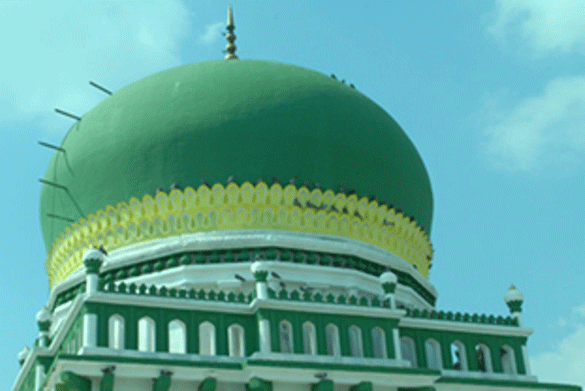
Known for intense devotion, he recited the entire Qur’an across his obligatory, Sunnah, Nafl, Tahajjud, Ishraq, and Chasht prayers, following one of the seven canonical recitation styles consistently. His daily routine centred on the mosque: attending Fajr, remaining in dhikr until Ishraq, returning briefly home, then staying in the mosque from before Zuhr until Isha, and rising again at night for Tahajjud. He passed away on 4 Muharram 1265 Hijri and buried at Edi Bazaar, Hyderabad, in the garden of Hazrat Syed Daim, who later built a grand mausoleum over his grave. leaving behind a revived mosque, enduring institutions of learning, and a spiritual legacy that continued to illuminate Hyderabad.
Urs and Enduring Legacy
Every year on 3rd Muharram, the Urs of Hazrat Mir Shujauddin Hussain Qadri is observed at his dargah in Hyderabad, drawing several lakhs devotees from all backgrounds who gather for blessings. The commemorations begin on 2nd Muharram with the ghusl of the mazar after Maghrib, followed by a Jalsa-e-Qiraat after Isha at the shrine in Edi Bazaar. On 3rd Muharram, the annual Sandal procession starts at 4 pm from Jama Masjid Shujaiya Charminar and reaches the dargah before Maghrib, after which sandal rituals, zikr, and Qur’an recitation take place. On 4th Muharram, Qur’an recitation and Fateha are held after Fajr at the mausoleum, while Mehfil-e-Naat and Milaad gatherings occur after Maghrib. On 5th Muharram, a Natiya and Munqabati Mushaira is organised after Isha at the Shujaiya Charminar shrine complex.
Hazrat Mir Shujauddin Hussain Qadri is remembered as a towering Sufi saint and prolific author, a Qutub of the Deccan whose lifelong sermons, teaching, and spiritual training shaped religious life across South India. His tireless efforts in preaching and guiding people left a lasting imprint on the region, and his legacy continues through the annual Urs, where devotion, remembrance, and gratitude keep his spiritual influence alive.
__
Adnan Faizi is a Peace and Harmony activist based in Delhi. He is an alumni of CCS University, Meerut.
New Age Islam, Islam Online, Islamic Website, African Muslim News, Arab World News, South Asia News, Indian Muslim News, World Muslim News, Women in Islam, Islamic Feminism, Arab Women, Women In Arab, Islamophobia in America, Muslim Women in West, Islam Women and Feminism