
Qutb-E-Kokan: Hazrat Khwaja Habib Ali Shah Chishti's Deccan Illumination And Global Chishti Legacy

By Adnan Faizi, New Age Islam
02 April 2026
Hazrat Khwaja Habib Ali Shah Chishti, Qutb-e-Kokan and Shah-e-Deccan, transformed Hyderabad's spiritual landscape. His Chishti Habeebi silsila reached South Africa, establishing enduring khanqahs fostering multicultural harmony.
Main points:
· Hazrat Khwaja Habib Ali Shah was born 1236 Hijri Hyderabad.
· Hazrat received bayah from Hazrat Khwaja Hafiz Ali Shah Khairabadi.
· He sent khulafa globally for propagation of Chishti teachings widely.
· Hazrat established a khanqah at Dockyard Road Mumbai for guidance.
· His burial took place at historic Makkah Masjid Hyderabad thereafter.
Introduction
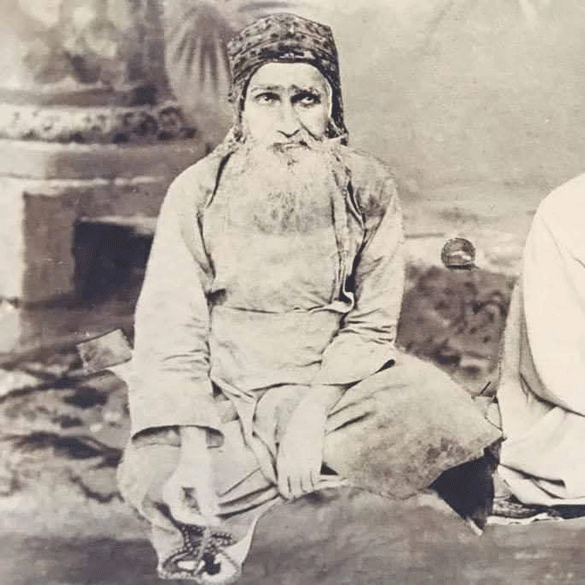
Hazrat Khwaja Habib Ali Shah Chishti stands among the towering Sufi figures of the Deccan, honoured as Qutb-e-Kokan and Shah-e-Deccan. His life represents a rare synthesis of royal influence and spiritual authority, linking the court of the Nizam with the wider world through the Chishti silsila. He was born on 20 Jamadi-us-Sani 1236 Hijri in Hyderabad into a distinguished family known for both medical excellence and spiritual refinement. His father, Hazrat Nawab Ahmad Yaar Khan bin Nawab Izzat Yaar Khan, served as Hakeem-ul-Hukuma (Chief Royal Physician) and Sadr-us-Sudoor, while his mother, Hazrat Bibi Amatul Fatima bint Hazrat Syed Ali Razwi al-Madani, connected him to a noble Prophetic lineage. Carrying forward a legacy of scholarship and service, he later established a khanqah at Dockyard Road, Mazgaon (Mumbai), from where he trained and dispatched khulafa across different regions of the world. His spiritual network extended as far as South Africa through disciples like Hazrat Khwaja Shah Ghulam Muhammad Soofi Siddiqui (Durban) and Hazrat Maulana Abdul Lateef Qazi Siddiqui (Cape Town), making him a key figure in global Chishti propagation.
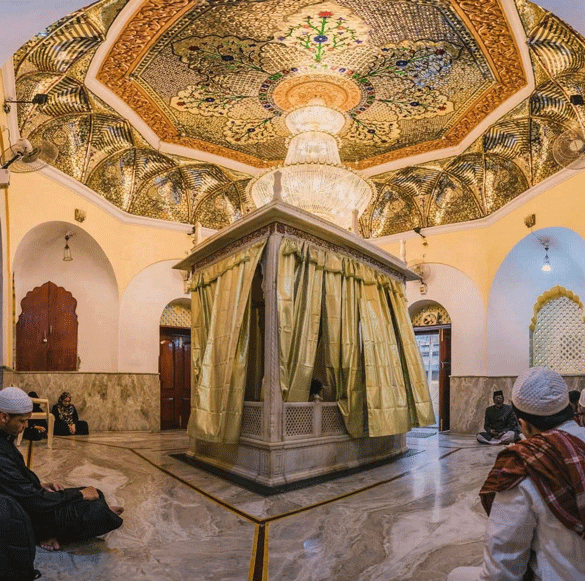
His wisaal occurred on 6 Zil Hijjah 1323 Hijri, and his janaza was held at Makkah Masjid, Hyderabad. He was laid to rest at Katalmandi, where his mazar continues to attract seekers. His teachings especially the structured understanding of fanaa and classifications of zikr remain influential even today, inspiring contemporary spiritual frameworks and institutions.
Ancestral Excellence and Prophetic Nativity
Hazrat Khwaja Habib Ali Shah Chishti was born into an exceptional lineage that combined Tibb (medicine), Tasawwuf, and Shariat. This legacy traces back to his great-grandfather, Hazrat Maulana Hakeem Abdul Khadar bin Shah Abdul Ghafur Siddiqui Chinaki, Murshid of multiple disciplines who migrated to Hyderabad in 1176 Hijri from Ahmedabad along with his brother, Hazrat Maulana Hakeem Shah Muhammad Ja'afar Siddiqui Chinaki, upon the invitation of Nawab Mir Nizam Ali Khan Bahadur. From that point onward, the family continuously held the prestigious position of Hakeem-ul-Hukuma across generations—first Hazrat Maulana Hakeem Abdul Khadar, then Hazrat Maulana Hakeem Shah Mohammad Ja'afar Khan, followed by Hazrat Hakeem Nawab Izzat Yar Khan, and then Hazrat Nawab Ahmad Yaar Khan—blending royal service with spiritual authority. Before his birth, Hazrat Khwaja Haafiz Ali Shah Khairabadi foretold to his father: “Tumhare yahan mera farzand paida hoga. Us ka naam Habeeb rakhna.” Despite concerns regarding maternal age, this prophecy was fulfilled two years later, affirming the child’s destined spiritual rank.
At the age of four years and four days, during his Bismillah ceremony on 23 Shawwal 1240 Hijri, a symbolic moment revealed his inclination toward both outward and inward wealth. Hazrat Khwaja Hafiz Ali Shah placed sweets in one hand and gold ashrafiyas in the other, then presented them before him saying, “Choose what you like.” He replied, “I will take both.” Smiling, Hazrat Hafiz Pak remarked, “My son will ultimately prefer spiritual wealth over worldly riches and be enriched by it.” Thereafter, he renounced material attachments and immersed himself in deep study, mastering classical works such as Masnavi Shareef, Kashf-ul-Mahjub, and Fusus-ul-Hikam, while also authoring 22 treatises including Habeeb-ul-Taalibaan. This powerful combination of inherited barakah, prophetic indication, and disciplined spiritual training shaped him into one of the most influential Sufi figures of his era.
Spiritual Training, Bay‘ah, and Global Chishti Mission
Hazrat Khwaja Habib Ali Shah Chishti displayed extraordinary spiritual maturity from early childhood. At the age of six, he adopted muraqaba (deep meditation) and solitude; by nine, he maintained perpetual wuzu, reflecting constant spiritual awareness. He memorised the Quran and gained mastery over Hadith, Tafseer, Arabic, and Persian texts, laying a strong scholarly and spiritual foundation. At sixteen years of age (30 Muharram 1252 Hijri), he took bay‘ah at the hands of Hazrat Khwaja Hafiz Syed Mo6hammad Ali Shah Khairabadi Chishti. This marked a decisive turning point—he renounced material possessions and dedicated himself completely to khidmat and spiritual discipline. Under his murshid’s guidance, he studied and internalised classical masterpieces including Masnavi Shareef, Kashf-ul-Mahjub, Dala’il-ul-Arifeen, Madaarij-un-Nubuwwah, Rahat-ul-Quloob, Fusus-ul-Hikam, Kashkol-e-Kaleemi, Ghunyat-ut-Talibeen, and Tafseer Ibn Kathir.
His deep peer-mohabbat found expression in heartfelt verses:
“Hum ko Hafiz ki gali ka woh tasawwur bandha,
Shauq Jannat na raha baagh-e-Iram bhool gaye.”
“Hamari kuchh bhi na thi haqeeqat, Tumhare dar se mili hai izzat,
Kharaab hone na dijiyo sahib, Tumhare dar ka bana hua hu.”
Following his spiritual perfection, he emerged as a leading Shaykh of the Chishti Habeebi silsila. In accordance with his peer’s instruction, he established a flourishing khanqah at Dockyard Road, Mazgaon (Mumbai), which became a centre of taleem and faiz. From here, he trained and sent distinguished khulafa across regions for the propagation of Islam and Chishti teachings, including: Hazrat Khwaja Shah Ghulam Muhammad urf Sufi Sahib (Durban, South Africa), Hazrat Maulana Abdul Lateef Qazi Siddiqui (Cape Town, South Africa), Hazrat Khwaja Shah Muhammad Ibrahim Sufi (Ajmer), Hazrat Khwaja Hidayat Ali Shah (Hyderabad), Hazrat Khwaja Makhdoom Hafiz Ali Shah (Hyderabad), Hazrat Syed Faqir Muhammad Shah (Ahmednagar).
Teachings, Literary Contributions, and Spiritual Framework
Hazrat Khwaja Habib Ali Shah Chishti articulated a refined and structured understanding of spiritual progression, centred on fana (annihilation of the self) and zikr (remembrance of Allah). He explained that fana unfolds through three principal stages—Fanaa fi’l-Shaykh (annihilation in the guide), Fanaa fi’r-Rasool (annihilation in the Messenger), and Fanaa fi’llah (annihilation in Allah)—each comprising countless levels, guiding the seeker from attachment to ultimate divine proximity. Complementing this, he classified zikr into four ascending categories:
Zikr an-Naasut (“La ilaha ill-Allah”) — the zikr of Shariat
Zikr al-Malakut (“Ill-Allah”) — the zikr of Tariqat
Zikr al-Jabarut (“Allah”) — the zikr of Ma‘arifat
Zikr al-Laahut (“Hu”) — the zikr of Haqiqat
This systematic framework presents a gradual inner transformation from outward practice to complete spiritual realisation offering seekers a clear, disciplined path of growth. Alongside his theoretical teachings, his practical emphasis remained firmly rooted in ikhlas (sincerity), khidmat-e-khalq (service to humanity), and restraint from unnecessary debates. His own life marked by early muraqaba and lifelong wuzu embodied these principles, making his teachings both experiential and accessible. His intellectual and literary legacy is equally significant. He authored approximately 22 works, among which Habeeb-ul-Talibaan stands out as a guide for spiritual aspirants, outlining practical steps of sulook (spiritual journey), while Habeeb-un-Naas fi Radd il Khannas addresses inner purification and protection from spiritual distractions. In addition, his poetic expressions in Hindi, Urdu, Farsi, and Kokani were compiled into Deewaan-e-Habeeb (three volumes), reflecting deep love for the Divine and devotion to the spiritual path. Together, his teachings, writings, and institutional khanqah model form a cohesive system that continues to guide seekers, blending inner transformation with outward service and offering a timeless framework adaptable even within the complexities of the modern world.
Family Legacy, Passing, and Enduring Global Impact
Hazrat Khwaja Habib Ali Shah Chishti’s spiritual legacy continued through his two distinguished sons: Hazrat Khwaja Hidayat Ali Shah (urf Hidayat Yaar Khan) and Hazrat Khwaja Makhdoom Hafiz Ali Shah (urf Kareem Yaar Khan), who served as Sajjada Nasheen. Through them, the family khanqahs remained active across Hyderabad, Mumbai, and South Africa, preserving and transmitting the Chishti Habeebi silsila across regions. This continuity reflects a balanced model where inherited spiritual authority adapts to changing times, and today’s sajjada nasheens increasingly use modern platforms to maintain authenticity while reaching a global audience. He passed away on Thursday, 6 Zil Hijjah 1323 Hijri in Mumbai. His blessed body was transported to Hyderabad by rail, where an extraordinary scene unfolded. After the Eid prayer, a second, unprecedented janaza was held at Makkah Masjid under the leadership of Hazrat Maulana Hasan uz-Zaman Hafizi, attended by vast crowds. He was laid to rest on 10 Zil Hijjah 1323 Hijri at Katalmandi, Hyderabad, where his mazar remains a vibrant centre of devotion, marked by annual Urs, langar, and qawwali gatherings.
Today, his influence continues to resonate globally. His khanqahs in South Africa actively promote harmony and counter social tensions such as xenophobia, while the Dockyard Road Mumbai model inspires inclusive urban spiritual centres. His structured teachings on fanaa and zikr are increasingly reflected in modern meditation frameworks, and his literary work Deewaan-e-Habeeb has been digitised for wider access. His ancestral connection to traditional medicine also inspires renewed interest in integrating Unani practices with other healing systems. At a broader level, his emphasis on ikhlas and khidmat-e-khalq offers a powerful response to modern challenges, encouraging service, balance, and spiritual depth. His far-reaching khulafa network anticipated today’s interconnected world, and his legacy as Qutb-e-Kokan stands as a testament to the universal relevance of the Chishti path—harmonising shariat and haqiqat while guiding seekers toward a deeper divine connection even in the complexities of the present age.
___
Adnan Faizi is a Peace and Harmony activist based in Delhi. He is an alumnus of CCS University, Meerut.
New Age Islam, Islam Online, Islamic Website, African Muslim News, Arab World News, South Asia News, Indian Muslim News, World Muslim News, Women in Islam, Islamic Feminism, Arab Women, Women In Arab, Islamophobia in America, Muslim Women in West, Islam Women and Feminism